
Spiritual Entrepreneur Burnout: Signs, Causes and Recovery
Spiritual entrepreneur burnout is the exhaustion that builds when your gifts, your calling and your income all depend on the same person: you. It rarely looks like a dramatic collapse. More often you keep showing up, keep serving, and notice that the work no longer feeds you, your guidance feels distant, and decisions come from depletion instead of discernment. Recovery is possible, and it begins by naming what is happening, changing what drained you, and rebuilding a business that fits your real capacity.
This guide is written for healers, channelers, intuitive women and spiritual leaders who run their own work. It is not clinical care, and it does not replace support from a licensed professional when you need one.
TL;DR
Burnout is an occupational phenomenon marked by exhaustion, cynicism about the work and a drop in felt effectiveness. It is different from a busy season or a hard week.
A calling can make it harder to see, because exhaustion can pass for devotion and withdrawal can pass for retreat.
Recovery usually means changing the pace, the structure of your offers and your relationship to the role, not pushing harder or adding another practice.
Symptoms that last more than a couple of weeks, or that affect sleep, relationships or safety, call for a licensed mental-health or medical professional.
Pairing intuition with practical structure, such as capacity-based offers and clear boundaries, is what makes recovery last.
Table of Contents
What burnout actually is
Burnout is not a medical diagnosis. In an interview with the American Psychological Association, burnout researcher Christina Maslach describes it through three components: exhaustion, an increasingly cynical response to the work, and a reduced sense of professional effectiveness. She also separates it from ordinary stress. A person who is exhausted but still likes the work and feels effective is overextended, not burned out.
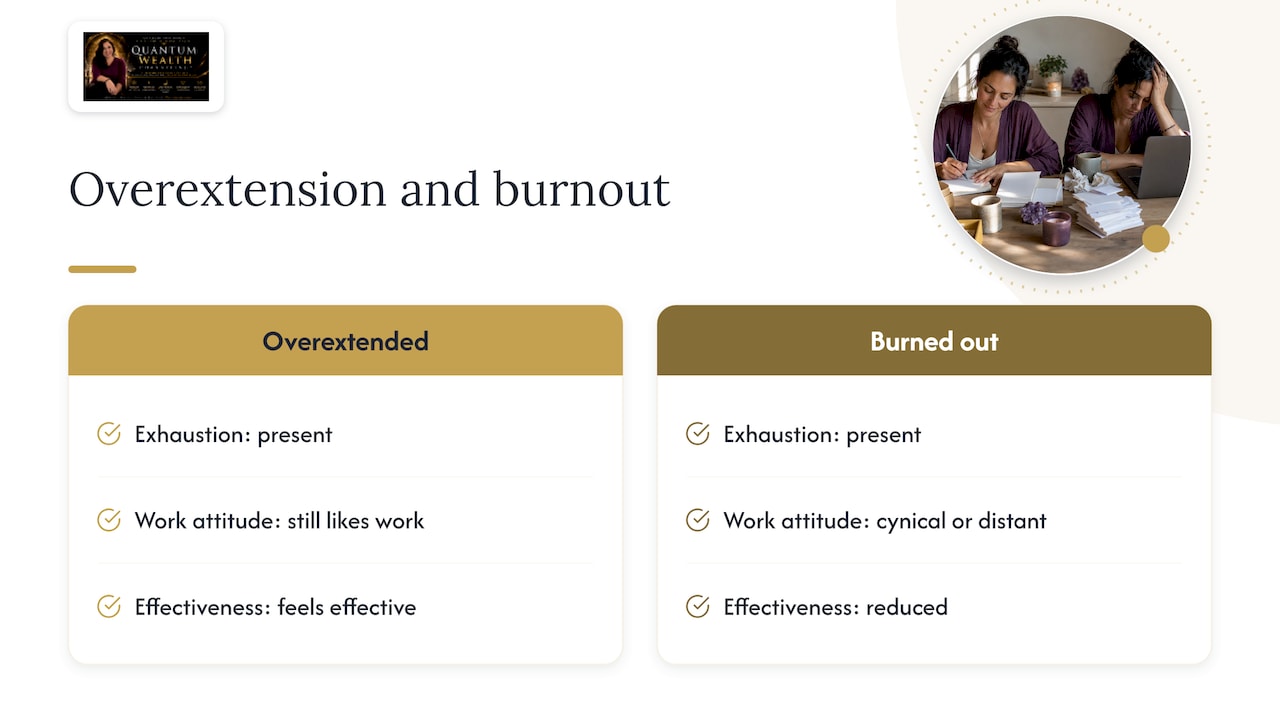
That distinction matters for you. If you are tired after a launch but still love your clients and trust your offers, you may need rest and a lighter calendar. If you feel numb toward the people you serve, doubt that anything you do matters, and dread work you once found meaningful, you are looking at something deeper.
The World Health Organization’s ICD-11 likewise treats burnout as an occupational phenomenon rather than a medical condition, defined by exhaustion, mental distance or cynicism about work, and reduced effectiveness. It is also cumulative. Burnout builds over time in response to chronic job stressors and tends to be fairly stable once established, which is why a weekend away rarely resolves it.
Why a calling makes burnout harder to see
Ordinary burnout sounds like “I don’t like what I’m doing anymore.” Burnout inside a calling often sounds different. Communication scholar Arianna Molloy, in a Biola University article on calling and burnout, describes it as identity-level: “I don’t know who I am anymore.” She notes that people driven by a calling tend to be highly motivated and satisfied, yet more prone to burnout because boundaries are harder to hold when the work feels like a sacred obligation.
If you work with energy, intuition or channeled guidance, you may recognize this. The work is not only what you do. It is who you believe you are. So when the business struggles, or a client leaves, it can land as a verdict on your gift. A Santa Clara University resource on rest for entrepreneurs makes a related point: when a business becomes tied to self-worth, purpose and a sense of connection to something greater, setbacks outside your control can weigh more heavily on your well-being.
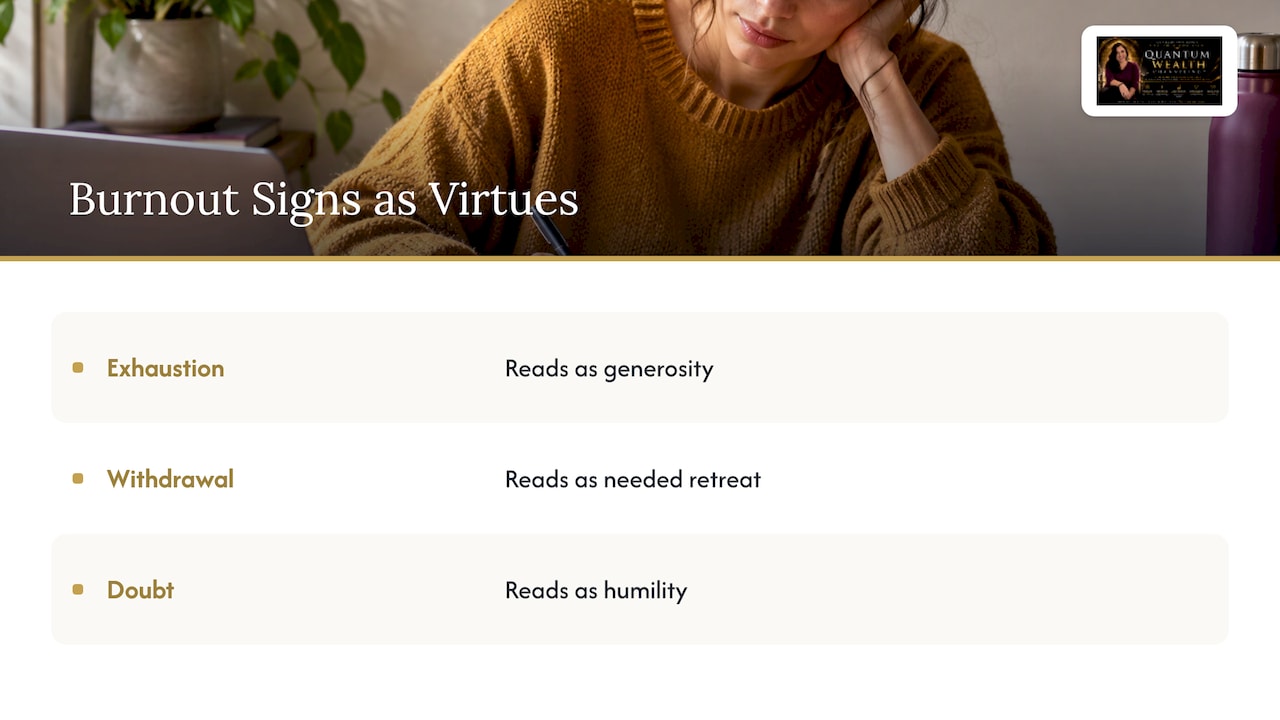
There is a second layer. Early signs of burnout in a spiritual life can look like virtues: exhaustion reads as generosity, withdrawal as a needed retreat, doubt as humility. You can keep praising yourself for the very pattern that is wearing you down. Tiredness is not a failure of faith, devotion or spiritual strength. It is a sign that a human body and nervous system have limits, and that every sustainable practice has to account for them.
What drives it: the mismatches behind the exhaustion
Maslach and Leiter’s research, summarized in a guide to the signs of burnout, points to six mismatches between a person and their work: workload, lack of control, insufficient reward, breakdown of community, absence of fairness, and conflict of values. Here is how each can show up in a spiritual business.
Mismatch | How it can look in spiritual work |
Workload | Taking every client, every call and every request because turning someone away feels like withholding love |
Lack of control | Letting the market, the algorithm or other people’s expectations dictate your offers and schedule |
Insufficient reward | Giving generously while your pricing and income do not reflect the value you provide |
Breakdown of community | Leading others without anyone holding space for you |
Absence of fairness | Quietly resenting clients, peers or the industry for what they take or earn |
Values conflict | Selling in ways that feel at odds with the depth of what you actually teach |
Notice how many of these are structural rather than spiritual. A weak boundary, an underpriced offer or a calendar with no recovery time will exhaust even the most gifted practitioner. Sensitivity and skill do not protect you from them.
The pressure of self-employment itself adds to this. A systematic review covering more than 3.1 million participants found evidence linking self-employment with a higher risk of mental-health problems, though results varied across studies. The takeaway is not alarm. It is that running your own business is demanding work, and it deserves real support and structure.
Signs it is affecting your work, health and decisions
The signs below are drawn from the same overview of burnout symptoms. Read them as a pattern across weeks, not a single bad day.
Exhaustion that sleep does not fix, along with headaches, frequent illness or disrupted sleep.
Cynicism, including a growing coldness toward clients or the work itself.
Self-doubt and irritability that feel out of character.
Withdrawal and procrastination, including avoiding your own practices.
Trouble concentrating and a drop in the quality of your work.
Reliance on substances to unwind or keep going.
For a channeler or intuitive, one more sign deserves attention: your decisions. When you are depleted, it becomes difficult to tell guidance from fear, urgency or the wish for relief. You may find yourself making offers, pricing changes or commitments that your calmer self would not choose. Founders are also advised to watch changes in how they work, not only how many hours they work, because fewer hours can still sit alongside severe exhaustion or detachment.
A simple check: ask whether you are still moved by the work when you are rested, or whether the numbness persists even after time off. The second answer points toward burnout rather than a busy season.
When to involve a licensed professional
Burnout can overlap with anxiety, depression and sleep problems, and those need qualified care. According to guidance on when to get help, it is time to reach out to a mental-health professional if:
symptoms last longer than two weeks,
time off or a vacation does not help,
you are struggling to function at work, at home or in relationships,
you feel hopeless, worthless or numb most of the day,
you rely on substances to cope, have panic attacks or cannot sleep,
people close to you express worry.
Thoughts of self-harm are never ordinary business stress. If you have them, contact a licensed mental-health professional or a crisis service right away; in the United States you can call or text 988, the Suicide and Crisis Lifeline. Persistent anxiety, depression, serious sleep problems and inability to function call for professional support, not another productivity system. Some people find it helpful to read about whole-person approaches to healing when deciding what kind of support suits them. Our work is spiritual education and channel development, and it is not therapy or medical care.
How recovery tends to unfold
Timelines vary. One clinical overview suggests that mild burnout may ease within a few weeks of rest and boundary changes, while moderate to severe burnout often takes three to twelve months, and recovery moves faster when co-occurring anxiety, depression or sleep problems are treated at the same time.
A 2020 study of Christian youth-worker burnout offers a useful picture of what people reported helping. Among respondents who had experienced burnout, most stayed in or returned to their ministry work, and their recovery accounts mentioned breaks or sabbaticals, reaffirmed calling, boundaries, delegation, spiritual disciplines, network support and, for some, counseling. The study is about ministry workers, not spiritual business owners, but the pattern is instructive: recovery was rarely one fix. It was a change in how the work was structured and supported.
We think of recovery in three movements, and you can read our own three phases to recover from spiritual burnout with scripture and grounding for a deeper walk-through.
Stop the drain. Decide what you can pause, delegate or decline for the next several weeks. This is not abandoning your purpose. It is protecting the vessel that carries it.
Restore your relationship to your own guidance. Return to simple, unforced practices that were nourishing before they became performance. Do them for yourself, not for content or clients.
Rebuild with structure. Redesign your offers, schedule and pricing around the capacity you actually have, then let your intuition work inside that frame.
If you want a longer view of how this can pace out, our spiritual healing timeline for intuitive women lays out a three to twelve month plan, and the guide to post-healing integration in 30 to 90 days covers what to do once the acute depletion lifts.
Boundaries and structure that protect your purpose
Boundaries often feel unspiritual to people who serve for a living. They are better understood as the container that lets your service stay clean. A few practical anchors:
Offer to your capacity. Design programs, session loads and launches around the energy you have in a normal month, not your best month.
Schedule rest the way you schedule clients. Put recovery days on the calendar before the work goes in.
Keep a grounding ritual that is not about the business. Daily gratitude unrelated to work and time with community are among the practices suggested for spiritual rest.
Name your limits before someone tests them. Decide your response times, your refund and scheduling terms, and your no, in advance.
Separate identity from output. You are not your revenue month, and your gift does not disappear in a slow quarter.
We go deeper on this in our piece on boundaries in business for intuitive women. If visibility is part of what wears you down, the five steps in healing the fear of visibility may help too.
Our perspective
We have a view on this that shapes everything we teach. Burnout in spiritual work is rarely a lack of devotion. More often it is a lack of structure around devotion. Intuitive women and channelers are taught, sometimes explicitly and sometimes by the culture around them, to receive endlessly and to give without limit. When guidance is treated as something that must be acted on instantly, or when spirituality is used in place of practical decisions, authority slowly moves outward and the body pays for it. Our work with Quantum Wealth Channeling is built on the opposite principle: strengthen your own channel, deepen discernment and self-trust, and translate what you receive into grounded decisions, action and physical creation. That means learning to tell guidance from fear and urgency, building your capacity to receive and hold wealth, and refusing to outsource your authority to anyone, including us. We do not offer this as treatment for burnout, and we never frame our work as clinical care. We offer it as spiritual education for women who are ready to run their work from clarity rather than depletion. When your receiving and your action are in alignment, the work stops asking you to sacrifice yourself in order to serve. Shantana Telise
A grounded next step
If you are past the acute phase and ready to rebuild how you receive guidance, price your work and make decisions, our four-month Quantum Wealth Channeling program applies channeling to wealth, business and creation. It is offered as a Core Experience at $2,497 or as VIP Private Access at $4,196, both one-time payments. Please check the program page for current availability before you plan around it.
[

If you would like a lower-commitment place to begin, the Intuitive Income Reset is a $7 entry offer for reconnecting your intuition with your income. We do not guarantee financial outcomes from any of our programs, and nothing here substitutes for professional care when you need it.
FAQ
Is spiritual burnout the same as ordinary burnout?
They share the same core: exhaustion, cynicism and a drop in felt effectiveness. Spiritual burnout adds a layer of meaning, because the practices and purpose that once nourished you can feel hollow or even shameful to struggle with. It is still not a moral or spiritual failure.
How long does recovery take?
It depends on severity and on what you change. One clinical overview suggests mild burnout can improve within a few weeks, while moderate or severe cases often take three to twelve months. Treating any co-occurring anxiety, depression or sleep problems at the same time tends to speed things up.
Can I keep my business running while I recover?
Often yes, if you reduce the load first. Pause or delegate what you can, shrink your calendar to your real capacity, and protect rest before taking on anything new. If you cannot function at work or at home, speak with a licensed professional about how much to step back.
Should I use my intuition to decide what to do about burnout?
Intuition is a valuable partner, but depleted people struggle to distinguish guidance from fear or urgency. Pair it with practical checks: your calendar, your finances and your body’s signals. For symptoms that persist, rely on a licensed professional as well.
When is it more than burnout?
Seek professional help if symptoms last more than two weeks, time off does not help, you feel hopeless or numb most of the day, you rely on substances, or you have thoughts of self-harm. In the United States, call or text 988 in a crisis.
Sources
Recommended
Comments