

Spiritual Entrepreneurs: 5 Steps to Heal Fear of Visibility
Fear of visibility is the persistent anxiety that comes from being seen, noticed, or evaluated, whether that’s speaking up in a meeting or launching your business publicly. It overlaps clinically with social anxiety disorder. The single most useful first move is choosing one small, repeatable exposure to being seen, paired with a body-regulation practice like slow breathing, then reviewing what actually happened afterward. If this fear has disrupted your work, relationships, or daily functioning for six months or more, that’s the signal to bring in a licensed clinician alongside anything else you’re doing.
TL;DR:
The fear of visibility often stems from early experiences like criticism, humiliation, or conditional approval, leading to learned avoidance behaviors.
Behavioral, cognitive, and somatic signs include hiding work, catastrophizing judgments, physical symptoms like blushing, and avoiding praise or success.
Effective treatments focus on cognitive behavioral therapy, gradual exposure, somatic regulation, and sometimes medication, with professional support advised if disruption persists beyond six months.
Self-exposure strategies involve naming specific fears, regulating body responses, starting with small actions, and reviewing outcomes to break the avoidance loop.
Spiritual and embodied practices can complement clinical care but cannot replace professional therapy when anxiety severely impairs functioning.
Table of Contents
What Does “Fear of Visibility” Actually Mean?
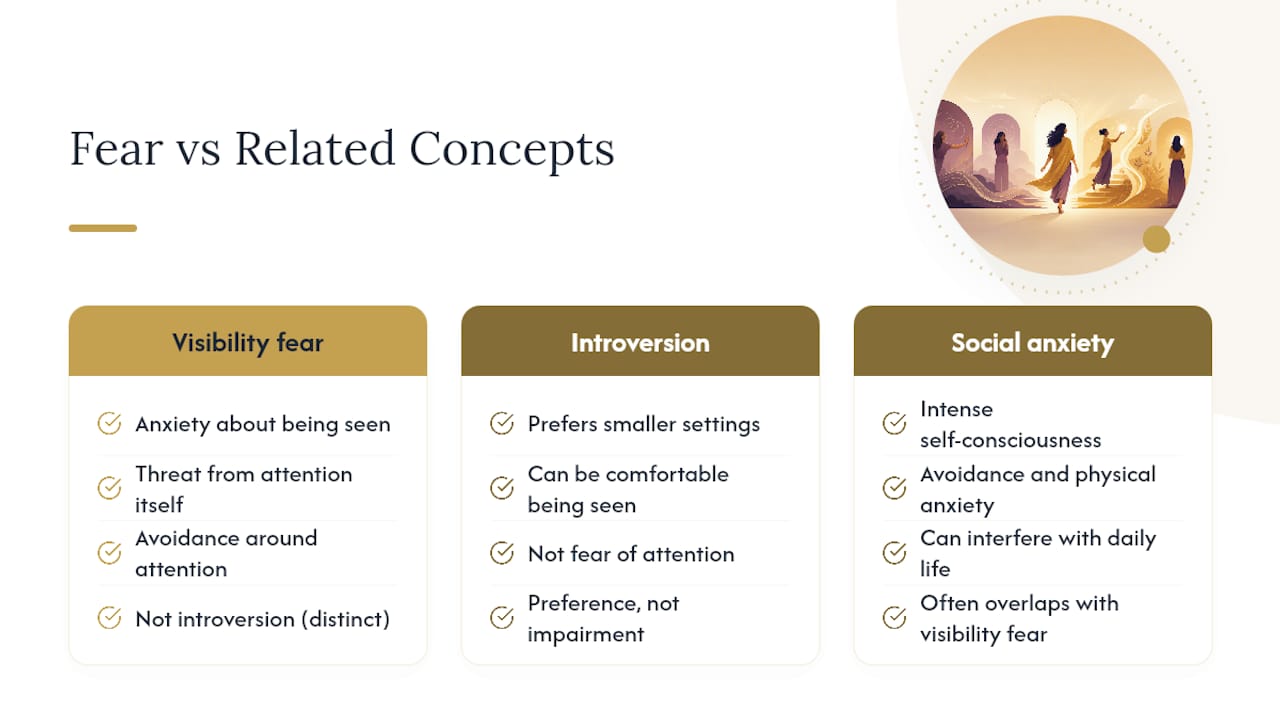
Fear of visibility describes the anxiety that shows up specifically around being seen, noticed, or judged, whether that’s your face on camera, your name on a byline, or your opinion in a room full of people. It isn’t the same as introversion. An introvert can feel completely comfortable being seen and simply prefer smaller settings; someone with fear of visibility feels genuine threat at the prospect of attention itself, regardless of setting size.
Clinically, this fear frequently overlaps with social anxiety disorder, which the National Institute of Mental Health (NIMH) describes as intense self-consciousness, avoidance, and physical anxiety severe enough to interfere with work, school, relationships, or daily tasks.
Two related terms come up often and deserve precision. Scopophobia refers specifically to the fear of being stared at, and it can produce sharp physical reactions like blushing or a racing heart, according to Healthline. Anthropophobia, a broader fear of people, is sometimes used loosely but shouldn’t be treated as interchangeable with social anxiety. Cleveland Clinic notes these labels overlap but require careful assessment to direct the right treatment. Getting the label right matters less than noticing the pattern: does attention itself feel dangerous?
Where Does the Fear of Being Seen Actually Come From?
Fear of visibility is usually learned, not innate. A handful of common experiences plant the seed early:
Being harshly criticized for mistakes made in front of others, especially as a child
Growing up with conditional approval, where love or attention depended on performance
Public humiliation, ridicule, or bullying tied to speaking up or standing out
Family, cultural, or religious messages that framed visibility as vanity, arrogance, or danger
Once the nervous system learns that visibility equals risk, avoidance becomes the coping strategy. And avoidance works, in the short term. Skip the presentation, cancel the launch, stay quiet in the meeting, and the anxiety drops immediately. That relief is exactly what makes the pattern so hard to break: every act of hiding reinforces the belief that hiding is what kept you safe. Over months and years, the avoidance loop quietly narrows a person’s life, business, and voice, even as the anxiety itself never actually gets tested against reality.
What Are the Signs You’re Dealing With This Fear?
Fear of visibility rarely announces itself outright. It usually hides inside habits that look like caution, perfectionism, or simply being “private.”
Behavioral signs are the easiest to spot once you know what to look for. Psychology Today identifies several recognizable patterns:
Hiding finished work instead of sharing or publishing it
Repeatedly delaying launches, posts, or announcements
Minimizing your own achievements or deflecting praise when it arrives
Over-preparing to the point of exhaustion before any public moment
Withdrawing or feeling regret immediately after sharing something
Cognitive signs run underneath the behavior: impostor thoughts, catastrophic predictions about how others will judge you, and, less obviously, a fear of positive evaluation. That last one matters more than most people realize. Praise raises expectations and attention, which can feel just as threatening as criticism, and it’s a documented driver of withdrawal after success.
Somatic signs include blushing, shaking hands, a pounding heart, or even freezing and dissociating mid conversation. These show up whether the visibility is a work presentation, a first date, or a comment section on your own Instagram post.
Which Treatments Actually Work for Visibility Anxiety?
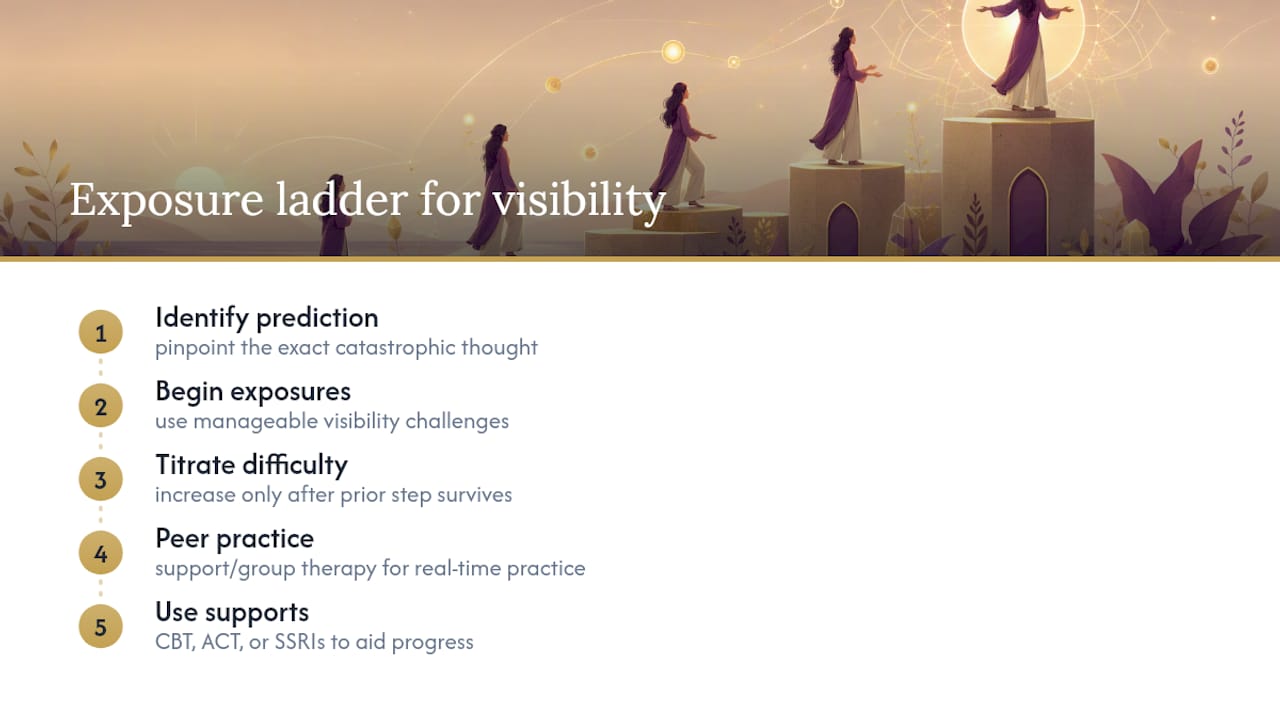
Cognitive behavioral therapy (CBT) is considered first line care for social anxiety and visibility fears, largely because it targets the specific thoughts driving the avoidance rather than just managing the anxiety in general. Expect a CBT process to involve identifying the exact catastrophic prediction (“everyone will think I’m incompetent”) and testing it against real outcomes.
Exposure therapy works alongside CBT and is deliberately titrated. Rather than throwing you into your biggest fear, a clinician builds a ladder of manageable visibility challenges, increasing difficulty only once the nervous system has proof it survived the last step. This gradual approach is part of the treatment guidance that NIMH outlines for social anxiety disorder.
Acceptance and Commitment Therapy (ACT) takes a different angle: instead of trying to eliminate the anxiety first, it helps you act on your values while the anxiety is still present. For entrepreneurs and healers whose work depends on visibility, this can matter more than symptom reduction alone.
Medication, typically SSRIs, can lower the baseline intensity enough to make exposure work possible, and it’s worth discussing with a prescriber when anxiety is severe. Support and group therapy add something none of the above can: real-time practice being seen by peers in a structured, safer setting.
A Step-by-Step Sequence to Reduce Avoidance Right Now
You don’t need a therapist in the room to start collecting evidence against the fear. This sequence works because it turns a vague dread into a specific, testable experiment.
Name the exact feared prediction. Not “people will judge me” but the specific sentence your mind is generating: “They’ll think my voice sounds shaky” or “No one will respond and that will prove I’m invisible.”
Regulate before you act. A few minutes of slow, paced breathing or a grounding exercise (naming five things you see, four you hear) lowers arousal enough that you can actually think during the exposure instead of just surviving it. Guided breathwork can help make this a repeatable habit rather than a one-off scramble.
Design a tiny, specific visibility step. Comment on one post. Send one voice message. Share one unfinished draft with one trusted person. Small enough that you’ll actually do it.
Stay present and review afterward. Don’t just survive the moment, actually collect data: what did you predict would happen, and what actually happened? Write it down.
Scale up gradually, and pause to consult a clinician if panic, dissociation, or a spike in avoidance follows instead of gradual relief.
Pro Tip: Track two columns after every exposure: the short-term relief of avoiding versus the long-term cost of staying hidden. Seeing that gap on paper is often what finally breaks the avoidance loop’s grip.
Why the Body Needs Its Own Kind of Regulation
Cognitive reframing alone often fails when the nervous system is already activated, because a racing heart and a tight chest don’t respond to logic in the moment they’re happening. This is where somatic work earns its place alongside talk therapy rather than as a substitute for it.
Practical tools include paced breathing, orienting exercises that help the body register the room as safe (a polyvagal-informed approach), and titrated movement like shaking out tension after a stressful exposure. Elemental, energy-centered practices can support this kind of regulation for people who respond well to embodied rather than purely cognitive tools.
The sequencing matters: regulate first, then micro-expose, and pause the exposure entirely if you notice real dysregulation rather than manageable discomfort. And a caveat worth stating plainly: somatic and spiritual practices can support this process, but they don’t replace clinical care when the impairment is severe or persistent. Mindfulness-based approaches, including the kind outlined in this anxiety-focused mindfulness guide, can be a useful complement to both.
When Should You Bring in a Professional?
A few signals mean it’s time to stop self-managing alone. If the fear has disrupted your functioning for six months or longer, if you’re experiencing panic attacks or dissociation, or if you notice any suicidal ideation, those are clear indicators for professional support, not personal failure.
When screening a therapist, ask directly about their experience with social anxiety, exposure therapy, and somatic methods. A solid intake process should include safety planning, a realistic pacing plan, and measurable goals rather than vague reassurance. Options range from individual CBT to group exposure therapy, psychiatric consultation for medication, and community support groups where being seen by peers becomes part of the practice itself.
A Channel’s View on Visibility, Discernment, and Embodiment
Visibility work is discernment work before it’s ever performance work. As a Quantum Channel and educator, I center this with clients constantly: the fear rarely lies about the stakes, it lies about the size of the step required. Before anyone shows up publicly, I ask them to get clear on the message, the actual audience, the boundary they’re holding, and the single next action, not the whole rollout.
Spiritual guidance can absolutely inform when and how to show up, and it can build the kind of embodied trust that makes visibility feel less like exposure and more like sovereignty. It cannot, however, substitute for clinical treatment when impairment is severe. Guidance points the direction; regulation and evidence-based care make the step survivable.
— Shantana Telise
Ready to Turn Visibility Into a Grounded, Receiving-Capable Practice?
Working through fear of visibility on your own gets you insight. Pairing that insight with real channel development and nervous-system resourcing is what actually changes how you show up, decide, and receive. This kind of spiritual discernment applied to the practical, physical work of being seen and getting paid can help bridge that gap.
[

If you’re just starting to reconnect intuition with income after hiding for too long, the Intuitive Income Reset is a $7 entry point built for that exact moment. For deeper work that pairs channeling with wealth, business, and creation over four months, Quantum Wealth Channeling gives you the structure to build receiving capacity while you practice visible action. And if channel development itself is the missing piece, The Art of Divine Channeling Masterclass builds the discernment that makes every future visible step feel less like exposure and more like alignment. Start by exploring what fits at Work With Me.
This article is general information, not a substitute for advice from a qualified doctor. Consult a qualified healthcare professional about your own circumstances before acting on anything here.
Sources
FAQ
What Are the Symptoms of Anthropophobia?
Anthropophobia typically involves intense fear or avoidance of people in general, along with physical symptoms like a racing heart, sweating, or the urge to flee social situations. Cleveland Clinic notes it overlaps with social anxiety but isn’t identical to it, so an accurate diagnosis requires professional assessment rather than self-labeling.
What Is Fear of Positive Evaluation?
Fear of positive evaluation is the anxiety that comes specifically from praise or success, since both raise attention and future expectations. Research shows it’s linked to social anxiety and often drives people to withdraw right after achieving something, per the PMC review on the topic.
What Is Scopophobia?
Scopophobia is the specific fear of being stared at or watched, distinct from broader social anxiety, and it can trigger blushing, a pounding heart, or sweating even in low-stakes settings. Healthline notes therapy and relaxation techniques can meaningfully reduce these reactions over time.
Does Fear of Visibility Ever Come From Cultural or Family Messages?
Yes, growing up with messages that framed standing out as vanity, arrogance, or danger is a common contributor to fear of visibility later in life. These messages combine with the avoidance-relief loop, where hiding brings short-term calm but reinforces the underlying belief long term.
Can Spiritual Practices Help With Fear of Visibility?
Spiritual and somatic practices, including discernment work and body regulation, can support the process of showing up more consistently and can help build receiving capacity around being seen. They work best alongside, not instead of, evidence-based treatments like CBT or exposure therapy when the fear is significantly disrupting daily life.
Recommended
Comments