
Sacred Rage Healing: Turning Anger Into Clarity and Grounded Action
Sacred rage healing is the practice of treating anger as information rather than as a flaw: you feel it in the body, move it through a safe container, and then ask what it is protecting, so the message can become a boundary, a decision or an act of creation. It is not about venting at people or staying angry. It is about letting a strong signal finish its work. For intuitive women, healers and spiritual entrepreneurs, that work often shows up in how you price, what you say yes to, and how much you let yourself receive.
TL;DR
Sacred rage is anger that comes from clarity and care, not from a wish to hurt. Its purpose is to show you what needs protecting or changing.
Safe practice moves anger through the body with choices you can stop or soften: writing, movement, sound, drumming, ritual. Nothing that harms you or anyone else.
The message matters more than the release. A practice is complete when the insight becomes a boundary, a decision or an action.
Anger can sit close to grief and to old pain. If a practice leaves you numb, disoriented, unable to stop or thinking of harming yourself, pause and contact a licensed mental health professional.
For women who channel or build businesses, rage often points at undervalued gifts and unspoken limits, which makes discernment and grounded action the natural next step.
Table of Contents
What sacred rage actually means
The phrase is used in several traditions and by several writers, and they agree on a few things. Sacred rage is purposeful. It arises in response to violation, injustice or a betrayal of something you love, and it is aligned with truth rather than driven by ego or revenge. A mental health organization’s definition of sacred rage describes it as anger that is rooted in love, felt in the body and meant as a catalyst for transformation, not as reactive rage aimed at hurting someone.
The author and activist Valarie Kaur frames rage in a similar way: rage as a bodily power to protect yourself or others, and honoring it as a way of tending pain and mobilizing energy for action. She distinguishes raw rage, which needs processing, from what she calls divine rage, whose stated aim is to reorder the world rather than to seek vengeance. In a 2026 piece she draws on figures such as Kali and cites Audre Lorde’s line that anger is loaded with information and energy, which, focused with precision, can serve change.
That distinction is the heart of the practice. Anger itself is not the spiritual part. The spiritual part is the relationship you build with it: paying attention, staying present, and asking what it carries.
Why anger belongs in a spiritual practice
Many spiritually activated women learned early that being receptive meant being agreeable. Anger was labeled unevolved, unkind or low vibration, and so it went underground. The cost is practical as well as emotional. Writing in Spirituality+Health, Julie Peters describes how anger can signal that something is wrong in an intimate or communal setting, motivating protection, withdrawal or change, and that righteous anger in response to injustice can be clear and focused rather than chaotic.
Spiritual bypassing is the habit of using spiritual ideas to skip over a feeling instead of meeting it. If you have ever said “I’m choosing love” while your body was clenched with resentment, you know how that goes. Sacred rage work is the opposite move. You stop bypassing, you let the feeling be honest, and you do it with enough structure that it does not run you.
This is also where discernment grows. A channel who cannot feel her own anger has trouble telling guidance from people-pleasing, because both can arrive as a soft, agreeable voice. Anger often marks the exact place where you have been overriding yourself. Learning to read it strengthens self-trust.
Sacred rage versus destructive anger
The difference is not how loud the feeling is. It is what you do with it and what it is serving.
Sacred rage | Destructive anger | |
Source | A clear “no” to a violation or a loss of something you love | Habit, reactivity, a need to win or punish |
Aim | Protection, truth, change | Vengeance, control, discharge at someone |
Relationship to the body | Felt, moved, tracked with attention | Acted out before it is felt |
After | More clarity, a boundary or decision | Regret, repair work, the same pattern again |
Container | Chosen in advance, with choices to stop | None, or other people become the container |
Notice that sacred rage does not require a calm mind. It requires a container. You can be shaking and furious inside a practice that is safe, and still be doing sacred work.
What a guided rage practice looks like
There is no single correct ritual. Kaur’s article lists possible containers such as shaking, pounding, screaming, drumming, dancing, crying, wailing, venting, writing and therapy, with the clear condition that no harm comes to you or anyone else. She also describes a guided inquiry: notice the sensations and impulses to move, choose a safe container, ask what the rage carries, and consider what creative, nonviolent action it might call for.
Here is a simple sequence in that spirit. Treat it as a framework you adapt, and stop at any point.
Arrive. Sit or stand somewhere private. Feel your feet and breath for a minute. Decide in advance that you can stop or soften the practice at any moment.
Name the situation. Write one sentence about what happened or what keeps happening. Keep it factual.
Find the sensation. Where is the anger in your body? Jaw, hands, chest, belly? Describe it in plain words: hot, tight, pressing, sharp.
Let it move. Choose one container: shake your arms, press your hands into a wall, hum or sound out loud, drum on a pillow, write without editing. Keep the intensity at a level you could sustain for several more minutes.
Ask what it protects. Once the charge has dropped a little, write: “What am I protecting? What is this telling me I will no longer agree to?”
Translate. Turn the answer into one concrete next action, however small, such as a sentence you will say, a boundary you will set or a decision you have been delaying.
Close. Wash your hands, drink water, walk outside or look around the room and name what you see. Let your body know the practice is over.
The sixth step is the one most people skip, and it is where the practice becomes more than release. A ritual that ends with catharsis but no change can quietly turn into another loop. If a pattern keeps returning, our guide to shadow work with embodied prompts offers a structured way to look at what sits beneath it.
Exploring it safely
Strong feelings deserve care, and a good practice builds that care in.
Go slowly and keep choices. Kaur advises going slowly and gently, choosing containers that do not harm you or others, and considering a trusted friend nearby if exploring rage is new to you. A therapist-written guide on spiritual healing after trauma similarly recommends practices that offer choices and let you stop or modify them, rather than forcing intensity. It also notes that doubt and boundaries are not spiritual failures. If a practice or a teacher pressures you to go deeper than feels right, that is a reason to slow down.
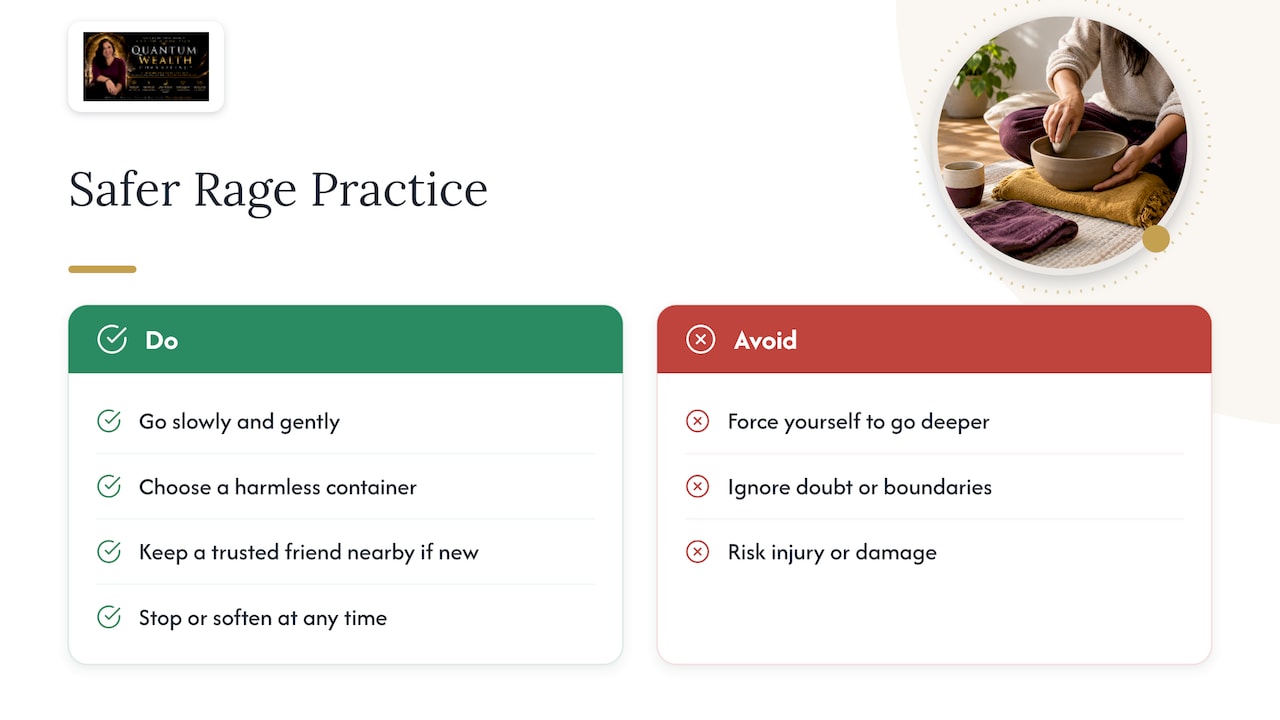
Match the intensity to your capacity. More is not better. Practical guidance on processing anger without forcing intensity pays attention to bodily sensations first, which is a good habit for anyone: feel before you act, and let the body set the pace.
Keep the physical release harmless. Mental Health America lists ten healthy ways to release rage, including screaming into a pillow in private, singing, dancing, working out, journaling, making art, changing your surroundings and speaking to an empty chair. Choose what feels safe in your space, and avoid anything that could injure you or damage things you care about.

Know when to pause and get support. A therapist’s guide to women’s anger advises pausing and seeking trauma-informed professional support if you dissociate, lose time, want to harm yourself or feel unable to stop during an anger practice. Mental Health America suggests taking a mental health screen if managing your feelings seems impossible, and lists 24/7 help through 988 or the Crisis Text Line in the United States. Sacred rage practice is a spiritual and personal development path. It is not therapy and does not replace care from a licensed clinician, particularly when anger is tied to trauma, grief or thoughts of harming yourself or others.
If your body tends to flood or shut down quickly, it helps to build steadiness first. Our pieces on nervous system regulation and spirituality and safety steps for energy work with trauma are good places to start.
What your anger may be telling you
Anger rarely arrives alone. Psychologist Jennifer Mullan, speaking in a podcast interview, describes sacred rage as embodied anger that becomes more constructive when you pay attention to it and stay in relationship with it, linking it to injustice, grief and shame. So when you sit with rage, you may find a few common messages underneath:
A boundary was crossed. Something you agreed to, you did not actually agree to.
Grief is waiting. The anger is protecting a loss you have not yet let yourself feel.
Your worth was discounted. Someone, or you, treated your gifts as smaller than they are.
A truth is pressing to be spoken. You already know what needs to change.
Not every wave of anger carries a deep message. Sometimes you are tired, hungry or overstimulated. Part of discernment is telling the difference, and the practice gives you time to do that rather than reacting in the moment. If resentment toward a specific person is the thread, forgiveness energy work offers a grounded way to release it once the message has been heard, without skipping the anger itself.
Rage, wealth and the capacity to receive
For women who channel, heal or build spiritual businesses, anger often gathers around money and visibility. You may feel it when you undercharge and then resent the work, when a client crosses a limit, when you watch others receive what you have been quietly denying yourself, or when you notice how long you have waited for permission.
That anger is not a sign that wealth and spirituality conflict. It is frequently the signal that your current wealth identity is smaller than your gifts. Reading it well can change how you set prices, structure offers and say no. This is not a promise of any financial result. It is a way to make decisions from clarity instead of from guilt or fear.
A useful test is the pairing of guidance with action. After a rage practice, ask:
What did this show me about what I tolerate?
What decision have I been postponing because I did not trust myself?
What is one action I can take this week that matches what I now know?
If resistance shows up when you try to act, our 30 day test for healing resistance gives you a way to observe it without forcing change.
Perspective: Anger as guidance that needs grounding
We teach intuitive and spiritually activated women to strengthen their channel, deepen discernment and self-trust, and turn what they receive into grounded decisions and physical creation. Anger belongs in that work. When a woman has spent years being the calm one, the intuitive one, the one who holds space, her anger often becomes the clearest signal she has. It tells her where she has been outsourcing her authority, where she has been saying yes against her own knowing, and where her capacity to receive has been capped by an old identity. Our approach is to let that signal be honest and then bring it into the body and into practical life. Guidance that never becomes a decision is not complete, and spirituality is never a substitute for action. We would rather you feel the rage, ask what it protects, and then make the boundary, the offer or the choice that honors it. This is why we work with the pairing of channel development and wealth creation: discernment tells you what is yours to act on, and embodiment lets you hold the result. Anger, understood as information, becomes one of the faster ways to find the edge of your own self-trust. Shantana Telise
Where to go from here
If this article speaks to the place where your anger meets your work and your income, our four-month Quantum Wealth Channeling program is built for applying channeling to wealth, business and creation. It is offered as the Core Experience at $2,497 or as VIP Private Access at $4,196, both one-time payments. Check the page for current enrollment and what each level includes.
[

If you would like a lighter first step, the Intuitive Income Reset is a $7 entry offer for reconnecting your intuition with your income. And if you are not ready for a program, The God Portal to Ascension is an educational next step for exploring this work at your own pace.
A short practice for this week
You do not need a three-hour ritual. Choose one situation where you feel quiet resentment and give it ten minutes on three separate days.
Day one: Feel it. Write what happened, find the sensation, and move it for a few minutes using a container that feels safe.
Day two: Ask what it protects. Write freely, then underline the one sentence that feels most true.
Day three: Act. Turn that sentence into one visible step: an email, a changed price, a refusal, a conversation.
At the end of the three days, notice what shifted in your body and what is still unresolved. Anything that leaves you flooded, numb or afraid for your safety is a reason to stop and reach out to a licensed mental health professional or, in a crisis in the U.S., call or text 988.
FAQ
Is sacred rage the same as being angry all the time?
No. Sacred rage is a specific, purposeful response to something that violates what you value, and it is meant to be felt, understood and then acted on. Staying in anger without ever asking what it protects is closer to a loop than a practice. The goal is clarity and a change in how you live.
Can I do a sacred rage practice alone?
Many people begin alone with simple containers such as writing, movement or sound. Going slowly matters, and having a trusted friend aware of what you are doing can help if the practice is new. Keep choices open, stop whenever you need to, and avoid anything that could hurt you or others.
Is sacred rage healing a form of therapy?
No. It is a spiritual and personal development practice, not clinical care, trauma treatment or mental health care. If anger is connected to trauma, if you dissociate, lose time or feel unable to stop, pause and seek support from a licensed professional. In the U.S., 988 offers 24/7 help.
How do I know if my anger is a message or just a bad day?
Look for patterns. Anger that returns around the same person, request or situation usually points to a boundary or a truth. Anger that rises when you are depleted often eases with rest, food and quiet. Giving yourself a pause before you act is part of discernment.
How does sacred rage connect to money and business?
Resentment about undercharging, overgiving or being overlooked often marks the place where your wealth identity is smaller than your gifts. Listening to it can inform how you set boundaries and structure your offers. It supports clearer decisions, but it does not guarantee any financial outcome.
Sources
Recommended
Comments