
Spiritual Coach vs. Therapist: How to Choose the Right Support
A spiritual coach and a therapist answer different questions. A licensed therapist is trained and regulated to assess and treat mental health conditions. A spiritual coach, mentor or channeler works with direction, discernment, identity and action, and is not a clinician. If you are intuitive, spiritually activated or building a business around your gifts, the useful question is not which one is better. It is which kind of support matches what you need right now, and how to keep your own authority intact while you receive it.
I write this as a Quantum Channel, Multidimensional Healer and Spiritual Educator. My work is spiritual education and channel development. It is not clinical care, therapy or mental health treatment, and I want you to be able to tell those apart before you spend your time or money anywhere.
TL;DR
Therapy is a licensed, regulated service for assessing and treating mental health conditions. Coaching and spiritual mentorship are not treatment.
Coaching is unregulated in the United States, so training, ethics and scope vary widely. Ask each practitioner what they do and do not do.
Seek a licensed professional first for suicidal thoughts, self-harm, a diagnosed condition, trauma symptoms that disrupt daily life or problematic substance use. In a crisis in the US, call or text 988.
Many people work with a therapist and a coach or mentor at the same time, with each role kept distinct.
Spiritual mentorship is strongest when it strengthens your discernment and self-trust, then connects guidance to real decisions and action.
Table of Contents
What each role is actually for
The cleanest way to hold the distinction is by purpose. The National Board for Certified Counselors describes psychotherapy as the diagnosis and treatment of clinical mental health conditions, provided by a licensed professional, while coaching is future-focused and not treatment, centered on growth, self-discovery, skill-building and intentional action.
Cleveland Clinic frames it in time. A life coach works in the present tense on goals and obstacles, while people turn to psychologists, social workers and licensed mental health counselors for processing the past and healing. That is a simplification, since therapy also works with the present and the future, but it points to something real: the two roles ask different things of you.
Spiritual guidance sits beside both. A Presbyterian Church (USA) resource sheet separates spiritual direction, which centers on contemplative listening, silence and prayer, from counseling, which is provided by someone professionally trained and licensed in mental health. It also notes that the training of spiritual directors varies widely and may be non-institutional.
A simple way to see the three side by side:
Therapist | Life or spiritual coach | Spiritual mentor or channeler | |
Primary focus | Assessing and treating mental health conditions | Goals, direction, action | Guidance, discernment, spiritual development |
Regulation in the US | State license required | No state license | No state license |
Typical question | “What is happening to me, and how do I heal it?” | “What do I want, and how do I get there?” | “What am I receiving, and how do I trust and apply it?” |
Confidentiality | Protected by law and ethics codes | Set by agreement, not by clinical law | Set by agreement, not by clinical law |
What a therapist’s training means for you
The difference in training is not a matter of opinion. According to the National Council of Psychometric Services, therapists typically invest eight to ten years in education and training, including a master’s program and 2,000 to 4,000 hours of supervised clinical experience. The same source notes that coaching has no universally accepted educational standard, and programs range from 20-hour online courses to two-year master’s programs.
That training is what allows a therapist to assess, diagnose and treat. It is also why a therapist carries duties a coach does not: mandated reporting, duty to warn, limits of confidentiality and a professional code of ethics. NBCC points out that even a counselor who also coaches remains bound by those duties.
If you want a therapist, look for a state license, and check that license with your state board. If your goal is a lower-cost route, ask about community clinics, sliding-scale practices or your employer’s assistance program. Those are all licensed settings.
What a coach or spiritual mentor can and cannot do
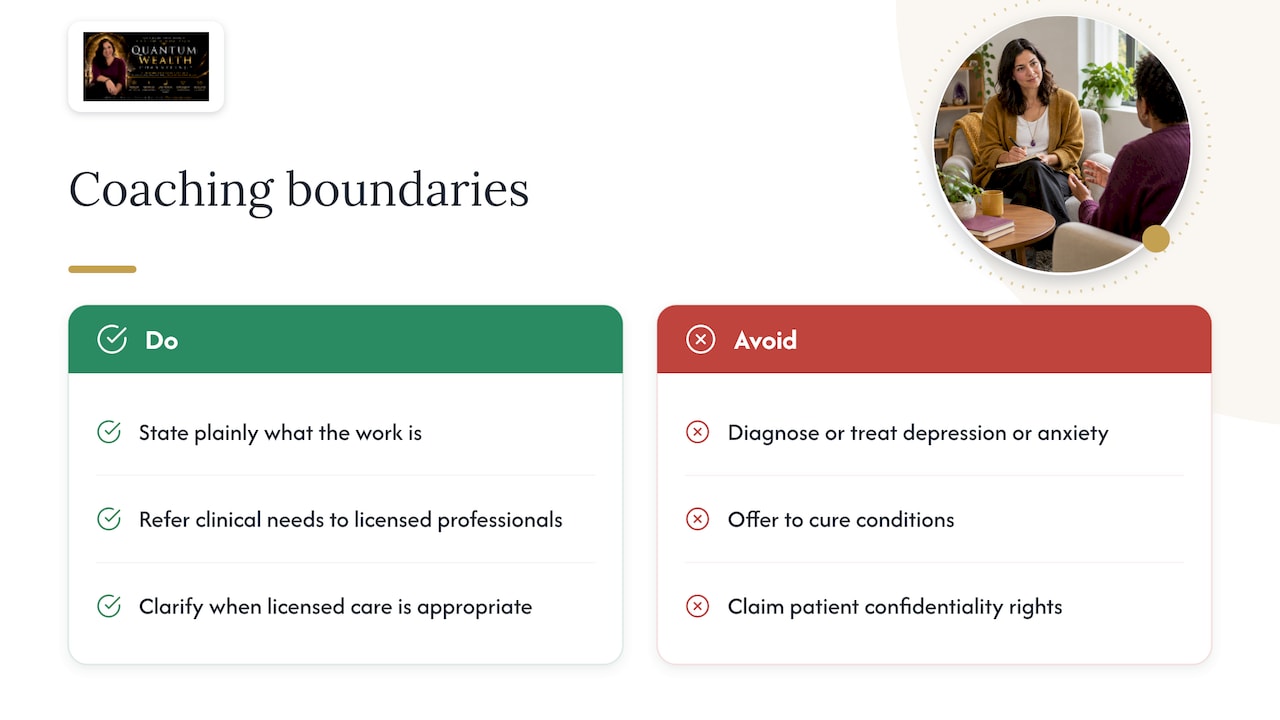
Because coaching is not licensed at the state level, the title tells you very little. Anyone can use it. NPR’s reporting on coaching and therapy adds that non-licensed coaches are legally not allowed to diagnose or treat conditions such as depression or anxiety, and that coaching clients do not have legal rights such as patient confidentiality.
Cleveland Clinic names the practical red flags: a coach who diagnoses conditions or offers to cure them has stepped outside the role. The same principle applies to anyone who offers spiritual work. A trustworthy practitioner states plainly what the work is, what it is not, and where a licensed professional is the right person for you.
There is a clear place for the work spiritual mentors do. If you are an intuitive woman, healer or channeler, you may be basically well and still stuck at a different kind of edge: you receive guidance but doubt it, you sense where your business is meant to go but hesitate to act, or you can feel the next level of income and notice yourself pulling back from holding it. Those are questions of discernment, identity and capacity. They are the territory of spiritual education and mentorship. A simple readiness check for intuitive women can help you see whether that is where you are.
When to see a licensed professional first
Some situations belong with a licensed therapist or physician, not with a coach or mentor of any kind. Seek that care first if you are experiencing:
Thoughts of suicide, self-harm or harming others. In the US, call or text 988, or go to an emergency room.
A diagnosed mental health condition that you want treated.
Trauma symptoms that interfere with your daily life, sleep, work or relationships.
Problematic use of alcohol or other substances.
Depressed mood that persists, or anxiety that disrupts sleep, work or relationships.
This is not a ranking of which support is more valuable. It is about fit. NPR reports one academic study finding that 25% to 50% of people working with a life coach have mental health conditions that call for a higher level of support. If you recognize yourself in that group, therapy is the right foundation, and it can be paired with other growth work when your therapist agrees it fits.
If your nervous system feels overwhelmed and you are looking for gentle, grounded practices, our guide to nervous system regulation and spirituality is educational and sits alongside, never in place of, care from a licensed professional.
Using both at the same time
Many people do not choose. A therapist can attend to symptoms, history and patterns, while a coach or mentor attends to a forward direction. Cleveland Clinic notes that many people work with both at once. The one caution from NBCC is that counseling and coaching should not be delivered at once by the same provider, since the roles carry different obligations. Keep them separate, and let each practitioner know the other exists.
It helps to be clear about the line between a coach’s question and a clinician’s question, which is why a plain comparison of how coaches and therapists differ is useful when you are deciding whom to approach for a specific challenge. For the business side of the question, an overview of what career coaching involves shows how goal-focused coaching differs from clinical work.
How to choose a spiritual mentor wisely
Because there is no license to check, your discernment is the main tool. These questions help you use it.
Does the practitioner say what the work is and is not? Look for clear language that it is not therapy, diagnosis or medical care.
Is your authority kept intact? Good spiritual education builds your ability to access and discern your own guidance. It does not make you dependent on someone else’s reading of it.
Does guidance lead to action? Spirituality is not a substitute for decisions. Ask how receiving connects to what you will actually do in your work, finances and relationships.
Are outcomes promised? Be careful with anyone who guarantees income, healing or cures. Honest practitioners describe the work and the container, not a certain result.
Is the structure clear? Look at the length of the program, the format, the price and what is included, stated plainly on a public page.
Does it fit alongside your other care? A steady practitioner welcomes your therapist, doctor or advisor being part of your life.
The way a space is held also matters. We have written about how a coaching container is held energetically, and about the practical benefits of spiritual mentorship for women who want to ground what they receive.
Where licensing is changing, and what it does not change
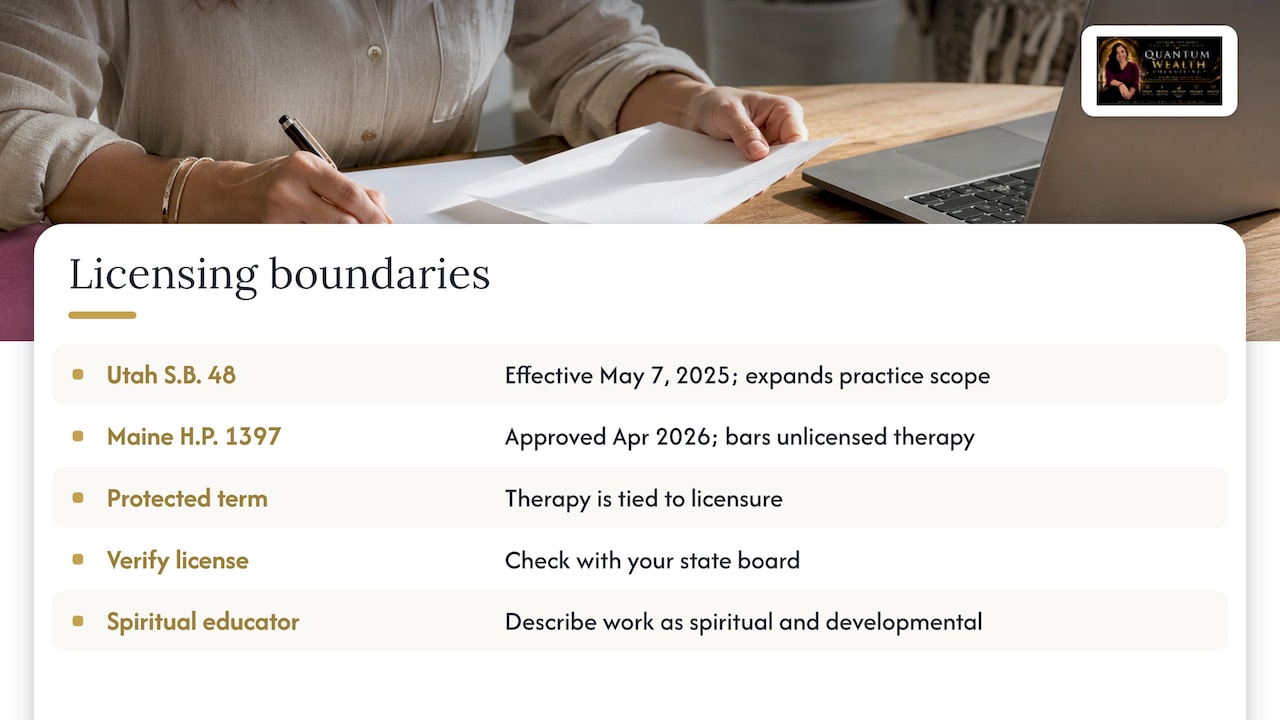
Therapist licensing is an active area, and it differs by state. Utah’s S.B. 48, effective May 7, 2025, expanded scopes of practice for mental health therapists. Maine’s H.P. 1397, approved in April 2026, prohibits offering therapy or psychotherapy unless it is provided by a licensed professional, including through internet-based artificial intelligence.
The common thread is that the word therapy is protected and tied to licensure. For you, that means two things. If you want therapy, confirm the license with your state’s board. And if you are working with a spiritual educator, you can expect that person to describe the work in spiritual and developmental terms, never as treatment.
I teach spiritually activated women to access and discern their own guidance, and then to bring it into the physical world through decisions, action and creation. That is the center of what I do as a Quantum Channel, Multidimensional Healer and Spiritual Educator. I want to be exact about the boundary. My work is not therapy, trauma treatment or mental health care, and I never frame it that way. If you are carrying symptoms that need clinical attention, a licensed professional is where to begin, and what I teach can come alongside that when the time is right. What I see as the real edge for many intuitive women and spiritual entrepreneurs is not a lack of gifts. It is the gap between receiving and acting: guidance arrives, but self-trust wavers, wealth identity stays small and the capacity to hold more has not yet been built. My programs are designed to close that gap through channel development, discernment, work with Wealth and Business Councils, codes, grids, timelines and energetic architecture, always paired with practical strategy. I do not believe in outsourcing your authority, and I do not believe spirituality replaces action. The strongest support helps you hear yourself more clearly and then move. Shantana Telise
Our perspective
A way in, if your questions are about wealth and guidance
If what you want is to apply channeling to wealth, business and creation, Quantum Wealth Channeling is a four-month program built for exactly that. It is offered as the Core Experience at $2,497 or as VIP Private Access at $4,196, both as one-time payments. It teaches you to strengthen your channel, deepen discernment and turn what you receive into grounded decisions. Check the program page for current enrollment before you plan around it.
[

If you would like a lower-commitment first step, the Intuitive Income Reset is a $7 entry offer for reconnecting your intuition with your income. For a deeper, longer path, Portal of the Gods is a ten-month multidimensional initiation into divine power, love, quantum wealth and sovereign leadership, offered at $9,000 as a one-time payment. None of these offers promises a financial result, and none is a substitute for clinical care.
FAQ
Do I need a therapist or a spiritual coach?
If you want a condition assessed or treated, or you are struggling with symptoms that disrupt daily life, start with a licensed therapist or physician. If you are basically well and want direction, discernment and help turning guidance into action, a spiritual coach or mentor fits. You can also have both, with each role kept clear.
What do spiritual coaches do?
They support personal and spiritual development: clarifying purpose, strengthening self-trust and discernment, and connecting inner guidance to real choices. Because the field is not licensed, the specifics vary by practitioner, so read what each one says their work includes.
Can a life coach call themselves a therapist?
No. Therapy is a licensed service, and in the US the title and the practice are tied to state licensure. Coaching, by contrast, is not licensed at the state level, so a coach cannot legally diagnose or treat conditions like depression or anxiety, as NPR reports.
Can I work with a therapist and a spiritual mentor at the same time?
Yes, and many people do. Let each know about the other, and keep their roles distinct. NBCC advises that one provider should not deliver counseling and coaching simultaneously, because the duties of each are different.
Sources
Recommended
Comments