
Alignment vs. Strategy: How to Use Both in Your Business
Alignment is the inner and relational clarity about what you are building and why. Strategy is the set of choices that turns that clarity into a plan, a sequence and results you can see. They are not rivals. Alignment without strategy stays a feeling, and strategy without alignment becomes effort pointed at the wrong thing. If you are an intuitive woman, healer, channeler or spiritual entrepreneur, the work is learning to let guidance set the direction and then letting practical decisions carry it into physical creation. This is the thread that runs through our Quantum Wealth Channeling program, and this article lays out the reasoning behind it.
TL;DR
Alignment answers “what is true for me and for this business, and why does it matter?” Strategy answers “what do I do, in what order, and how will I know it is working?”
Researchers who study intuition and leadership describe the same pairing: receive the insight first, then bring it to a deliberate rollout.
Alignment is not agreement and it is not a mood. It holds up under questions, disagreement and changing conditions.
A short decision filter, a written set of values and a few numbers let you test any offer, hire or launch against both.
Review both on a schedule, because alignment is not permanent and a strategy left on a shelf stops guiding anything.
Table of Contents
What alignment means and what strategy means
In business writing, alignment usually means that goals, people and priorities pull in one direction. In the spiritual work we do, it carries a more personal meaning: your inner knowing, your values, your offers and your daily actions say the same thing. The two meanings meet in the same place. Something is aligned when there is no hidden contradiction between what you say you want and what you actually do.
Strategy is the set of deliberate choices about where to play, what to offer, to whom, at what price, and in what sequence. The Michigan Small Business Development Center’s Focus Four framework puts vision first, built on a core purpose and core values, and strategy, execution and cash flow after it. It also warns against “SPOTS,” strategic plans on top shelves, and favors ongoing strategic thinking over a document nobody opens.
That order matters. Purpose and values come first, and strategy follows from them. But strategy is not decoration on top of purpose. It is where purpose gets tested against reality: pricing, capacity, timing, cash.
Why neither one works alone
Columbia professor Lisa Miller, in a McKinsey Author Talks interview, separates two modes. “Achieving awareness” is data-driven and backward-looking: strategy and tactics. “Awakened awareness” is receptive, intuitive knowing. She says achieving awareness alone is too rigid, while awakened awareness alone is “without implementation.” Her answer is to integrate them: honor the intuitive flash, then bring it to the achieving mind to envision the rollout. She compares it with how good scientists work, insight first and rigorous rollout after.
Many women we write for know both failure modes well.
Guidance without structure. You receive something clear, you feel certain, and then nothing in your calendar, pricing or offers changes. Over time you begin to distrust the guidance itself, when the missing piece was a plan.
Structure without guidance. You follow a proven launch formula, hit the milestones and feel a quiet wrongness about the whole thing. You may then blame yourself for being ungrateful when the real issue is direction.
The corrective is not to choose a side. It is to give each its job. Alignment sets the direction and the filter. Strategy builds the road.
What the research says about purpose and results
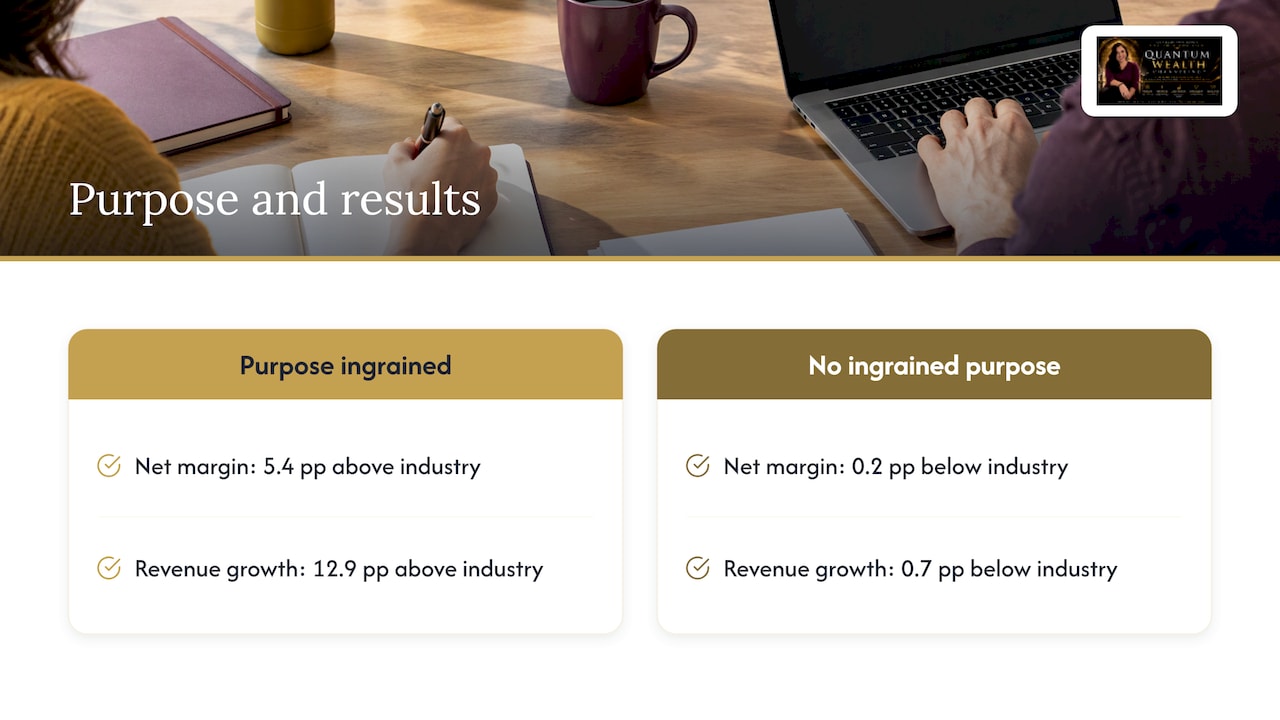
A 2023 MIT CISR research briefing, drawn from a survey of 342 organizations, found that decentralized decision-making paid off only when a comprehensive purpose was ingrained. Those organizations reported net profit margins and revenue growth 5.4 and 12.9 percentage points above industry averages. Decentralized organizations without an ingrained purpose came in 0.2 and 0.7 points below. This is organizational research, not a promise about any individual business, but the logic transfers: when decisions are spread across many choices, a clear purpose is what keeps them coherent.
McKinsey’s paper The aligned organization reports a study in which companies whose people understood and were excited about the direction were twice as likely to have an earnings margin above the median. It also describes real alignment, where strategy, goals and meaningful purpose reinforce one another, as freeing an organization to spend less energy deciding what to do and more energy doing it.
For a solo founder, the same effect shows up as fewer second-guessed decisions. When you know what you will not sacrifice, a large share of offers, collaborations and tactics answer themselves.
Alignment is not agreement
A common confusion is treating alignment as a feeling of ease or of everyone nodding. Forbes Business Council contributor Lee Eisenstaedt distinguishes the two: agreement is saying yes to a plan, while alignment means supporting a decision once it is made, even if you argued against it.
Bain & Company’s David Michels adds that alignment is fluid and fleeting. Teams drift out of it as conditions change, and the mark of a truly aligned team is that it can disagree and debate well. Leaders who read a smooth, agreeable meeting as proof of alignment were often leaving unresolved issues under the table.
This applies inside one person too. You may have an inner voice that wants to expand and another that wants safety. Alignment does not mean silencing one. It means hearing both, deciding, and then acting without relitigating the choice every morning. Where the decision came from guidance, this is also where discernment matters: asking whether what you received holds up when you bring it to numbers, timing and your real capacity.
The inner qualities that make both possible
What lets someone stay steady enough to hold intuition and strategy together? McKinsey’s Manish Chopra names four inner qualities: character, mastery, wisdom and equanimity. He notes that spiritual attunement need not come from organized religion, and that an equanimous leader can set a direction that is both adaptable and rooted in the organization’s purpose and values. On mastery of the mind, he cites a 2010 Science study by Killingsworth and Gilbert finding that nearly half the time we try to focus, our minds wander.
That is a useful reminder for anyone developing a channel. Receiving clearly depends on a mind that can settle, and acting well depends on a mind that can stay with a plan. Writing on leadership as attunement explores how steady, relational presence builds trust and performance in teams. If you want to go deeper on the inner side of leading, our guides to spiritual sovereignty and soul-led leadership cover how to lead from within and still decide well.
A decision filter that uses both
When an opportunity arrives, whether a launch idea, a price change, a new collaborator or a direction you received in meditation, run it through two lenses in order.
Lens one: alignment
Does it fit what I will not sacrifice? Write a short list of values and priorities that are non-negotiable. EP Wealth Advisors recommends a written “North Star” of exactly this kind, with a qualitative list of priorities plus a “freedom number”, the after-tax wealth you would need to be independent of the business, used as a filter for decisions like taking on debt, partners or growth.
How does it feel in the doing, not only the imagining? Forbes contributor Jodie Cook describes the difference between inspired action and desperate hustle: inspired action feels like flow, while hustle feels like drowning. Her test is whether you would still do the activity if it were guaranteed to fail.
Lens two: strategy
What exactly will I do, and by when? Turn the guidance into a specific action with a date.
What does it cost and what does it require of me? Check your cash flow, your hours and your energy. Simon Quick Advisors suggests business owners know two numbers: what the business is worth and the after-tax amount needed to fund their lifestyle and legacy goals, and use the gap to guide reinvestment, timing and risk. They also recommend separating business and personal cash flows with a consistent owner’s pay schedule.
How will I know within a set period whether to continue? Decide the checkpoint before you begin, not after.
A decision that passes lens one and fails lens two is not a bad idea. It is an idea that needs a different sequence or more capacity. A decision that passes lens two and fails lens one is the quiet wrongness described earlier. Only when both pass do you move without friction.
Building a strategy around your purpose
BMO Wealth Management’s five-step guide to purpose-aligned strategy is a clear model to adapt. It asks you to understand purpose as the reason a business exists beyond profit, separate your personal purpose from your business purpose, embed purpose into the mission, offers and operations, use it as a touchstone at crunch points, and measure impact with milestones and feedback, including a way to repair course when you fall out of alignment.
For an intuitive founder, a workable routine looks like this:
Name the purpose in one sentence. Not the offer, the reason the offer exists.
List your non-negotiables. These become the filter above.
Choose one direction for the next quarter. Many guidance-led founders receive more than they can build at once. Pick one.
Translate it into three actions with dates, a number you are tracking and a review day.
Review monthly. Ask what is working, what is draining and whether the direction still feels true.
If you want a structured version of the purpose step, our 90-day plan for deepening purpose alignment walks through it, and our guide to spiritual wealth alignment connects it to how you receive and steward money.
How to tell whether the strategy is working
A strategy can be working on paper while your alignment erodes, or the reverse. Track both on the same review day.
Strategy signals are concrete: revenue against the number you set, hours spent against hours planned, conversations started, offers delivered. If these stay flat across two review periods with the actions actually done, the plan needs revising, not more faith.
Alignment signals are quieter: whether you are making decisions faster, whether you dread or look forward to the work, whether you keep postponing the same task, and whether you can state your purpose without hedging. Treat a repeated postponement as information about either the plan or the direction, and look at which one.
Because alignment is fluid, schedule these checks rather than waiting for a crisis. If the signals disagree, adjust one variable at a time: the action, the sequence or the offer. Keep the purpose steady until you have clear reason to change it.
Where Quantum Wealth Channeling fits
Our work teaches spiritually activated women to access and discern their own guidance, and then to translate what they receive into real decisions, action and the capacity to hold what they create, without outsourcing their authority and without using spirituality as a substitute for action.
Quantum Wealth Channeling is a four-month program for applying channeling to wealth, business and creation. It is offered as the Core Experience at $2,497 or as VIP Private Access at $4,196, each a one-time payment. Please confirm current availability and inclusions on the program page before you decide.
[
If you would like a lower-commitment starting point for reconnecting intuition with income, the Intuitive Income Reset is a $7 one-time offer. And if you want a free educational next step on this theme, you can begin with The God Portal to Ascension.
Perspective
We hold that alignment and strategy are two halves of the same act of creation. Guidance tells you what is true and where to move. Strategy gives that truth a body: a price, a schedule, an offer someone can say yes to. What we teach is meant to keep your authority in your own hands. You learn to receive your own guidance, to discern it, and to bring it into decisions you can stand behind. Receiving and acting belong together, and our work connects them. This is why we pair intuition with practical strategy rather than asking you to choose. A founder who can only receive, or only plan, is carrying half the work. Our programs are designed to help you build the capacity to do both, steadily, in your own time and on your own terms. We make no promise about financial outcomes. We offer a way of working in which your direction is clearer, your decisions are more your own, and your actions follow from what you know. Shantana Telise
FAQ
What is the difference between alignment and strategy?
Alignment is the consistency between your values, your guidance, your offers and your actions. Strategy is the plan for what you will do, in what order, and how you will measure it. Alignment sets the direction, and strategy turns it into a path you can follow.
Can I have a strategy without alignment?
Yes, and many founders do. The plan may be sound and the numbers may move, yet the work can feel hollow or draining. Research on organizations suggests purpose and direction matter for results, which is why we start with direction and then build the plan.
What is the difference between alignment and agreement?
Agreement means you say yes to a plan. Alignment means you commit to a decision and act on it, even if you argued against it earlier. In a business, and inside yourself, healthy alignment can include real disagreement during the decision and clear commitment afterward.
How often should I review my alignment and my strategy?
A monthly review works well for most solo founders, with a larger look each quarter. Alignment shifts as conditions change, so a scheduled check keeps both the direction and the plan current instead of leaving them on a shelf.
How do I know whether guidance is real or wishful thinking?
Bring it to your values, your numbers and a specific action with a checkpoint. Guidance you can act on, review and refine tends to hold up. Discernment is a skill that grows with practice, and it is central to how we teach channeling.
Sources
Recommended
Comments