
Sound Bath vs. Meditation: What Each Practice Asks of You
A sound bath is something you receive, and meditation is something you train. In a sound bath, a facilitator plays instruments while you lie back and listen. In meditation, you direct your own attention and practice returning to it. Both can settle the nervous system, but only one builds the inner skill that intuitive work, channeling and wealth decisions depend on: staying present, noticing what arises and discerning what to do with it. That distinction matters if you are a healer, a channeler or a spiritual entrepreneur deciding where to put your time.
TL;DR
A sound bath is a receptive, mostly passive experience of instruments such as singing bowls and gongs. Meditation is an active practice of focusing attention and gently returning when it wanders.
Early research on sound baths is encouraging for short-term feelings of calm, but the studies are small and the long-term effects are not yet known.
Meditation has a larger research base, with modest improvements reported for stress, anxiety, sleep and mood when practiced consistently.
If your goal is discernment and self-trust, a practice that trains your own attention does work that being soothed by sound cannot do for you.
Some people should check with a doctor before either practice. The specifics are below.
Table of Contents
What a sound bath actually is
Despite the name, no water is involved. WebMD describes a sound bath as a meditative experience in which you lie down and let waves of sound wash over you, using instruments such as singing bowls, gongs, tuning forks, bells or chimes. You do not need to chant or concentrate. You listen.
Sessions typically run about an hour, though they can be shorter or longer. They usually happen in a quiet, dimly lit room with mats, blankets or pillows. The facilitator plays in a slow, deliberate pattern, the sounds rise and fade, and the session ends with a few minutes of quiet.
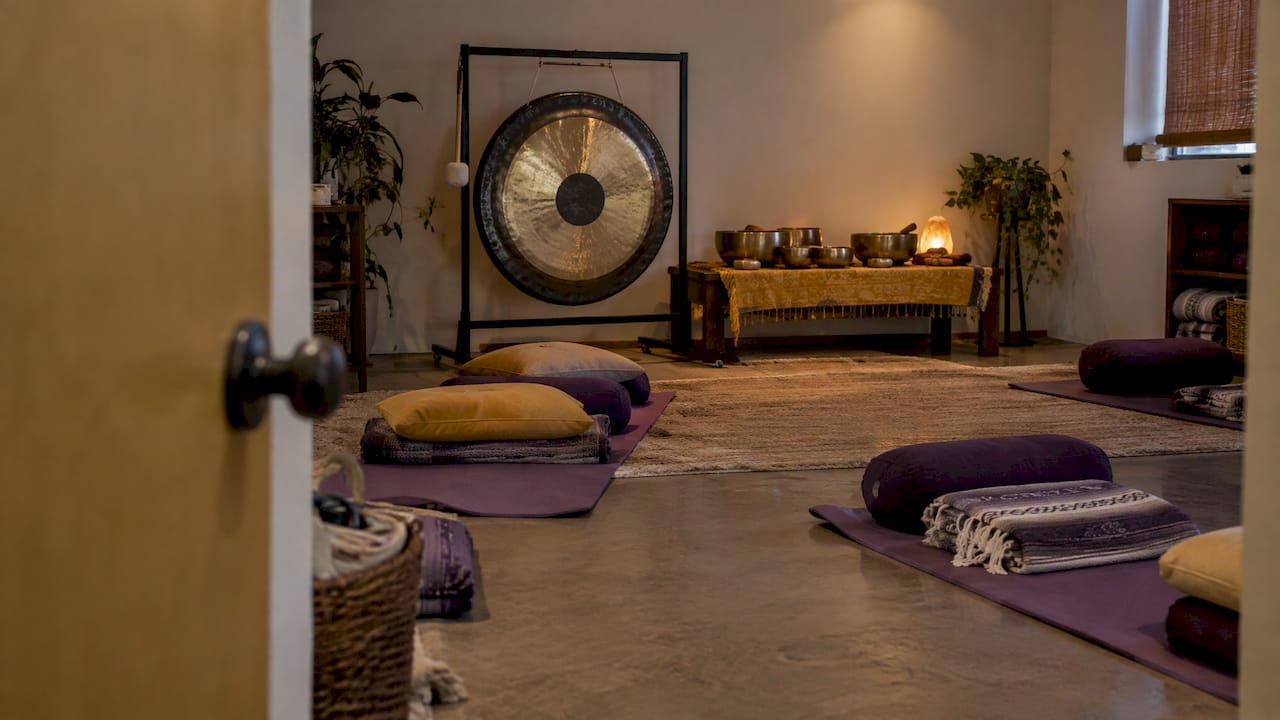
The traditions around it vary. Cleveland Clinic notes the idea that specific tones and frequencies correspond to energy centers in the body and can help reset them. Elisa Sobo, an anthropologist at San Diego State University, explains in The Conversation that the yogic sound bath is essentially an extended, sound-enhanced savasana, the resting pose at the end of a yoga class, which emerged from modern yoga. Her research found that participants used both scientific language, like the nervous system’s rest-and-digest state, and spiritual language, like vibrations unblocking chakras, to describe what they felt.
That range is worth holding lightly. A sound bath can be a physiological experience, a spiritual one, or both, and you do not need to choose a single explanation for it to be valuable to you.
What meditation asks of you
Meditation is a different kind of participation. According to Mayo Clinic, meditation is a mind-body practice in which you train yourself to focus on one thing, such as your breath, and when the mind wanders, the practice is to bring it back. Most forms involve a quiet setting, a comfortable position, focused attention and an open, nonjudgmental attitude. Beginners are advised to start with 10 to 15 minutes.
There are many forms. Cleveland Clinic lists body-centered self-scanning, contemplation, emotion-centered meditation, mantra meditation, meditation with movement, mindfulness meditation and visual-based meditation among the common types.
The point that most beginners miss is that wandering is not failure. Dr. Darshan Mehta of the Benson-Henry Institute at Harvard Medical School says in Harvard Health that the goal of most practices is not to stop thoughts but to change your relationship to them. Each time you notice the mind has drifted and gently escort attention back, that counts as a successful repetition. He recommends bringing curiosity and kindness rather than self-criticism.
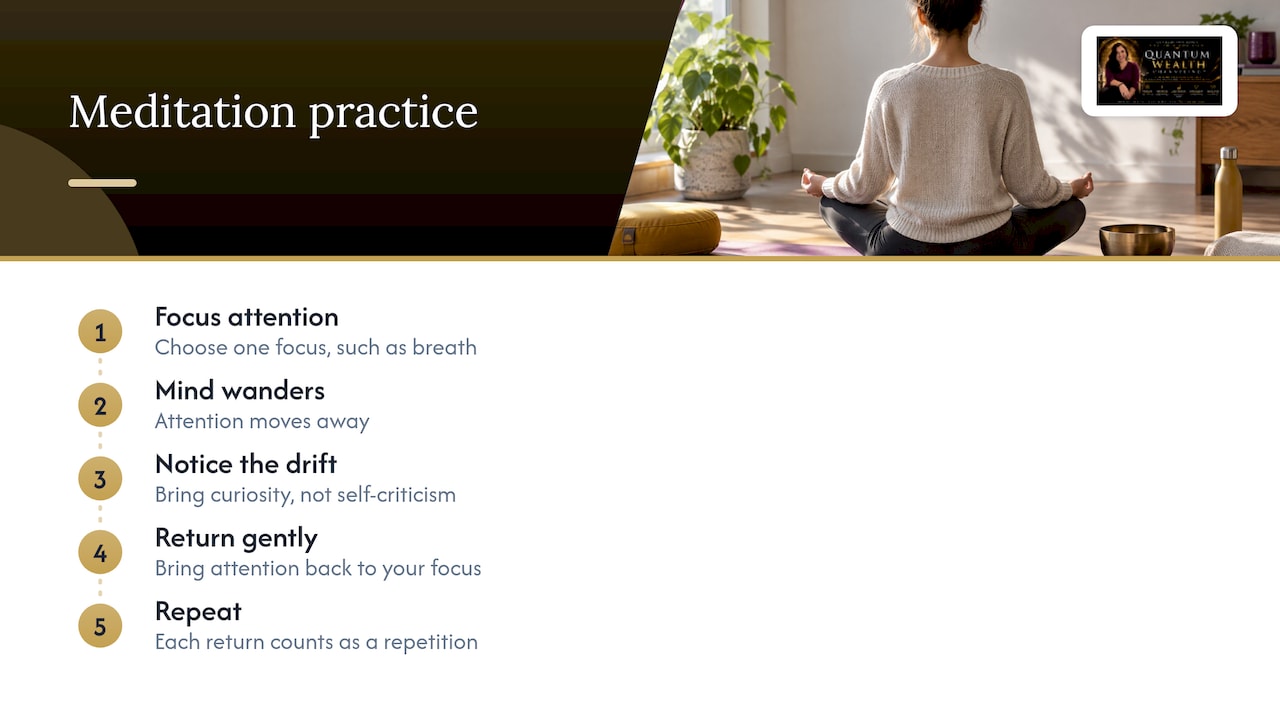
That sentence describes a skill, and it is the same skill a channeler uses when a thought, a sensation or an impression arises and she has to decide whether it is guidance, anxiety or habit.
Sound bath vs. meditation, side by side
Sound bath | Meditation | |
Your role | Receive and listen | Direct and return your attention |
Who leads | A facilitator plays instruments | You, often with a teacher or recording |
Effort | Little; you are not asked to focus | Gentle, repeated effort |
Typical length | About 60 minutes | 10 to 15 minutes to start, per Mayo Clinic |
Setting | Usually a group, lying down | Anywhere, alone or in a group |
What it builds | A felt experience of rest | A trained capacity for attention and awareness |
Research base | Small and early | Larger, with modest reported benefits |
Tamara Goldsby, a research psychologist at UC San Diego who studies sound baths, describes them in Popular Science as a passive experience distinct from the more active practice of meditation, while allowing that there may be some overlap. She also says the reasons for sound bath effects are still primarily theoretical, though the body appears to move toward what Herbert Benson called the relaxation response, a shift out of fight-or-flight and into rest-and-digest.
That last phrase is useful. A sound bath can invite the relaxation response without asking anything of you. Meditation invites it too, but through your own practice, which means you can reach for it in the middle of a business decision, a difficult conversation or a channeling session.
Is meditation just relaxation?
Not quite. The federal AHRQ evidence report on meditation practices notes that Benson, who coined the relaxation response in the early 1970s, emphasized that it is not simply a state of relaxation and not a sleep-like state. It is a particular state reached by following specific instructions.
That is the quiet difference between lying in a warm room being soothed and practicing. Both feel good. Only one leaves you with something you can repeat on your own.
There is also research comparing the two. A 2019 meta-analysis in Psychological Medicine pooled 14 randomized trials with 862 participants who had anxiety disorders or high trait anxiety. It found meditation techniques somewhat more effective than relaxation therapies for anxiety. The effect was modest, so treat it as a direction rather than a promise.
What the research says about sound baths
The honest picture is that sound baths are promising and young.
A 2020 systematic review of four peer-reviewed studies, summarized by Cleveland Clinic, showed possible health benefits from playing or listening to singing bowls, with a call for more research. People commonly report feeling calmer, looser in the muscles, more relaxed and more aware of their bodies.
In a study of 62 participants, most reported less tension, anger, fatigue and depression after a single singing-bowl session, according to UCLA Health. The same article notes there is no data yet on how long those changed feelings last.
A 2023 paper summarized in Popular Science found changes in stress-related hormones, self-reported anxiety and alpha brainwaves after a single Tibetan singing bowl session with 50 participants.
As Sobo points out, even an excellent sound bath cannot relieve stress over the long term if the causes of the stress remain in place. That is not a flaw of the practice. It is a reminder that rest and restructuring your life are two different jobs, and the second one needs decisions. If you want a wider look at how sound relates to stress, this overview of how sound shapes stress relief summarizes the reported benefits and where the evidence currently ends.
Meditation has a deeper body of work. Harvard Health states that consistent daily practice can bring modest improvements in stress, anxiety, sleep, mood and attention. NCCIH, the National Institutes of Health center for complementary approaches, reports that a 2018 analysis of 142 groups with more than 12,000 participants found mindfulness-based approaches better than no treatment for anxiety and depression.
Neither practice is a substitute for medical or mental health care. Both are best understood as complements to it.
Which one fits what you are trying to do
The useful question is not which is better. It is what you want the practice to do for you.
Choose a sound bath when you are depleted and need to be held in a room where nothing is required of you. It suits the season when effort itself feels like too much, and it can be a genuine reset after a launch, a long client week or a period of heavy intuitive output. Sitting in a group while someone else carries the container has its own value, and our piece on what shared circles can offer explores that side.
Choose meditation when you want to build something you can carry. If you channel, read energy, lead others or make financial decisions from intuition, you need to tell the difference between a clear impression and a nervous-system surge. That discernment is trained by the exact repetition Mehta describes: notice, return, notice again, without punishing yourself.
Use both when you want rest and structure. A common pattern is to practice meditation for a short stretch most days and book a sound bath when you want to be carried. If you want to see how another receptive practice compares to meditation, Yoga Nidra vs. Meditation walks through that distinction, and feminine embodiment meditation offers a grounded practice for bringing attention back into the body.
Why trained attention matters for intuitive and wealth work
Many intuitive women and healers I speak with are not short on guidance. They receive a great deal. What is harder is deciding which of it to act on, holding steady while money, visibility or responsibility expand, and trusting themselves without outsourcing that trust to a teacher, a reading or a feeling in a room.
A receptive practice such as a sound bath can soften you enough to hear more. A trained practice is what lets you evaluate what you heard. Receiving and discerning are two halves of one capacity, and the second half does not arrive by being soothed. It is built the way attention is built, through repeated, kind returns.
This is also why intuition and strategy belong together. Guidance that never becomes a decision, an offer, a boundary or a budget remains an experience. Guidance that you have learned to discern, and then act on, becomes physical creation.
Who should check with a doctor first
Both practices are generally gentle, but they are not right for everyone at every moment.
WebMD advises care if you have seizures triggered by certain sounds, a psychiatric condition such as schizophrenia, or PTSD or past trauma involving sound. If you are unsure, start with a short session or a home recording.
UCLA Health recommends consulting your primary care physician before sound therapy if you have a serious medical condition such as cardiac arrhythmia, epilepsy or an implanted device.
Cleveland Clinic says that if you live with a psychiatric disorder, you should check with your doctor first, with essentially the same rules as for meditation, because in some people meditation can cause or heighten symptoms of disorders like schizophrenia. It also suggests drinking water, eating lightly and sleeping well before a session.
Healthline reports that practitioners advise checking with a healthcare professional if you are pregnant or have a history of epilepsy, and that people with bipolar disorder or schizophrenia should speak with their mental health professional first.
NCCIH reports that a 2020 review of 83 studies found about 8% of participants had a negative effect from meditation, most often anxiety or depression. If a practice seems to intensify distress, Mehta advises pausing and discussing it with your medical provider.
Sobo also suggests noticing how a facilitator speaks. In her view, a provider who talks about their own trauma can invite you to absorb someone else’s story rather than enjoy the immersion. For more on pacing and safety in energetic work, see our guide to energy healing side effects.
A simple way to begin
If you are new to meditation, keep it modest.
Choose a length you can repeat. Mayo Clinic suggests beginning with 10 to 15 minutes.
Pick one anchor. Your breath, a sound or the sensation of your feet on the floor.
Expect wandering. Each time you notice and return, you have completed a repetition.
Close with one decision. Ask what one small, practical action the stillness points toward, and do it that day.
Adjust for your body. If a practice feels activating or distressing, stop, and speak with your doctor or mental health professional.
The fourth step is the one most spiritual practices skip, and it is the bridge between inner experience and the life you build.
I teach women who are already intuitive, already activated, and often already tired of being told that more receiving is the answer. In my work, the turning point is rarely another beautiful experience. It is learning to access your own guidance, discern it, and translate it into decisions you can stand behind. That is why I see sound baths and meditation as different tools. A sound bath can hold you. Meditation, and the deeper channel development I teach, asks you to become the one who holds the signal: to build self-trust, strengthen your channel and expand your capacity to receive and steward what you create, without outsourcing your authority and without using spirituality as a substitute for action. Our work pairs advanced multidimensional channeling with grounded wealth creation. The practices are not a replacement for medical or mental health care, and nothing here promises a financial outcome. They are a way of meeting yourself with more clarity, so that what you receive can become something real. Shantana Telise
Our perspective
Where to go from here
If you are curious about the quieter, receptive side of this work, our free gift, The God Portal to Ascension, is an approved educational next step.
If you are ready to turn channeling into grounded wealth decisions, Quantum Wealth Channeling is a four-month program for applying channeling to wealth, business and creation. It is offered as the Core Experience at $2,497 or VIP Private Access at $4,196. For a first, low-commitment step, the Intuitive Income Reset is a $7 entry offer for reconnecting intuition with income. Please confirm current availability on each page before enrolling.
[
FAQ
Is a sound bath the same as meditation?
Not exactly. A sound bath is a receptive experience in which you lie back while someone plays instruments, and you are not asked to focus. Meditation is a practice in which you direct your attention and return to it when it drifts. Researcher Tamara Goldsby describes sound baths as passive and meditation as more active, with some overlap.
Do sound baths really help?
Many people report feeling calmer and more relaxed afterward, and small studies point to short-term reductions in tension and anxiety. However, researchers say more evidence is needed, and it is not yet known how long the effects last. A sound bath is best treated as a complement to medical care, not a replacement.
Who should not do a sound bath?
Check with your doctor first if you have sound-triggered seizures, epilepsy, a heart rhythm condition, an implanted device, a psychiatric condition such as schizophrenia or bipolar disorder, or past trauma involving sound. Pregnant people are also advised to check first. If unsure, try a short session or a home recording.
How is meditation different from relaxation?
Relaxation is a state, while meditation is a practice with specific instructions. The AHRQ report notes that Herbert Benson stressed his relaxation response is not simply relaxation. A 2019 meta-analysis also found meditation somewhat more effective than relaxation therapies for anxiety.
Sources
I tried a sound bath to see if it actually made me calmer (Popular Science)
Meditation: What It Is, How To Meditate, Benefits & Types (Cleveland Clinic)
Meditation techniques: How to meditate for stress, sleep, and focus (Harvard Health)
What is sound therapy, and could it benefit your health? (UCLA Health)
Meditation Practices for Health: State of the Research (AHRQ)
Meditation techniques v. relaxation therapies when treating anxiety (Psychological Medicine)
Meditation and Mindfulness: Effectiveness and Safety (NCCIH)
Holistic Therapy: What It Is, Benefits, and Precautions (Healthline)
Recommended
Comments