

Wealth Embodiment: Living as Someone Who Can Receive Wealth

Wealth embodiment is the practice of letting your identity, your body and your daily decisions match the wealth you say you want to receive and steward. It is not a mood, an affirmation or a performance of success. It is a steady alignment between what you believe about money, what your nervous system does when money enters the room, and what you actually do on an ordinary Tuesday. It guarantees no financial outcome, but it changes the person who is making the decisions.
TL;DR
Wealth embodiment is lived alignment: your wealth identity, your body’s response to money and your concrete actions point the same way.
It differs from attracting or wishing because it asks you to change how you decide, spend, price, rest and receive, not only how you think.
Wealth is wider than income. Time, support, community and a sense of enough are part of the picture, and U.S. federal research treats financial well-being as more than a paycheck.
Intuitive guidance works best when it is paired with homework, reference points and trusted counsel before you act.
No practice here promises money. The aim is a clearer, calmer and more capable relationship with wealth.
Table of Contents
What wealth embodiment means
The word embodiment simply means that something you know becomes something you live. Most of us can describe the wealth we want in detail. Fewer of us notice that our posture, our pricing, our hesitation before sending an invoice and our reflex to deflect a compliment are already telling a different story.
So wealth embodiment has three layers. The first is identity: who you believe you are allowed to be around money. The second is the body: the felt sense of safety, tension or contraction that arrives when you look at a number. The third is behavior: the decisions that follow, whether you raise a rate, hire help, rest without guilt or accept a gift without immediately repaying it.
When the three agree, money decisions feel less like a negotiation with yourself. When they disagree, you can know exactly what you want and still find yourself undercutting it. In my work as a quantum channel, multidimensional healer and spiritual educator, this gap between knowing and living is where most intuitive women get stuck. The guidance is clear. The capacity to hold what it points toward has not caught up yet.
How embodiment differs from wanting or attracting wealth
Wanting wealth is a desire. Attracting wealth, as it is commonly taught, is a hope that the right thoughts will pull circumstances toward you. Embodiment starts from a different question: what kind of person is steadily making these decisions, and what would change in my week if I were already that person?
That shift matters for three reasons.
It puts action back in the picture. Spirituality is not a substitute for action. A channeled insight about your business still needs a price, a calendar, a conversation and a follow-through. Embodiment treats those as part of the practice rather than a lesser step after it.
It makes the work observable. You cannot easily measure whether you have attracted anything, but you can notice whether you open your bank statements, whether you state your fees without apologizing, and whether you ask for help before you are depleted.
It respects reality. Embodiment does not ask you to pretend that limits or hardship do not exist. One writer on mindset puts it plainly: abundance thinking can include time, friendship, community and support, and does not require denying financial difficulty. That honesty is what keeps the practice grounded.
If you want a longer look at how energy and capacity relate, our article on channeling quantum wealth and your capacity to receive goes deeper.

Wealth is wider than money
A person who embodies wealth usually has a definition of wealth that is bigger than a balance. That is not a way of dismissing money. It is a way of seeing which needs money meets and which it does not.
Elizabeth Husserl, who teaches on embodied wealth, describes money as one resource that can help meet human needs, alongside non-monetary resources, and separates money from a broader sense of wealth and fulfillment. In a separate conversation, she explains that wealth can include money and other resources, and that needs can be met in monetary and non-monetary ways.
U.S. federal research points the same direction. The Consumer Financial Protection Bureau defines financial well-being as the ability to meet current and ongoing obligations, feel secure in the future, and make choices that let you enjoy life. It also notes that financial well-being is not strictly aligned with income, and some people with much higher incomes do not feel they have high financial well-being. Elsewhere, it describes well-being as a continuum, and says people can move along that continuum through learning, effort and support.
This is encouraging for embodiment work. If your sense of wealth were only a function of income, there would be little to practice. Because it is also shaped by control over day-to-day finances, readiness for a shock and progress toward goals, there is a lot you can build. The distinction between net worth versus wealth is another useful angle on why a strong balance sheet and a felt sense of wealth are not always the same thing.
For a wider view, see our piece on why wealth expansion is more than money.

How the body holds beliefs about money
Many people discover that their resistance to wealth is not an idea at all. It is a bodily reaction: a tight chest at an unexpected expense, a flush of shame when someone asks what you charge, a flat numbness when you try to plan.
Annie Wright, writing about money and self-worth, explains the concept of neuroception, a term coined by Stephen Porges, as a largely unconscious scan for cues of safety or danger. Her point is that if money once meant danger, the body can still flag a bank notification as a threat even when the rational mind knows better, so a person can be financially secure and still feel in their body that they are at an edge.
She is also careful about the limits of this idea. She does not claim that the nervous system assigns a worth score, or that every financial stress response is trauma, and she notes that bodies respond to real financial precarity because it is actually dangerous. I find that framing helpful, and I share it. Embodiment is not about convincing yourself that your fears are baseless. It is about noticing what your body is responding to, separating then from now, and giving yourself enough steadiness to choose differently.
This is spiritual and energetic education, not clinical care. If financial stress feels overwhelming or is affecting your health, a licensed mental health professional or a qualified financial counselor is the right person to see.
If you recognize these patterns, our grounded guide to releasing money blocks walks through how intuitive women can approach them without force.
Practices for embodying wealth in everyday life
Nothing here requires special equipment. What it requires is consistency and honesty. These practices draw on Husserl’s published suggestions and on the way we teach discernment and grounded action.
1. Define what enough means
Scarcity thinking and inherited financial patterns shape how much feels safe to want. Husserl suggests defining what enough means and considering monetary and non-monetary ways of meeting human needs. Write your own definition in plain terms: a monthly number, a quality of rest, a level of support. Revisit it each quarter, because enough changes as your life does.
2. Map your needs, not only your income
Husserl describes a wealth mandala that looks at fulfillment across 12 human needs. You can adapt the idea in a notebook: list the needs that matter to you, note which are well met, and notice which you have been trying to solve with money alone when community, time or rest would meet them better.
3. Keep a satiation journal and pause to digest
The same source mentions a satiation journal and the habit of pausing to notice and digest meaningful experiences. At the end of each day, write one thing you received, whether it was payment, help, a kind word or a quiet hour, and let yourself register it before moving on. Receiving is a capacity, and it grows with attention.
4. Check the body before a money decision
Before you quote a price, sign a contract or make a purchase, take three slow breaths and notice where you feel tension. Name it without judgment. The goal is not to obey the sensation or to override it, but to know it is there while you decide.
5. Let one visible behavior change
Choose one concrete action that reflects the identity you are growing into: state your fee once without softening it, schedule a financial review, or accept help without apology. Small repeated acts teach your system what is now normal.
6. Consider the life energy behind money
Vicki Robin says that considering the life energy behind money can shift spending from consumption toward values-driven choices. Before a larger purchase, ask what portion of your time and attention it represents, and whether you would spend that portion on this again.
For business-specific exercises, you may like our guide to embodiment exercises for business decisions.
Turning intuitive guidance into grounded decisions
Intuitive women often carry strong guidance and still hesitate to act on it, or the reverse: they act on every impulse and wonder why results feel unstable. Embodiment sits between those. It asks you to receive guidance, discern it and then ground it.
A business leader writing in Fortune offers a sensible model that applies well here. Feris Rifai explains that before relying on instinct for a major decision, he asks questions and gathers as much information as he can, then turns to his gut. He describes each decision as a puzzle in which reference points give a rough picture and instinct fills in the rest. When the picture is unclear, he turns to colleagues and partners, because many people bring different expertise and different past experiences.
You can translate that into a simple sequence:
Receive. Notice the guidance and write it down exactly as it arrives.
Discern. Ask whether it is consistent with your values, your current reality and what you know about yourself. Notice whether it comes with steadiness or with urgency.
Gather reference points. Review numbers, timelines, market information and advice from people with relevant expertise.
Decide and act. Take the smallest concrete step that tests the direction in the physical world.
Review. Note what happened, what your body did and what you would adjust.
This keeps your authority with you. You are not outsourcing your decision to a teacher, a tool or a reading, and you are not using spirituality in place of action. If you want a framework for balancing receptive and directive energy in this process, see our guide to grounding feminine and masculine energy into action.
When the pursuit of wealth takes over
One caution belongs here. A well-known set of studies in the Journal of Personality and Social Psychology found that a high centrality of money-related values and financial-success aspirations was linked with lower well-being among college students, and in a noncollege sample with lower global adjustment and social productivity. These are correlations from 1993 samples, not a verdict on anyone’s ambitions.
The takeaway I draw is practical: wealth embodiment works best when money serves a life you value, not when it becomes the only measure of it. Wanting to receive more and being rooted in meaning, relationships and purpose are not in conflict.
Perspective
I have watched many intuitive women become very good at receiving guidance and much less practiced at holding what that guidance asks them to build. That is not a failure of faith or talent. It is a capacity question, and capacity can be developed. In my work as a quantum channel, multidimensional healer and spiritual educator, I treat wealth embodiment as the bridge between the two. We strengthen the channel, then we strengthen discernment and self-trust, and then we bring the guidance into the physical world through timelines, decisions, pricing, structure and action. Wealth identity is not a slogan you repeat. It is what you are willing to do consistently once you have decided what you can hold. I also believe the work should never ask you to give up your authority. Our approach is designed to help you access and discern your own guidance, so that what you receive becomes grounded decisions rather than another voice to follow. No practice, mine or anyone else’s, can promise a financial outcome, and I would not ask you to believe otherwise. What I can say is that when your identity, your body and your choices are aligned, your relationship with wealth becomes steadier and more spacious. Shantana Telise
Going deeper with Quantum Wealth Channeling
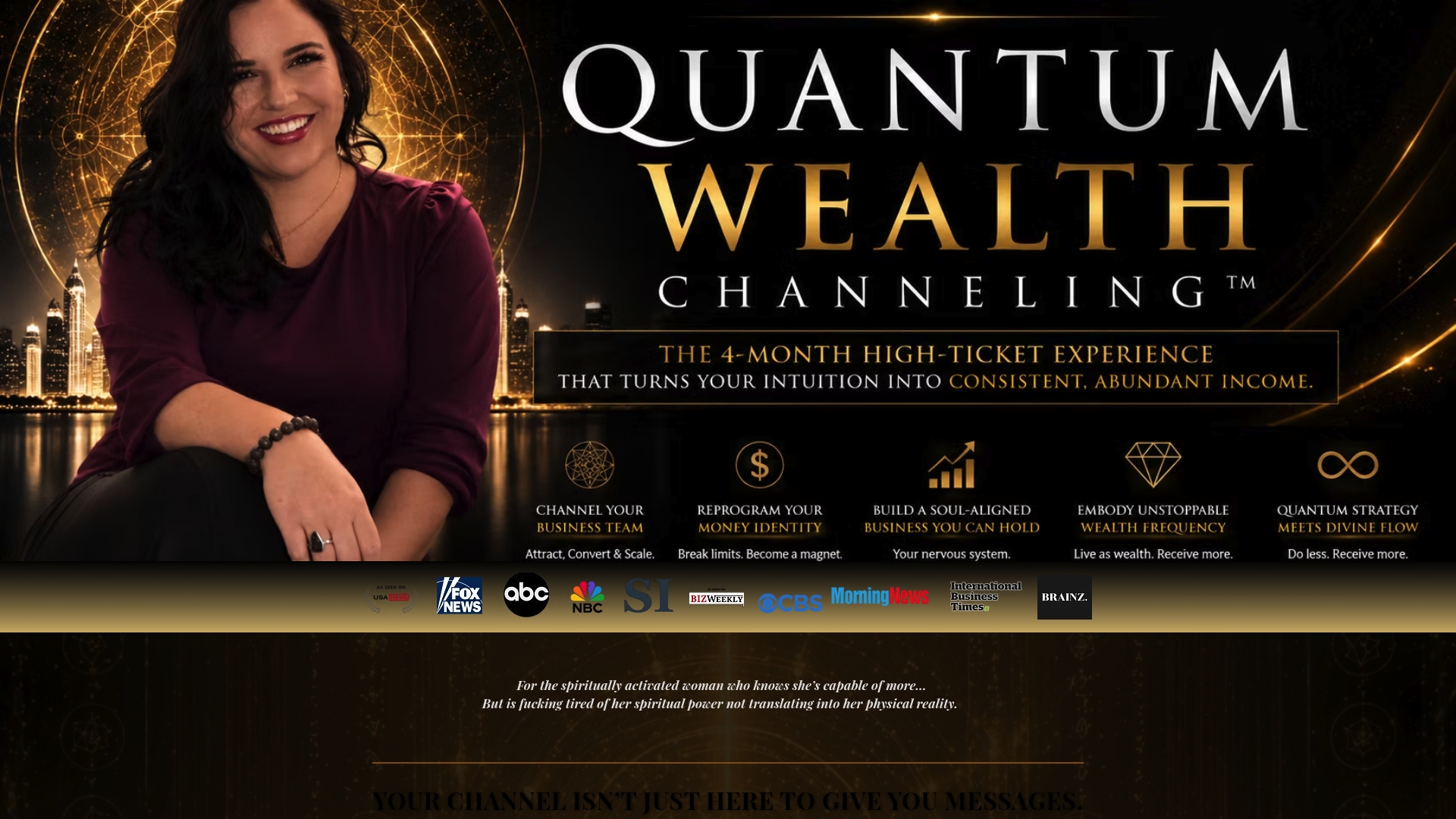
If you want structured support for applying channeling to wealth, business and creation, our four-month program, Quantum Wealth Channeling, is designed for exactly this bridge between guidance and grounded action. It is offered as a Core Experience at $2,497 and as VIP Private Access at $4,196, both as one-time payments. Please check the program page for current availability and what each level includes before you decide.
[
If you would like a lighter first step, you can also explore our free online Goddess Evolution Summit registration, which welcomes all genders and explores wealth, intuition, purpose and legacy with guest teachers. Check the page for current event details.
You can keep reading on our blog, including our guide to spiritual wealth alignment for intuitive women.
FAQ
What does it mean to embody wealth?
It means your identity, your body’s response to money and your daily decisions are aligned with the wealth you intend to receive and steward. It shows up in behavior such as how you price, spend, rest and accept support. It is a practice, not a guarantee of income.
Is wealth embodiment the same as manifesting?
Not quite. Manifesting usually focuses on thoughts and intention, while embodiment adds the lived layer: nervous system, identity and consistent action. In our teaching, guidance is always grounded in real decisions, and spirituality is never a substitute for action.
Can I embody wealth if I am not wealthy yet?
Yes, because the practice begins with how you relate to what you have and what you decide, not with a number. The CFPB notes that financial well-being is not strictly aligned with income, so a felt sense of security and choice can be built at many income levels. Real hardship still deserves real support, such as a financial counselor.
How do I start embodying wealth today?
Start small: define what enough means for you, write down one thing you received each day, and change one visible behavior, such as stating a fee without apologizing. Repeat for a few weeks and notice what shifts in your decisions.
Does wealth embodiment replace financial planning?
No. It supports it. Reference points, numbers and trusted advisors are part of grounded decision-making, and embodiment simply helps you approach them with more steadiness and self-trust.
Sources
Finding Joy in Your Relationship with Money with Elizabeth Husserl
Financial well-being: The goal of financial education, CFPB (2015)
Money and Self-Worth: Your Net Worth Is Not Your Self-Worth, Annie Wright
Never Make a Big Decision Without Doing This First, Fortune (2015)
A dark side of the American dream, Journal of Personality and Social Psychology (1993)
Recommended
Comments