

Embodiment for Women Entrepreneurs: 8 Exercises for Business Decisions

Embodiment, for an entrepreneur, means using your body’s states and somatic cues as real information when you lead and decide. The practical payoff is clearer, faster choices and marketing that sounds like you, not like a template. Below you will find a working model, daily practices, a decision protocol, messaging experiments, a practical timeline and eight short exercises.
TL;DR:
Choose two or three brief practices, attach each to an existing daily cue, and repeat them consistently rather than relying on occasional long rituals.
Before a consequential choice, state the decision, compare bodily responses to each option, take one small testable action, then review both sensations and business numbers.
For messaging, compare two drafts with everything else held constant, send each to a small segment, and assess replies and clicks alongside your physical response.
Treat bodily cues as input, not proof; validate them with evidence, since research linked evidence guided pivots among women entrepreneurs to better venture performance.
Table of Contents
What embodiment means for entrepreneurs and how it works in practice
In a business context, embodiment is the habit of treating your body as a source of data alongside your spreadsheets and strategy. A thinking-only model assumes you gather information, weigh it, and then act. Most of us know that is not how a real Tuesday unfolds. You feel the tightening before you say yes to a client who is wrong for you, and you feel the opening when an offer is right.
Research on embodied decisions supports this picture. Neurophysiological work on embodied decisions indicates that action and decision processes unfold in parallel, and that movement and bodily states such as fear and excitement feed back into decision quality. A review of embodied decision studies adds that sensorimotor planning, valuation, selection and execution can all occur at once, and that movement dynamics provide evidence that stabilizes choices and improves the speed-accuracy tradeoff.

We read that as permission to take your felt sense seriously, not as proof of anything spiritual. In leadership, embodiment shows up in three ways. Presence is staying in your body during a hard conversation instead of leaving it for your head. Pacing is moving at the speed your decision actually requires, which is often slower at the start and faster at the commitment. Capacity is how much visibility, revenue and responsibility your system can hold without contracting. Those three are trainable, and the rest of this guide shows you how.
Core embodiment practices and daily rituals you can use
You do not need an hour of ritual before breakfast. You need a small set of practices that you will repeat. We group them by the moment in your day when they do the most work.
Morning anchoring (briefly): Stand or sit, feel your feet, and name your top three priorities out loud while noticing how your body responds to each one.
Pre-decision somatic check (2 minutes): Before any strategic choice, scan from your jaw to your belly and note where you feel tension, ease or heat.
Client-facing presence ritual (1–2 minutes): Before a call or launch, take three slow breaths, press your feet into the floor and soften your shoulders.
End-of-day release (briefly): Shake out your hands and arms, then write one sentence about what your body told you today.
Choosing matters more than collecting. Pick two or three of these, attach each to a moment that already exists in your day (coffee, a calendar alert, closing your laptop), and keep them small enough that you cannot fail. A brief practice you do regularly beats a long ritual you rarely do.
The pre-decision check deserves special attention because it carries the most direct business value. Many women entrepreneurs we work with describe knowing an answer in their body days before they could justify it in words. That felt data is not a replacement for numbers. It is the missing column in the spreadsheet.
Pro Tip: Attach each practice to an existing habit, such as brewing coffee or opening your inbox, so you never rely on willpower to remember it.
If visibility is where your body tightens most, our post on healing the fear of visibility goes deeper into client-facing presence.
Embodied decision-making and leadership: a repeatable protocol
The research gives us a useful implication. Because movement and bodily states feed back into the choice itself, studies of embodied decisions find that movement stabilizes choices and improves the balance between speed and accuracy. In practice, that suggests deciding is not a single moment of calculation. It is a process you can support with your body, and then commit to in small, testable steps.
Here is the protocol we use:
Prepare: State the decision and your intention in one sentence. “I am deciding whether to raise my group program price” is clear. “I am figuring out the business” is not.
Sense: Run your brief body check while holding each option in mind. Note which option brings expansion, which brings contraction, and which brings numbness.
Act: Make a micro-commitment, the smallest real step that tests the option, such as telling one client the new price or posting one draft offer.
Reflect: Log what happened in your body and in the numbers. A few lines is enough.
This protocol earns its keep on the decisions that feel heavy. When you are pivoting an offer, the sense step shows you whether the new direction excites or merely relieves you. For a pricing test, the act step keeps you from debating for weeks. When you are hiring, the body check during a later interview often tells you something the résumé cannot.
Embodiment does not replace evidence. Research on female entrepreneurs targeting women found that training entrepreneurs to build theoretical maps and validate them with evidence increased the likelihood of radical, performance-improving pivots, and those who pivoted showed better medium-term venture performance. We pair that rigor with felt sense: the body points, the evidence confirms.
For a deeper look at deciding quickly from sovereignty, read our post on leadership embodiment.
Embodied marketing and messaging: show up from the body
When you write or speak from a regulated body, your message gets simpler. You stop hedging, over-explaining and borrowing phrases you do not believe. Readers and buyers can usually feel that difference even when they cannot name it. We treat that as a working hypothesis to test, not a promise.
The feminine cues we see most often are receptivity (inviting instead of pushing), pacing (leaving space between ideas) and relational framing (speaking to a person, not a funnel). Used well, they sound like a thoughtful friend with expertise. Used badly, they sound like soft clichés, so keep each claim concrete and each offer clear.
You can test embodied messaging without a big budget. Run these micro-experiments over time:
Write two versions of one message. Draft the first from your head, the way you think a marketer would write it. Draft the second right after your brief body check, in the plain words you would say to a client.
Read both aloud and note your body. Mark which version makes your chest open and which makes your throat tighten.
Send each version to a small segment. Use an email subject line, a post or a story, and keep everything else identical.
Capture response and feel. Record replies, clicks and the words people use back to you, plus how you felt hitting send.
Keep what resonates in both columns. If the numbers and your body agree, make that your voice. If they disagree, run one more round before deciding.
Our post on turning intuitive decision-making into income shows how to fold these tests into a revenue rhythm.
Building capacity: timelines, signs of progress and simple metrics
Capacity grows the way strength does, through repetition and rest. Here is a realistic arc, offered as a guide and not a guarantee, since every nervous system moves at its own pace.
Establish. Choose your two or three practices and do them most days. The goal is consistency, not depth. You will likely notice that you catch tension sooner, even if you cannot yet act on it.
Apply. Start using the pre-decision check on real choices and run one messaging experiment. Expect some friction, because feeling more also means noticing what you used to override.
Integrate. Run the full protocol on at least one significant decision, and review your logs for patterns. By now many people find their pace has changed: less looping, quicker commitment.
You do not need an elaborate dashboard. Track three low-effort indicators:
Decision time: How long a typical choice takes from first thought to commitment.
Meeting energy: A simple rating of how depleted or steady you feel after client or team conversations.
Client response notes: The exact phrases people use when they reply to your messaging.
Once solo practice feels stable, translate it into team norms. Open meetings with thirty seconds of silence, ask “what does your gut say?” before voting, and let people pause before committing. Small rituals signal that felt data counts here, and they spread faster than policies.
Micro-practices: 8 quick embodiment exercises you can use today
Each of these takes between 60 seconds and 10 minutes. Try them one at a time before you stack them.
Feet and floor: Press both feet down and exhale slowly. Use it any time you feel rushed.
Jaw-to-belly scan (2 minutes): Move attention downward and name the strongest sensation. Use it before a decision.
Yes/no test (2 minutes): Imagine saying yes to an option, notice your body, then imagine saying no. Compare the two.
Shake-out (briefly): Shake your arms, legs and shoulders to release a stuck state after a difficult email.
Hand-on-heart pause (2 minutes): Rest a hand on your chest and breathe slowly before a vulnerable post.
Pre-client-call reset (2 minutes): Three breaths, ground your feet, soften your face, then state your intention for the call.
Walking decision: Walk while holding the question in mind and notice where your pace quickens or slows.
Launch-day sequence (10 minutes): Shake out, do the jaw-to-belly scan, name your intention aloud, then breathe slowly and end with a hand on your heart before you hit publish.
Pro Tip: Sequence from movement to stillness: shake or walk first to discharge energy, then scan, then decide. Your signals are far clearer once your body has settled.
For somatic prompts that go further, our four-step shadow work for intuitive women pairs embodied questions with integration practices.
How this work fits Shantana Telise’s background
Shantana Telise is a Quantum Channel, Multidimensional Healer and Spiritual Educator. Her work helps intuitive and spiritually activated women strengthen their channel, deepen discernment and self-trust, expand their capacity to receive and hold wealth, and turn guidance into grounded decisions and physical creation.
Embodiment sits underneath all of it. Four of her approved programs support different stages: Quantum Wealth Channeling applies channeling to wealth, business and creation; Portal of the Gods is a ten-month initiation into divine power, love, quantum wealth and sovereign leadership; Intuitive Income Reset is a short entry point for reconnecting intuition with income; and The Art of Divine Channeling Masterclass is her channel-development program.
Solo practice is a fine way to begin. Guided support becomes useful when you want structure, accountability and a trained eye on your blind spots.
Integrating embodiment while growing a business
I have learned that embodiment does not slow a business down, but it does change what you are willing to do quickly. The trade-off is real: you will sometimes feel a “no” that costs you a short-term opportunity, and you will have to trust it.
Start with a short micro-plan: choose two practices, run the pre-decision check on every meaningful choice, and write one line a day. Track both sides, the felt shift in your body and the business indicators, because neither tells the whole story alone.
— Shantana Telise
How a guided program can speed up embodiment integration
[
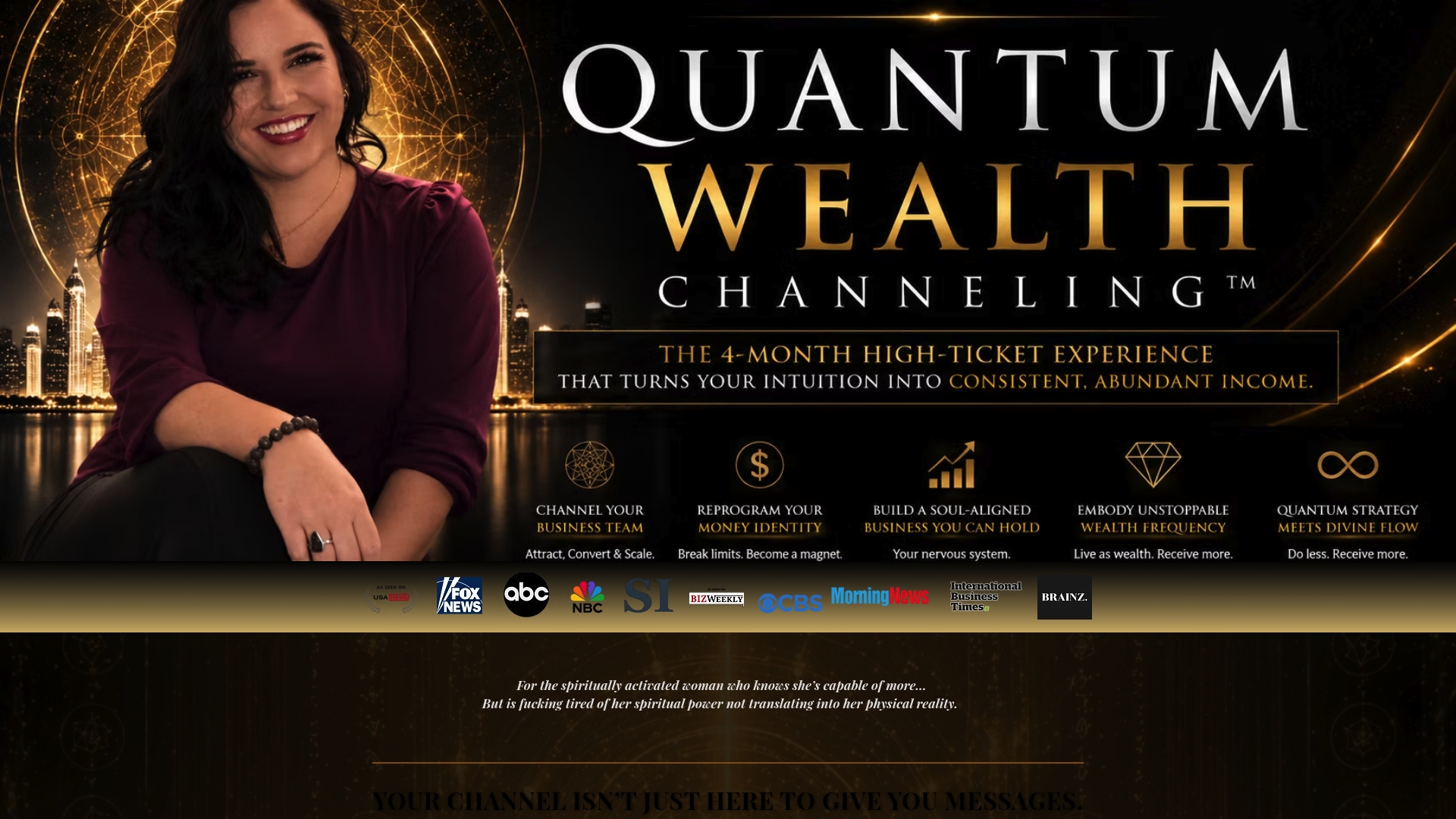
If you want programmatic support for turning guidance into business decisions, Quantum Wealth Channeling is the best fit. It is built for women who want to apply channeling to wealth, business and creation, and we guide you through:
Channel development: strengthening how you receive and trust guidance
Discernment: telling authentic intuition from mental noise
Grounded action: translating what you receive into real decisions and results
Current prices are on our Quantum Wealth Channeling and Intuitive Income Reset pages. Choose the Reset today, or explore the program page and begin when it feels like a clear yes in your body.
FAQ
What is business empowerment?
Business empowerment is building the confidence, skills and capacity to make your own decisions and act on them. For many women entrepreneurs, it also includes trusting felt guidance alongside data. Sense-making research reports that some women entrepreneurs use spirituality as an interpretive framework that supports persistence and adaptive decision-making.
Is there a certification program for embodiment coaching?
Embodiment practices are taught in many settings, and credentials vary widely by tradition and provider. We do not offer a coaching certification. If you want to see how embodiment is applied to leadership, workshop-style leadership and business sessions show practical examples.
How do I start a strong business using embodiment?
Begin by clarifying one offer and one person you want to serve, then run the pre-decision check on each early choice. Keep your commitments small and testable, and log both the numbers and your body’s response. That combination builds a business you can sustain.
What is the spirit of entrepreneurship?
It is the willingness to act on an idea before every answer is known, and to adjust as you learn. Embodiment adds a way to stay steady while you do that, because your body tells you when you are overreaching or settling.
Sources
Recommended
Comments