

Channel Spirit Into Measurable Wealth in 8 Weeks for Intuitive Women

Channeling spirit, in the way we teach it, means developing your own capacity to receive multidimensional guidance and translate it into real decisions, rather than waiting for a dramatic sign. The single most reliable practice is a short loop: ground for two to five minutes, receive without forcing, record the impression exactly as it came, then verify before you act on it. Expect gradual clarity, not instant certainty. Channeling sharpens judgment; it does not replace it.
TL;DR:
Consistent practice should focus on grounding techniques, brief receiving sessions, and immediate, verbatim recording to improve accuracy and discernment over time.
Use verification questions to test impressions, seeking supporting evidence and plausible alternatives before acting on guidance.
Reversible, small-scale actions based on the received impressions foster disciplined testing and reduce the risk of bias or impulsive decisions.
Daily tracking of confidence, support evidence, and outcomes helps measure progress and identify when to slow down or seek mentorship.
Grounding, setting time limits, and monitoring for distress are essential safety practices to protect well-being during the channeling process.
Table of Contents
Translating Guidance Into Measurable Wealth and Business Actions
Common Challenges in Spirit Channeling and How to Work Through Them
Ethical Considerations and Best Practices in Spirit Channeling
Types of Guidance You Might Receive and How to Recognize Them
Shantana Telise’s Perspective on Channel Development and Wealth Translation
The Core Practice: Prepare, Receive, and Record
Before you ask for anything, settle your body. A stable physical setting matters more than most people assume: the same chair, the same time of day if possible, phone on silent. Begin with a brief grounding period, what we think of as a micro-practice rather than a ritual: two to five minutes of slower breathing, feet on the floor, attention moving from your head into your chest and belly. Research on brief mindfulness interventions suggests that even a three-minute pause can improve reflective decision-making, which is exactly the window you are opening here. State your intention in one plain sentence: what are you asking, and why now.
Receiving is not forcing. Notice sensations, colors, single words, a shift in temperature or mood, a phrase that repeats. You are not building a narrative yet. Hold the space loosely: if nothing distinct comes in the first minute, stay seated rather than inventing content to fill the silence.
Recording happens immediately, before interpretation creeps in.
Capture the impression verbatim, in the words or images it arrived in, using a voice note or quick timed text.
Log the date, the question you posed, and your emotional valence (calm, anxious, excited) at the time.
Add a confidence rating from one to ten, separate from how true you hope it is.
Do this now:
Sit, ground for two to five minutes, state your question once.
Receive without editing for thirty to sixty seconds.
Record the raw impression, your confidence rating, and your emotional state.
Close the session before analyzing anything.
Pro Tip: Write down exactly what arrived before you write down what you think it means. The two get tangled fast, and separating them is what makes verification possible later.
How to Test and Verify What You Receive
A clear impression and a correct one are not the same thing. Intuitive confidence tends to feel strongest precisely when it is easiest to generate, which is part of why decreasing intuitive confidence has been shown to reduce intuitive bias across multiple studies. Treat every channeled message as a hypothesis, not a verdict, and run it through three questions before you act:
What exactly did I receive, stripped of the story I built around it?
What observable evidence, inside or outside me, supports this?
What is the most plausible alternative explanation?
Before answering, take a short mindfulness pause, a minute or two of quiet attention to your body, scanning for the particular heat of motivated reasoning: wanting something to be true because it is convenient, flattering, or urgent. This kind of pause has been linked to better detection of mismatches between intended and actual choices, which is precisely the skill discernment depends on.
Design your next step to be reversible and low-cost wherever possible: a small test, a conversation, a modest financial move you can undo, rather than a leap you cannot walk back. Watch for familiar traps: pattern-seeking that turns coincidence into destiny, confirmation bias that only remembers the hits, and motivated reasoning that reshapes the question to fit the answer you wanted. Actively look for disconfirming evidence, not just supporting evidence; a message that cannot survive one honest counter-question deserves more time before it earns action.
Pro Tip: If you cannot name a single piece of observable evidence for an impression, treat it as a prompt for further listening, not a directive for immediate action.
An 8-Week Practice Plan to Strengthen Your Channel
Channel development is a skill, and skills respond to a schedule more than to inspiration. This plan assumes most readers can give five to ten minutes daily and slightly more on review days.
Daily (5 to 10 minutes): ground, run one brief receive session, log it with confidence rating and emotional valence.
Three times a week: a focused receiving session on a specific question, financial, business, or relational, using the full prepare-receive-record sequence.
Weekly: one review session applying the three verification questions to the week’s strongest impressions.
Track a short set of metrics so progress is visible rather than assumed:
Average clarity rating across the week’s sessions.
Number of impressions with at least one piece of supporting evidence.
Number of reversible actions actually taken.
Simple financial behaviors completed: a statement checked, a goal set, a budget reviewed, aligned with CFPB’s skill-to-behavior framework.
Your weekly review should ask: did clarity rise or fall this week, did any impression hold up against disconfirming evidence, and does practice intensity need to increase, hold steady, or pause? If confidence outpaces evidence for several weeks running, that is usually a signal to slow down and seek structured mentorship rather than push harder alone.
Translating Guidance Into Measurable Wealth and Business Actions
An impression is only useful once it becomes a behavior you can measure. Borrowing from the CFPB’s pathways research, financial skill becomes financial behavior, and financial behavior is what eventually shapes financial well-being. The same logic applies to channeled guidance: pick one grounded action per insight rather than a vague sense of direction.
Received a nudge toward a new offer? Design a seven-day outreach sprint to three potential clients, not an overnight launch.
Received a sense that money is “stuck”? Check an actual bank or business statement this week.
Received a pull toward a new income stream? Frame a thirty-day pilot with a defined, small budget and a clear stop point.
Financial well-being tends to track consistent, repeatable behavior more than any single decision, according to CFPB’s pathways-to-well-being research, which is the behavioral foundation underneath every suggestion in this section.
A simple tracking sheet, columns for date, impression, verification notes, action taken, and outcome observed, keeps wealth identity anchored to evidence rather than fantasy. Receiving capacity matters, but it only becomes wealth when it is paired with the discipline to measure what actually happened.
Common Challenges in Spirit Channeling and How to Work Through Them
The most common obstacle is not silence, it is noise: too many impressions, conflicting signals, or a loud inner critic insisting nothing is real. When sessions feel static, shorten them rather than pushing longer; two honest minutes beat fifteen forced ones. Doubt during or after a session is normal and does not mean the practice failed; log it as data rather than treating it as proof of failure.
Overconfidence is a quieter but more costly challenge. A strong, fast impression can feel more trustworthy simply because it arrived easily, not because it is accurate. This is why the verification questions matter every time, not just when something feels uncertain.
Inconsistency is often a scheduling problem disguised as a spiritual one. If daily practice keeps slipping, shrink the session rather than abandoning it: ninety seconds of grounding and one line logged is still a session. Comparing your pace to someone else’s timeline is another common trap; channel development is cumulative and personal, and a plateau for a few weeks is ordinary rather than a sign something is broken. When frustration builds, return to the basics: ground, receive briefly, record plainly, and let verification do the rest of the work instead of forcing a breakthrough.

Ethical Considerations and Best Practices in Spirit Channeling
Channeling guidance for yourself carries a different weight than channeling on someone else’s behalf, and the line between the two deserves respect. If you ever work with another person’s energy or questions, get clear, explicit consent first and stay inside the scope they asked for.
Honesty with yourself about confidence levels is a baseline ethic, not an optional extra. Logging a confidence rating every time, even when it is low, keeps you from quietly upgrading uncertain impressions into certainties after the fact.
Guidance received through channeling is an input into your own judgment, never a substitute for it, particularly around financial, medical, or legal decisions, where professional expertise should carry real weight alongside whatever you receive. Avoid presenting any impression as infallible or as applying to someone else’s life without their explicit invitation. Respecting the autonomy of anyone whose situation comes up in a session, including your own future self, means leaving room for the guidance to be wrong and for circumstances to change. Treat every session as part of an ongoing practice of refinement rather than a one-time pipeline to absolute truth.
Types of Guidance You Might Receive and How to Recognize Them
Not all channeled impressions carry the same texture, and learning to notice the differences sharpens discernment over time. Some impressions arrive as what feels like higher guidance or expanded awareness: broad, spacious, and oriented toward long-term direction rather than urgent instruction. Others feel more like contact with a specific presence or guide, often carrying a distinct tone, phrase pattern, or emotional signature that repeats across sessions.
A third category is simply your own subconscious surfacing, memory, fear, or desire dressed up as external guidance. This is where the verification questions earn their place: asking what evidence exists for an impression, separate from how it felt, helps distinguish a pattern that recurs with supporting detail from a single emotionally loaded moment that will not hold up to scrutiny.
Notice recurring versus one-off impressions, calm versus urgent tone, and whether the content orients you toward reflection or pressures you toward immediate action. Urgency paired with vague content is one of the more reliable flags that something deserves more verification before you move on it, regardless of what kind of source you believe it came from.
Safety Precautions to Protect Yourself During Channeling
Grounding before and after every session is the simplest protection available, and it is also the most consistently skipped. Closing a session deliberately, even with something as plain as a few slow breaths and a mental “that’s complete for now,” matters as much as opening one well.
Set clear time limits. A session that runs long without a natural stopping point tends to produce more noise, not more insight, and leaving your body for extended stretches of inward focus without a break is simply uncomfortable and unproductive.
Watch for signs you need to pause the practice altogether: persistent anxiety after sessions, difficulty concentrating on ordinary tasks, or a growing sense that channeling is replacing rather than informing your decisions. None of this is medical or mental health treatment, and if distress persists, a licensed professional is the appropriate next step, not a deeper channeling session. Keep a stable daily rhythm of sleep, food, and movement underneath the practice; channeling built on top of an exhausted nervous system tends to produce static rather than clarity.
Making Sense of Ambiguous Messages and Symbols
Ambiguity is the default, not the exception, and most of the work of channeling happens in the interpretation, not the receiving. When a symbol or phrase does not resolve easily, resist the urge to assign a definitive meaning on the first pass. Instead, log the impression exactly as it arrived and let it sit for a few days alongside your other entries.
Look for recurrence across multiple sessions, a symbol that shows up once might be noise, but one that returns across different questions and different weeks is worth closer attention. Note the emotional tone attached to it, since the same image can carry different meaning depending on whether it arrived with calm, dread, or curiosity.
Cross-reference ambiguous content against your own practical context rather than reaching for a universal symbol dictionary; a repeated image of a door might mean something different to someone weighing a business pivot than to someone navigating a relationship. When a message resists interpretation entirely, it is reasonable to simply hold it as unresolved. Treating psychology’s framing of intuition as hypothesis-generation rather than instruction is useful here: a symbol’s value often lies in the question it raises, not in a single fixed answer you force onto it before you are ready.

Shantana Telise’s Perspective on Channel Development and Wealth Translation
As a Quantum Channel, Multidimensional Healer, and Spiritual Educator, we built our work around one conviction: channeling only becomes wealth when discernment and grounded action travel with it. Guidance without verification is just noise with good timing.
Different readers need different levels of structure. Someone wanting a first taste of practice-focused support is often better served by a short, accessible entry point before committing to something longer. Someone ready to apply channeling directly to income and business decisions over several months needs a more structured container, and someone seeking deep, sustained initiation into multidimensional work and sovereign leadership needs a longer pathway entirely. Self-practice works well for daily maintenance; structured training earns its place when you are ready to apply the skill to real financial stakes.
— Shantana Telise
Where to Go Next if You Want Structured Support
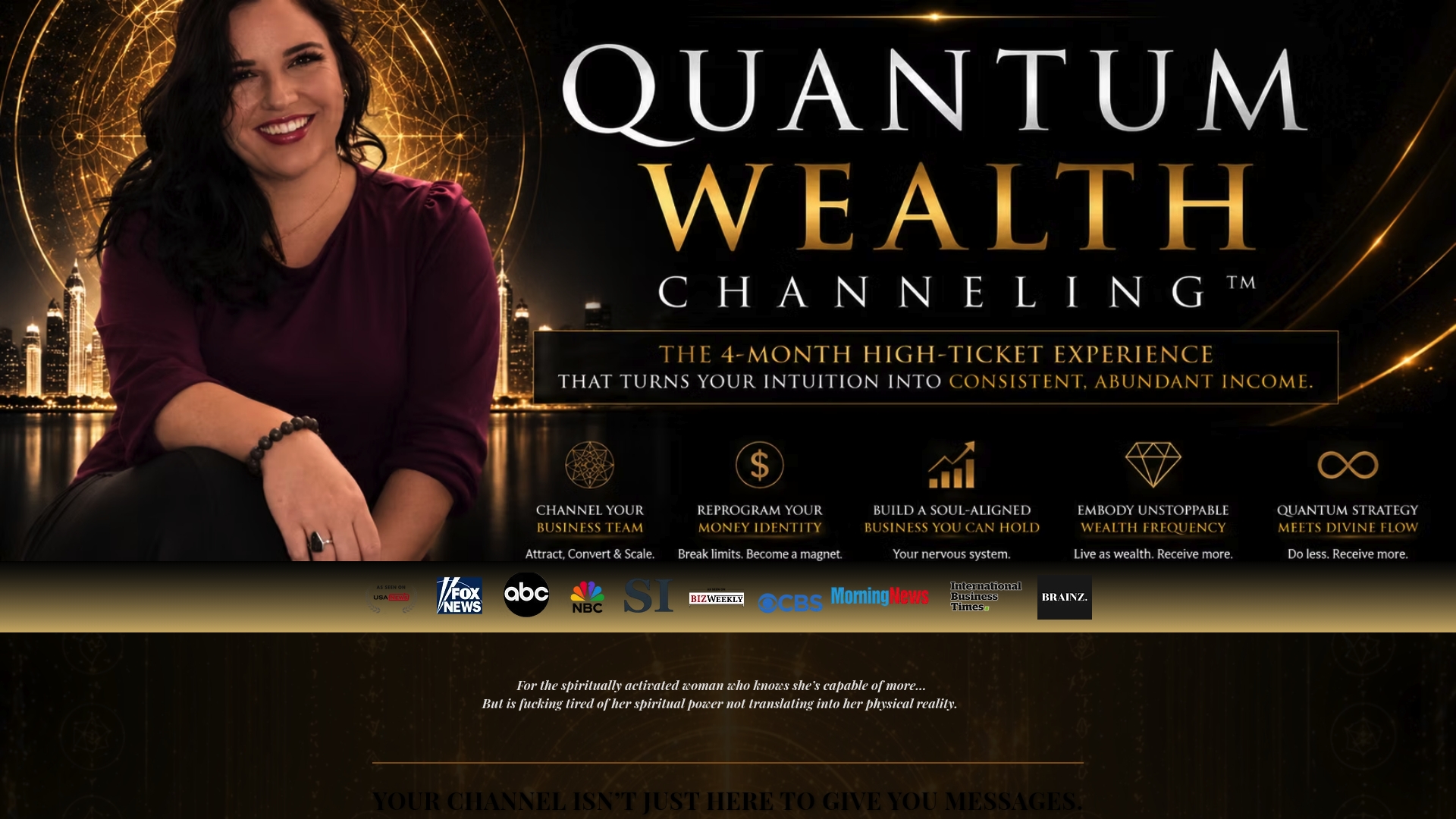
If today’s practice felt clarifying, that is the signal to build on it rather than start over each time. For an accessible first step, Intuitive Income Reset reconnects intuition with income in a focused, low-commitment format. For readers ready to apply channeling directly to wealth and business decisions over time, Quantum Wealth Channeling is our four-month program built for exactly that work, offered as Core Experience or VIP Private Access.
[
For deeper, sustained channel development, our nine-month Art of Divine Channeling Masterclass builds the skill itself, while Portal of the Gods offers a longer initiatory path into multidimensional power and sovereign leadership for those ready for that depth. No program here promises a financial outcome; each one builds capacity and discernment, which you then apply.
This article is general information, not a substitute for advice from a qualified financial advisor. Consult a qualified financial professional about your own circumstances before acting on anything here.
FAQ
What does “channeling spirit” actually mean in this context?
Here, channeling means developing your own capacity to receive multidimensional guidance and translate it into grounded decisions, not passive contact with an external entity delivering instructions. The skill sits in receiving, verifying, and acting, not in the impression alone.
How long does it take to strengthen a reliable channel?
Most people notice clearer impressions within a few weeks of consistent daily practice, though the timeline varies by person and session frequency. An eight-week structured plan with daily micro-practice and weekly review is a reasonable starting benchmark rather than a guarantee.
How do I know if a channeled message is trustworthy?
Run it through three questions: what exactly arrived, what observable evidence supports it, and what alternative explanation exists. A message that survives honest counter-questioning and comes with a reversible next step is more trustworthy than one that only feels urgent.
Can channeling guarantee financial results?
No single practice guarantees a financial outcome, and channeling works best as an input that sharpens decisions rather than a mechanism that produces income on its own. Pairing guidance with concrete, trackable financial behaviors, informed by frameworks like CFPB’s pathways research, is what tends to move real results.
Is channeling safe to practice alone, or do I need guidance?
Daily grounding and short receive-record sessions are generally safe to practice independently with reasonable time limits and attention to your own well-being. If sessions bring persistent distress or you want to apply guidance to significant financial decisions, structured mentorship or professional support is a sound next step rather than pushing through alone.
Sources
Recommended
Comments