

Stabilize Your Spiritual Quantum Leap in 90 Days With Somatic Work

A spiritual quantum leap is a sudden, sustained shift in your state of consciousness, an identity reorganization so complete that your old patterns simply stop fitting. With disciplined, embodied practice, you can create the conditions that make one more likely. This article covers the signs, the practices, the integration work, and what real guidance looks like once the leap has already begun.
TL;DR:
A spiritual quantum leap involves an irreversible shift in consciousness that leads to significant changes in decisions, identity, and emotional experience, often accompanied by physiological and sensory disruptions.
Recognizing a leap relies on clear signs like unwavering certainty, sudden decisions, and amplified sensory and emotional states, with the process typically taking several months to stabilize.
Intentional triggering requires sustained input over months, with practices like future-self embodiment and environmental restructuring forming a structured 90-day process to foster the shift.
Integration is essential for lasting change, involving embodied rituals, nervous-system regulation, and social support, while failure to integrate often results in reverting to old patterns.
Guided practitioners can accelerate stabilization by addressing energetic and identity shifts through energetic recalibration and supporting nervous-system regulation during the post-leap phase.
Table of Contents
What Is a Quantum Leap in Spirituality, Really?
The metaphor comes from physics: an electron moves from one energy level to another without passing through the space in between. It doesn’t drift there. It’s simply somewhere else. That image is what makes the phrase spiritual quantum leap so sticky. It describes a shift in consciousness that feels discontinuous, like you woke up one day and the emotional math of your life no longer computes.
Here’s the part that matters for accuracy: “quantum” in this context is a metaphor, not a mechanism. Nothing in quantum mechanics literally explains why someone leaves a marriage, closes a business, or stops recognizing their own reflection after a breakdown. Borrowing the physics term gives language to an experience that otherwise resists description, but it isn’t a scientific claim about your nervous system rearranging itself at the subatomic level. Treat it as poetry with structure, not as physics with feelings attached.
Within spiritual communities, you’ll hear a few common framings for the same core experience:
Frequency language — describing yourself as “raising your vibration,” useful shorthand for shifting emotional baseline, though it can slide into vague positivity if untethered from behavior.
Fifth-dimension or higher-density talk — popular in New Age circles, helpful as a symbolic marker of expanded perspective, less helpful if taken as a literal physical location.
Identity-shift language — the most grounded of the three, describing a change in self-concept that produces new choices, and the frame this article leans on most heavily.
Each has its place. The identity-shift frame tends to hold up best under scrutiny because it points to something observable: your decisions change because your sense of who you are has changed first.
How Do You Know You’re in a Quantum Leap?
Recognizing a leap while you’re inside it is harder than recognizing one in hindsight, but there are reliable markers across three domains.
Sudden clarity that won’t dissolve. You know something with a certainty that surprises you. Unlike a passing mood, it doesn’t fade after a good night’s sleep.
Irreversible decisions. You end the relationship, quit the job, or say the thing you’d rehearsed saying for years, and there’s no pull to take it back.
Identity reorganization. Old labels stop fitting. You may struggle to answer “tell me about yourself” because the answer you’d give feels like it belongs to someone else.
Physiological disruption. Insomnia, appetite changes, and unusually vivid dreams are common as the nervous system processes new information faster than it can settle.
Heightened emotional and sensory intensity. Colors seem sharper, music hits harder, and emotions arrive with less buffer between feeling and expression.
External synchronicities. Books, conversations, and strangers seem to hand you exactly what you need, often within days of asking an internal question out loud.
Relational fallout. Friendships that ran on your old identity start to strain. This is uncomfortable, not necessarily a sign anything has gone wrong.
Two cautions matter here. First, these signs vary enormously by person. Someone leaping toward financial independence experiences it differently than someone leaping out of a caretaking role. Second, resist catastrophic framing. Insomnia and intense emotion during a leap are disorienting, not dangerous, in the vast majority of cases. If distress becomes severe or persistent, that’s a signal to bring in professional support, not a sign the leap itself was a mistake.
Can You Intentionally Trigger a Quantum Leap?
Yes, within limits. The people who report the clearest leaps almost never describe them as random lightning strikes. Personal development writer Steve Pavlina has argued that quantum leaps typically follow months or years of sustained input, with the leap itself arriving as a single decisive moment that simply collapses accumulated pressure into action. The leap looks sudden. The setup rarely is.
Four principles underlie almost every reliable method:
Identity precedes reality. You act differently once you believe differently about who you are, not the other way around.
Input has to be sustained, not sporadic. A single meditation won’t move an identity that took decades to build; repetition does.
Environment and relationships either reinforce the old self or support the new one. There’s rarely a neutral middle ground.
Somatic readiness matters as much as mental clarity. A body braced for danger will override a mind convinced it’s safe.
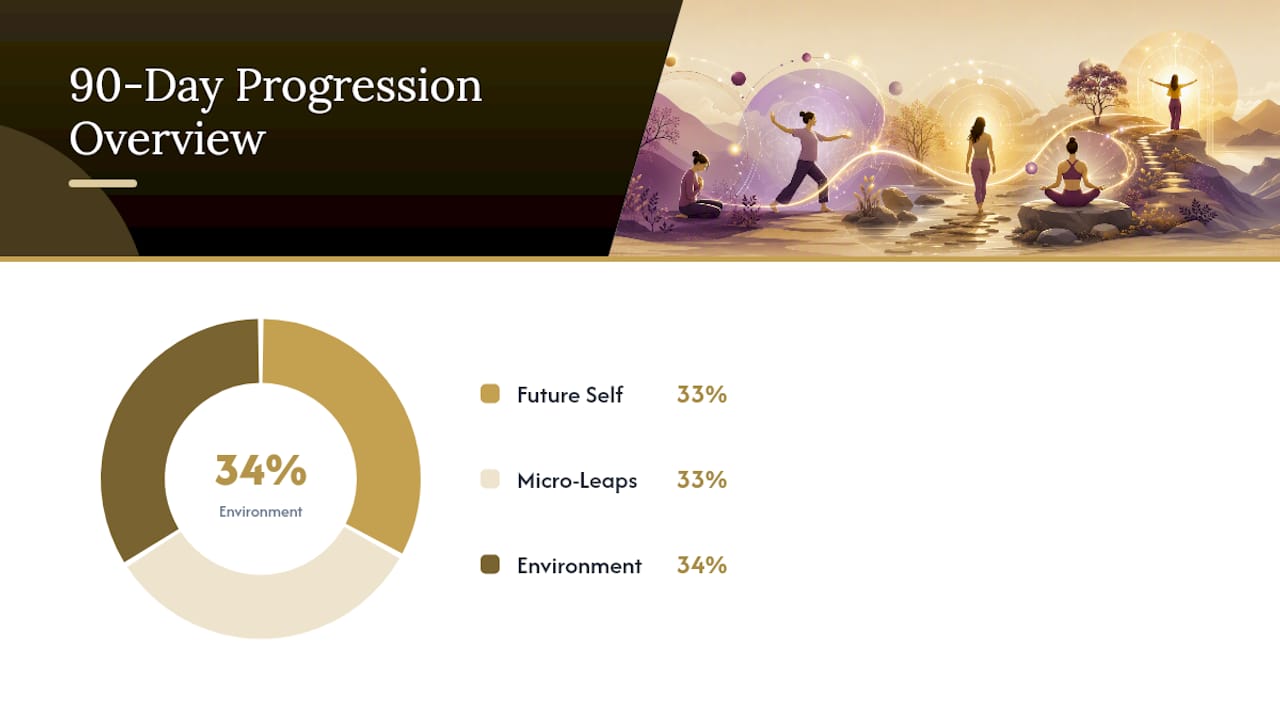
A practical container looks like this over 90 days:
Days 1 to 30: Build a future-self practice. Spend ten minutes daily inhabiting the felt sense, not just the mental image, of who you’re becoming. The It’s Yours Already method pairs this kind of meditation with physical rehearsal, walking, speaking, and gesturing as that version of yourself would.

Days 31 to 60: Introduce daily micro-leaps, small decisions made from the new identity rather than the old one. Choosing to speak up in one meeting builds more evidence than a month of journaling.
Days 61 to 90: Restructure one relationship or environmental cue that keeps pulling you back into the old pattern. This is usually the hardest step and the one people skip.
Dr. Kim Foster framework offers three neuroscience-grounded strategies for engineering a leap that echo this same arc: decide once instead of relitigating the decision daily, rehearse the identity somatically, and change the environment that keeps voting for your old self.
Pro Tip: Pace this like training, not like a dare. If a practice leaves you wired and sleepless for more than a few nights, scale back the intensity before scaling up the ambition.
Why Integration Determines Whether the Leap Lasts
A leap that doesn’t integrate collapses back into old patterns within weeks. This is the single most common failure point, and it has nothing to do with willpower. Your nervous system stores old patterns physically, and research on trauma and nervous-system regulation supports the idea that lasting behavioral change requires embodied practice, not just insight. Insight is cheap. Integration is where the work actually happens.
Effective integration tools include:
Embodied daily rituals that repeat the new identity physically, not just mentally.
Breathwork to downregulate the nervous system when old triggers resurface.
Evidence audits, brief written logs of moments where you acted from the new identity, which counter the mind’s tendency to forget progress.
Social scaffolding, at least one relationship or community that reflects the new self back to you.
Small repetition practices rather than dramatic one-time gestures.
Warning signs that integration is failing include reverting to old speech patterns under stress, isolating from the new relationships you built, or feeling the leap was “a phase.” The correction is almost always to shrink the practice, not abandon it. Do less, more consistently.
Pew Research Center has found that roughly half of American adults report at least one religious or mystical experience in their lifetime, which suggests sudden shifts in consciousness are far more common than the language around them implies. Most people who go through one simply never name it. Full stabilization typically takes several months, and maintenance eases considerably once the new identity has been lived into daily habit rather than held as an aspiration.
How a Guided Practitioner Approaches a Quantum Leap
A skilled practitioner can work with the leap from the inside, using multidimensional channeling and energetic recalibration to help clients identify where they’re already carrying a new identity that their daily life hasn’t caught up to yet. This approach can bypass conventional strategy work in favor of energetic mastery, meeting the nervous-system and identity principles described above but adding a layer of direct spiritual guidance that self-practice alone can’t replicate.
The leap itself rarely feels like arrival. It feels like finally admitting what you already knew, and then building a life that can hold it.
This is where an outside practitioner earns her place: not to hand you the leap, but to reflect back the shift you’re too close to see clearly, and to help you hold it once it lands.
What I Tell Clients Who Feel Disoriented Mid Leap
Disorientation is not a sign the leap went wrong. One client described feeling like a stranger in her own kitchen for weeks after a major decision, unsure which version of herself was supposed to be doing the dishes. That confusion is common, and it passes. Be gentle with yourself here; a leap under way rarely announces its own timeline. Keep one small daily practice running even when nothing feels certain, and if the ground keeps shifting under you, reach out for guided support rather than white knuckling it alone.
— Shantana
Ready to Move Through Your Leap With Support Instead of Guesswork?
Self-guided practice gets you far, but the identity work and somatic rehearsal described above tend to move faster with a practitioner who can see your energetic patterns from outside them. Shantana Telise’s Quantum Energy Alignment Package is built specifically for this stage, when you’re already mid-shift and need help stabilizing rather than starting from zero.

A first session typically runs through where your identity has already changed, where your environment and relationships are lagging behind it, and what a realistic integration timeline looks like for your situation. Follow-up sessions focus on nervous-system stabilization so the leap holds under stress instead of collapsing the first time life gets loud. If you’d rather start with a single guided check-in, the Quantum Alignment Consultation is a lighter entry point, and those working toward financial and purpose shifts specifically may find the Quantum Wealth Calibration Intensive more directly aligned. Book a session to find out which container fits where you actually are right now.
Where This Article’s Claims Come From
The Gaia explainer supplies the core definition and the electron-jump metaphor.
The Emissaries of Divine Light essay frames catalytic activation and frequency tuning.
Steve Pavlina’s piece and Dr. Kim Foster strategies ground the practical, sustained-effort methods.
It’s Yours Already details the somatic meditation approach used in the 90-day container.
For readers pairing reflective tools with this work, Tarot Chats’ guide to healing with tarot offers a complementary self-inquiry practice during integration.
Sources
FAQ
What Is the Spiritual Meaning of a Quantum Leap?
It describes a sudden, sustained shift in consciousness or identity, borrowed from the physics image of an electron jumping between energy states without passing through the space between them.
What Are the Signs Someone Is Going Through a Quantum Leap?
Common signs include sudden irreversible decisions, identity reorganization, disrupted sleep, heightened emotional sensitivity, and relationships or synchronicities shifting rapidly around the change.
How Do You Quantum Jump Spiritually?
Kim Foster and It’s Yours Already.
What Are the Levels of Spiritual Growth?
Definitions of spiritual “levels” vary widely across traditions and teachers, and no single agreed-upon framework covers all of them, so it’s worth treating any numbered list you encounter as one teacher’s model rather than a universal standard.
Can a Practitioner Help Me Through a Quantum Leap?
Yes. Guided support, such as Shantana Telise’s Quantum Energy Alignment Package, can help identify where your identity has already shifted and stabilize that change through the nervous system.
Recommended
Comments