

Channeling vs Mediumship for Intuitive Women: 3 Scenarios for Action

The clearest difference is this: mediumship centers on communicating with people who have died, while channeling draws from a wider field of sources, including guides, higher self, and consciousness beyond any single human lineage. If you want closure with someone who passed, mediumship fits your goal; if you want direction for your life, work, or creative path, channeling tends to be the better match. Many practitioners move between both, and the labels themselves still vary from one lineage to the next.
TL;DR:
Mediumship is focused on communicating with the deceased, while channeling sources from guides, higher self, or collective consciousness.
Most mediumship sessions are done with the medium aware and offer specific details, whereas channeling ranges from subtle intuition to deep trance states.
Practitioners often blend both practices, but clear communication about the technique used is essential for proper understanding and expectations.
Research indicates mediums may have higher well-being but does not definitively prove communication accuracy or source authenticity.
Extracting valuable guidance requires acting on messages, as reception alone does not guarantee clarity or practical usefulness.
Table of Contents
What channeling is and who typically does it
Channeling, in the most useful definition we have found, names the practice of receiving information from a source outside the channel’s own conscious, everyday mind. The Institute of Noetic Sciences describes channeling as a spectrum, stretching from the kind of subtle intuition many people experience without naming it, to the deep trance states associated with well-known historical figures like Edgar Cayce.
The sources named across this spectrum vary widely: a higher self practical guide, spirit guides, ascended masters, collective consciousness, or intelligences that practitioners describe as nonhuman. A terminology review from the Noetic research team treats channeling as the broader umbrella term, with mediumship sitting underneath it as one common subcategory.
The methods differ by practitioner. Mental channeling keeps the channel awake and aware, often describing the experience as receiving thought or imagery alongside their own mind. Trance channeling involves a deeper shift in consciousness, sometimes with partial or no memory of what came through. Automatic writing and clair senses (clairvoyance, clairaudience, clairsentience) round out the common modes. People generally seek channeling for teachings, symbolic or archetypal messages, or direction on a decision, a creative project, or a season of life, not specifically to reach someone who has died.

What mediumship is and what a session typically looks like
Mediumship is the specific practice of relaying communication from someone who has died to the living. That deceased-person focus is what separates it from the broader channeling field, and it shapes almost everything about how a session unfolds.
Most modern mediums work in what is called mental mediumship: they remain conscious throughout and describe receiving impressions, images, names, or memories that they then relate to the sitter. Trance mediumship, where the medium’s own awareness steps back further, still exists but is less common today. Historical physical mediumship, involving phenomena like raps or materializations, has largely fallen out of mainstream practice and carries a long history of fraud allegations, which is part of why the field shifted toward mental forms.
A typical session has a loose structure: the medium offers impressions, the sitter confirms or does not confirm what resonates, and the value of the session is often measured by specificity, the kind of personal detail a stranger would have no ordinary way of knowing. For someone grieving, a helpful session usually offers some combination of recognizable detail and emotional closure, rather than open-ended life advice.

Side by side: which approach matches your goal
A quick comparison makes the practical differences easier to hold in mind.
Dimension | Mediumship | Channeling |
Typical source | A specific deceased person | Guides, higher self, collective consciousness, or other nonphysical sources |
State of consciousness | Usually mentally aware; trance less common now | Ranges from fully awake to deep trance |
Common techniques | Mental mediumship, trance, historically physical mediumship | Mental channeling, trance channeling, automatic writing, clair senses |
Primary purpose | Communication and closure with someone who has died | Guidance, teaching, or direction for life and decisions |
Typical session outcome | Specific, recognizable details tied to the deceased | Insight, symbolic messages, or a felt sense of direction |
Three quick scenarios show how this plays out:
You lost a parent recently and want to feel their presence again: mediumship is the direct route.
You are facing a career or business decision and want broader perspective: channeling fits better.
You are grieving and also trying to figure out your next chapter: a practitioner who blends both may serve you well, as long as they are transparent about which mode they are using when.
Treat the table as a heuristic rather than a rulebook. Plenty of practitioners move fluidly between mediumship and channeling within a single session, and the strongest ones will tell you which they are doing and why.
How to read a practitioner’s bio before you book
Because channeling is the umbrella and mediumship the subcategory, the same practitioner can legitimately offer both, and their marketing language will not always make the distinction obvious. A few things to check before booking:
Does the bio name specific sources (a loved one, a guide, “spirit,” a collective field) or leave it vague?
Does the listing describe the method (mental, trance, automatic writing) or just the promised outcome?
Is session structure explained, including how long it runs and what you can expect to do versus receive?
Blended work often makes sense for grief paired with a life transition, a parent’s death that also forces a career pivot, for example. The simplest safeguard is to ask directly before you book: “Are we working with a specific person who has passed, or with broader guidance?” A grounded practitioner will answer plainly.
How practitioners train, set boundaries, and stay accountable
Development in this field rarely happens overnight. Most practitioners describe a combination of mentorship, structured training programs, practice circles with other developing channels, and ongoing journaling to track what is accurate versus what is strained or imagined. A community space focused on mediumship skill-building reflects how much of this growth happens in shared practice rather than in isolation.
Ethical practice rests on a few consistent commitments:
Respecting the client’s sovereignty, meaning the client decides what to do with any information received, never the practitioner.
Distinguishing clearly between what feels like direct evidence and what is the practitioner’s own interpretation.
Describing their methods honestly rather than implying certainty the method cannot support.
Grounding and clearing protocols matter here too. Applied research on practitioner boundaries describes disciplined pre and post-session routines, somatic anchoring, and explicit consent as the stabilizers that prevent energetic overload and protect both people in the exchange.
Pro Tip: Before a session, place both feet flat on the floor and take three slow breaths, naming one physical sensation you notice; afterward, repeat the same breath and sensation check to signal the session has closed.
Watch for red flags: vague promises of guaranteed outcomes, no explanation of method, or pressure to book repeat sessions before you have processed the first one.
What the research actually shows, and where it stops
The research base here is smaller than most people assume, and terminology has historically been inconsistent across studies, which makes comparing findings difficult. Still, a few threads are worth knowing.
Mediums in a UK-wide survey showed significantly higher psychological well-being and lower psychological distress than non-medium controls.
A nationwide survey of 80 mediums found this pattern held at a statistically meaningful level, suggesting mediumship may function more like a developed skill set than a symptom of distress.
Separately, blinded and controlled studies from the Windbridge research group have tested accuracy and phenomenology under experimental conditions, but they have not resolved where the information actually comes from, whether it reflects something like psychic perception in the medium or genuine communication from the deceased. That question remains open. The practical takeaway for anyone evaluating a practitioner: treat specificity and consistency as useful signals, but hold claims about the ultimate source of the information loosely.
Translating what comes through into grounded action
What I have come to trust most is that a message, however clear, is only useful once you act on it. Receiving guidance is not the finish line; it is the starting point for a decision, a boundary, a next step you take with your own hands and your own timing.
This is why discernment matters as much as reception. Learning to tell the difference between a clear transmission and your own fear or wishful thinking is a trainable skill, not a fixed gift, and it is a core part of our teaching for intuitive women building both their inner authority and their outer lives.
— Shantana Telise
Ways to deepen your channel if you want structured support
If this article clarified the distinction but left you wanting to build your own discernment rather than only booking sessions with others, a few structured paths exist for that.
[
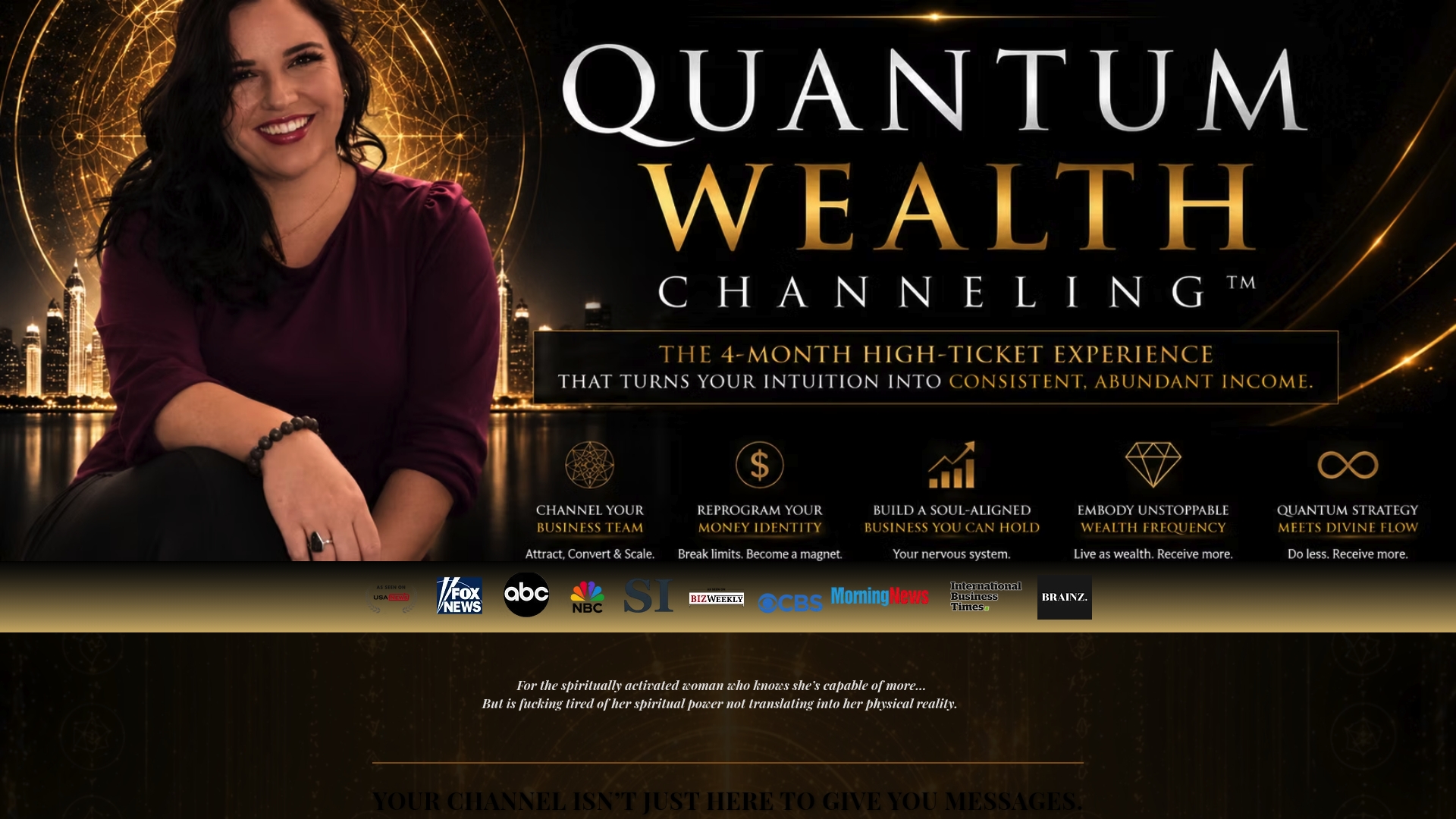
Quantum Wealth Channeling applies channel development directly to business and wealth decisions over a four-month program.
The Art of Divine Channeling Masterclass is a nine-month program built around developing a reliable, discerning channel from the ground up.
Intuitive Income Reset is an entry point for reconnecting intuition with income before committing to a longer program.
These paths suit intuitive women and spiritual entrepreneurs who want grounded discernment, not just more information. None of them promise a specific financial result; they build the skill of translating guidance into decisions you can stand behind. If structured, longer-term development is what you are after, Quantum Wealth Channeling is the place to start.
FAQ
What is an example of mediumship?
A common example is a mental mediumship session where the medium remains fully aware and relays specific names, memories, or physical descriptions tied to a deceased loved one, which the sitter then confirms or does not recognize. This differs from trance mediumship, where the medium’s own awareness steps back further during the communication.
Is channeling the same as mediumship?
No. Channeling is the broader term for receiving information from a nonphysical source, while mediumship is generally treated as one subcategory of channeling focused specifically on communication with deceased people.
Do channeling and mediumship require trance states?
Not necessarily. Many practitioners work while fully conscious, describing the experience as thoughts or images arriving alongside their own mind, and Noetic’s overview of channeling frames this as one end of a spectrum that runs from subtle intuition to deep trance.
Can one practitioner offer both mediumship and channeling?
Yes, and it is common. The clearest sign is whether the practitioner names which mode they are using and why, since a transparent bio or conversation before booking will usually tell you more than the label on the service itself.
What does research say about whether mediums are reliable?
Controlled studies have tested accuracy and consistency under blinded conditions, but research from the Windbridge Institute notes that the source of the information received remains unresolved, so specificity and consistency are more useful signals than any claim of proof.
Sources
Recommended
Comments