

4 Moves to Timeline Jumping in Under 10 Minutes for Women
Timeline jumping is an embodied practice of shifting your attention, energy, and behavior to inhabit a different, higher-frequency version of your life. It borrows the language of physics but functions as a manifestation practice: most of what people report is subjective, ranging from déjà vu to sudden shifts in circumstance, and the real work happens through repeatable steps rather than literal travel between universes. This guide covers the signs, the practice, the safety guardrails, and where science agrees or diverges.
TL;DR:
Timeline jumping is an embodied practice that involves shifting internal states through specific attention and behavior changes, not literal travel between universes.
Signs of a potential shift include déjà vu, collective misremembering, subtle environmental changes, and physical sensations, but these are subjective and pattern-based.
The practice emphasizes grounding methods like breathwork, sensory anchors, and sleep to prevent dissociation and avoid using it as a form of avoidance.
Scientifically, attention and embodiment influence perception and behavior, but there is no evidence supporting consciousness moving between parallel realities.
Guided support and clear ethical boundaries enhance safety and effectiveness, especially for deeper work in wealth, decision-making, or multidimensional leadership.
Table of Contents
What Is Timeline Jumping? Models, Metaphors, and Meaning
Ask ten practitioners what a “timeline” is and you will get ten metaphors pointing at the same idea. Some describe timelines as streams of energetic possibility running parallel to each other. Others call it an “event space,” a field of outcomes that hasn’t collapsed into fixed reality yet. A few use the image of a web, with each strand representing a version of your life built from a different set of choices, beliefs, and frequencies.
What they agree on is this: “becoming” a timeline is less about location and more about identity. You don’t travel to a new version of your life. You shift your internal state until you match it, and your circumstances reorganize around that match. Independent practitioner frameworks describe this as a sequence: choice, then attention, then frequency, then timeline. Your choices direct attention, attention shapes emotional frequency, and frequency is what teachers claim determines which version of reality you experience as “real.”
Teachers often reference an “access point,” a moment of unusual clarity, stillness, or emotional charge where the shift feels available. Some call the most aspirational version the “Golden Timeline,” shorthand for the highest-frequency life you can currently perceive.
Here is the distinction that matters most, and the one skeptics rightly push on:
Timeline jumping, as taught in this space, is an embodiment practice: changing internal state and behavior to access a different experience of life.
It is not a claim of literal teleportation between separate physical universes.
The “jump” describes a felt shift in identity and circumstance, not a measurable event in spacetime.
Holding that distinction is what separates grounded practice from magical thinking, and it’s the line this article stays on.
Signs You Might Be Experiencing a Timeline Shift
Most people who suspect they’ve shifted timelines describe a cluster of small, hard-to-explain moments rather than one dramatic event. The most commonly reported signs fall into four categories.
Déjà vu and memory mismatches. You recall a detail (a product name, a news event, a conversation) differently than everyone around you does. This is the closest thing to a studied phenomenon here. Déjà vu is a documented experience tied to how the brain processes recognition and memory, and it shows up constantly in accounts of shifting realities.
Mandela-effect-style collective misremembering. You and a friend both “remember” something the same wrong way, which practitioners read as evidence of a shift and skeptics read as a known quirk of shared memory formation.
Small environmental differences. A street sign in a different spot, a relationship dynamic that resolved faster than expected, a habit that suddenly feels easy instead of hard.
Synchronicities and physical sensations. Repeating numbers, chance meetings, or a wave of dizziness, tingling, or pressure that passes quickly and leaves a sense of “something moved.”
None of these prove anything on their own. What matters is the pattern over time, which is why a simple log is worth more than any single “sign.”
Pro Tip: Keep a one-line shift journal: date, what you noticed, your emotional state before it, and what you did differently that day. After a month, you’ll see whether shifts cluster around specific behaviors or moods, which is far more useful than chasing any single mysterious moment.
How to Start a Timeline Jumping Practice
The practice boils down to four moves, and you can do all four in under ten minutes: choose the timeline, embody it, take one aligned action, and integrate what happened. Independent teachers and mainstream coverage of the trend converge on a strikingly similar sequence: acknowledge where you are, choose what you want, keep the practice simple, and commit to it.
Choose with specificity. Vague desires produce vague results. Instead of “more abundance,” decide the exact scene: what you’re doing, wearing, saying, and feeling in the version of your life you’re choosing.
Embody before you act. Sit or stand the way that version of you would stand. Slow your breath to match calm rather than urgency. Speak one sentence out loud in the tone that person would use. This is the step practitioners cite most often as the one that actually anchors a shift, since bodily posture and sensory cues carry more weight than thought alone.
Take one small, real action. Send the email. Cancel the plan that doesn’t fit. Wear the outfit. The anchor behavior doesn’t need to be big; it needs to be evidence your body can register.
Integrate before you judge the result. Write one line about how it felt, not whether it “worked.” Judging too fast collapses the practice back into anxiety.
A few variations to fit into daily life:
A 5-minute morning version: embodiment posture plus one sentence of identity language before you check your phone.
An evening journaling prompt: “What did the version of me who already has this do today?”
A weekly review: scan your shift journal for repeating cues rather than isolated incidents.
The practice is deliberately low-tech. The consistency, not the complexity, is what makes it repeatable.
Grounding, Safety, and Integration
Any practice that plays with identity and perception needs a floor under it. Grounding keeps the work useful instead of dissociative.
Breathwork before and after any visualization or embodiment session, four counts in, six counts out, for one minute.
A body scan at the end of the day: name three physical sensations, out loud or in writing, to confirm you’re present in your actual body.
Sensory anchors: a specific scent, texture, or piece of music you use only for grounding, so your nervous system learns to associate it with “return.”
Movement and sleep on a normal schedule. Skipping sleep to chase a “shift” is a red flag, not a sign of progress.
Watch for signs that the practice has tipped into escapism: using timeline language to avoid a decision, blaming a “bad timeline” for problems that need direct action, or feeling disoriented for hours after a session. A critical look at the broader shifting community flags this exact risk, warning that timeline language can slide from helpful reframing into avoidance or self-blame when it replaces action instead of supporting it.
Pro Tip: If you finish a session feeling foggier, less present, or more anxious than before you started, stop the practice for a few days and return to basic grounding only. Consult a mental health professional if disorientation, dissociation, or distress persists beyond a session.
What Science and Philosophy Actually Say
The most borrowed piece of vocabulary in this space is “many worlds,” and it deserves a precise explanation. The Many-Worlds interpretation is a serious, decades-old framework in quantum physics. It proposes that all possible outcomes of a quantum event actually occur, each in its own branch. It is a real theory taken seriously by physicists.
It does not, however, offer any mechanism by which a person could consciously choose or steer which branch they experience. Practitioners use the term as a metaphor for possibility, not as a description of a technique with physical backing, and that distinction matters if you want to hold both curiosity and discernment.
The psychological explanations carry more direct relevance to what people actually report:
Attention shapes behavior. Focusing on a specific identity changes what you notice and act on, which changes outcomes, independent of any literal timeline shift.
Memory is reconstructive, not a recording. This is why two people can “remember” the same event differently, feeding Mandela-effect style reports.
Altered-state and memory research offers a framework for understanding subjective shift experiences without requiring literal parallel-universe travel as an explanation.
The practical takeaway: science supports the idea that attention and embodiment change behavior and perception. It does not support the idea that you are hopping between physical universes. Both things can be true at once, and holding that line is what keeps the practice useful.
Working With a Guide: A Structured Path Into Timeline Work
Timeline work goes deeper, faster, and safer with structured guidance, especially when it touches wealth identity, decision making, and the discernment required to trust your own perception. An experienced quantum channel and spiritual educator may treat channeling, discernment, and embodiment as one integrated skill rather than three separate practices.
For readers new to structured energetic work, an entry point like Intuitive Income Reset reconnects intuition with income decisions at low cost and low risk.
For those ready to apply channeling directly to wealth, business, and physical creation over time, Quantum Wealth Channeling builds the skill across four months.
Readers drawn to deeper channel development on its own, separate from a wealth focus, are better suited to The Art of Divine Channeling Masterclass as part of Shantana Telise’s established body of work.
Fit matters more than ambition here. The honest next step is a discovery conversation through the work with me page, not jumping straight to the most advanced offer.
Where the Idea Comes From: A Short History
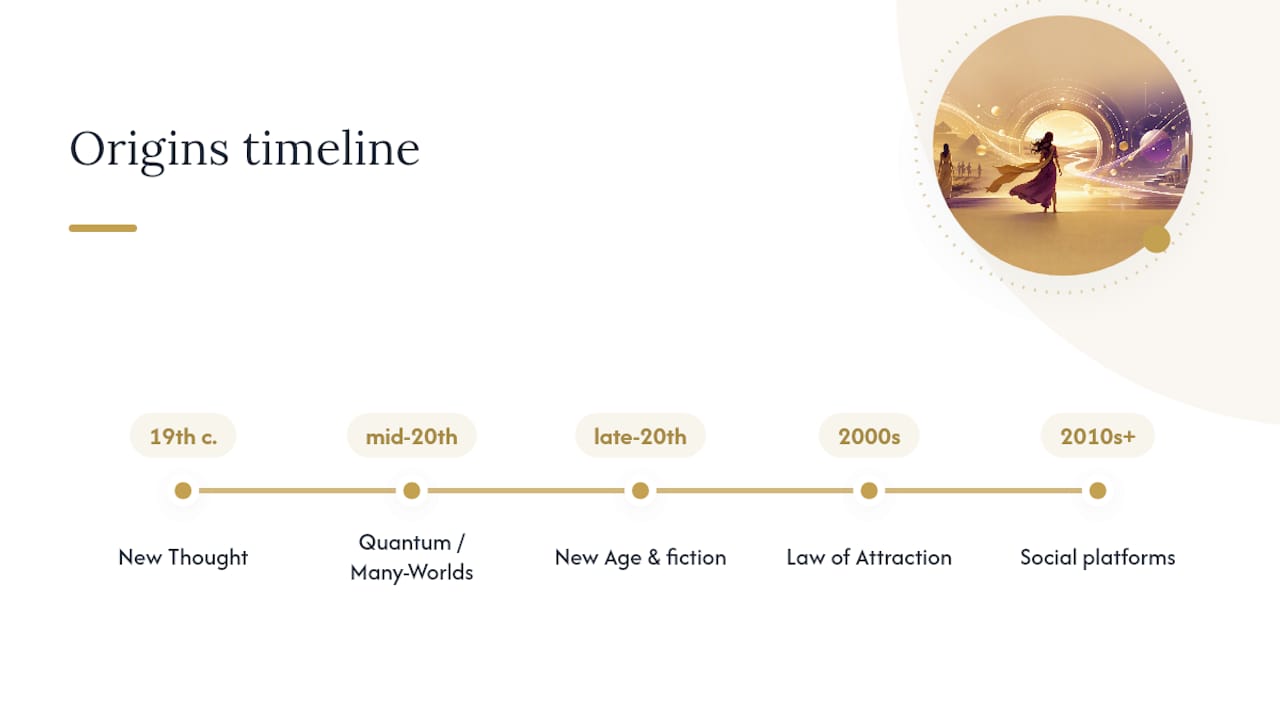
Timeline language did not appear from nowhere. Its roots run through several older traditions that all wrestle with the same question: is reality fixed, or is it responsive to consciousness?
Quantum physics gave the modern version its vocabulary starting in the mid-20th century, when the Many-Worlds interpretation entered academic circles as a real answer to unresolved questions about quantum measurement. New Age and metaphysical writers picked up the language decades later, blending it with older ideas from parallel-world science fiction and Eastern concepts of maya, the idea that ordinary reality is a layer over something more fluid.
The New Thought movement of the 19th and early 20th centuries laid separate groundwork, teaching that belief and mental focus shape material circumstances long before anyone used the word “quantum” to describe it. Law of Attraction writing in the early 2000s carried that thread forward into mainstream self-help.
Timeline jumping as a distinct, named practice is a more recent synthesis, gaining visibility through social platforms where practitioners distilled it into shareable steps. Coverage of the trend traces how it spread through social sharing and practitioner storytelling, turning a dense mix of physics metaphor and manifestation philosophy into something people could try in a five-minute morning practice. The through line across a century of these traditions is consistent: attention and belief are treated as active forces, not passive observations, in how a life unfolds.
Risks and Ethical Considerations Worth Naming
The biggest risk in timeline work is not physical. It’s the way the language can be misused to avoid responsibility or dismiss real hardship.
Calling a difficult season a “lower timeline” can quietly shift blame away from decisions that need to change. Analytical reviews of the broader shifting community flag this exact pattern: timeline language can slide from supportive reframing into spiritual bypass when it explains away a problem instead of prompting action on it.
There’s also a social risk. Telling someone their circumstances (illness, poverty, a difficult relationship) are simply “a timeline they’re choosing” can read as victim-blaming, even when that’s not the intent. Discernment means knowing when a situation calls for compassion and practical support, not a reframe.
A few guardrails worth holding:
Use timeline language to expand options, never to explain away accountability, yours or someone else’s.
Be cautious applying this framework to someone else’s hardship uninvited. It’s easier to hold for your own life than to project onto another person’s.
Notice if the practice becomes a substitute for decisions you’re avoiding, like ending a relationship, changing jobs, or seeking medical care.
Keep financial claims grounded. No practice, including this one, guarantees a specific financial outcome, and any teacher who promises one deserves skepticism.
Ethical timeline work stays in service of clearer decisions and more grounded action. The moment it starts replacing both, it’s worth stepping back.
What Practitioners Actually Report
Community accounts of timeline work are consistent in shape even when the details differ. Public threads compiling personal experiences show a recurring pattern: small environmental differences, sudden synchronicities, and shifts in identity that build gradually rather than arriving as one dramatic event.
A typical account looks something like this: someone commits to an embodiment practice around a specific goal, say, feeling secure in their business decisions. Over several weeks, they notice they’re negotiating differently, saying no to clients faster, and no longer replaying old money anxieties before bed. Nothing “teleported.” Their behavior changed first, and their circumstances followed.
Other reports lean more mystical: a specific dream, a stranger who says an oddly relevant sentence, a sudden clarity about a decision that had felt stuck for months. These are harder to verify and easier to over-interpret, which is exactly why a shift journal matters more than memory alone. Journaling and tracking help separate a single memory glitch from a repeated, integrative pattern worth paying attention to.
None of this constitutes evidence in a scientific sense. It constitutes a pattern of lived experience that practitioners find meaningful enough to keep practicing, which is a different and more modest claim than proof.
Timeline Jumping vs. Parallel Universes and Time Travel
These three concepts get flattened together constantly, and separating them clears up most of the confusion people have walking into this topic.
Time travel, in both physics and fiction, means moving your physical body or consciousness to a different point on a single timeline, the past or future of the one reality you’re already in. Nothing in timeline jumping practice claims this. No one is suggesting you visit next Tuesday.
Parallel universes, per the Many-Worlds interpretation, are a proposed physical structure: every possible outcome of every quantum event actually happens, each in its own separate branch of reality that you never perceive or access. It’s a claim about the structure of the universe, not a technique.
Timeline jumping, as practiced here, is neither. It’s a claim about internal state: that shifting your attention, emotional frequency, and behavior changes which version of your life you experience as real, without any assertion about branching universes or physical travel. It’s closer to focused intention and behavior change dressed in evocative language than to either physics concept it borrows from.
Confusing these three is where skeptics get their strongest ammunition, and where practitioners sometimes overclaim. Being precise about which claim you’re actually making protects the credibility of the practice itself.
A Practitioner’s Note on Integration
I think of one client who spent months certain she’d “jumped” into a harder version of her business, until we traced it back to a single unaddressed pricing decision she kept avoiding. The shift she needed wasn’t dimensional. It was a conversation she’d been postponing for weeks.
Try this prompt tonight: “What decision have I been calling a timeline problem?” If you want structured support working through what surfaces, a guided community space can hold that better than journaling alone.
— Shantana Telise
Ready to Go Deeper? Guided Paths for Timeline and Wealth Work
Journaling and solo practice take you far, but channeling, discernment, and wealth identity work compound faster with structure and a trained guide holding the space.
[

If you’re new to this work and want a low-cost way to test the waters, Intuitive Income Reset is an entry point for reconnecting intuition with income decisions. For a fuller container, Quantum Wealth Channeling runs four months and applies channeling directly to wealth, business, and physical creation, with Core and VIP access levels depending on how much direct support you want. Those ready for a more intensive, longer initiation into multidimensional leadership and wealth can look at Portal of the Gods, a ten-month program built for spiritually activated women ready to work at that depth. The most reliable next step is simple: start with the work with me page to see which path actually fits where you are right now.
Sources
For deeper context beyond this article, see the Many-Worlds interpretation, déjà vu research, and transpersonal healing approaches.
FAQ
How Do I Know If I’ve Jumped Timelines?
There’s no verifiable test, but practitioners point to clusters of signs: déjà vu, small environmental differences, synchronicities, or a physical sensation like dizziness that passes quickly. A shift journal tracking these over weeks tells you more than any single moment does.
What Does It Mean to Have a Timeline Jump?
A timeline jump describes a felt shift in identity and circumstance after changing your attention, emotional state, and behavior, not a literal move between physical universes. Most practitioners frame it as an embodiment and manifestation practice rather than a physics event.
Are Timeline Jumps Real?
The subjective experiences people report, like déjà vu and shifts in circumstance, are real in the sense that people genuinely have them, and some are grounded in documented memory processes. The claim that consciousness physically travels between parallel universes has no scientific support, since the Many-Worlds interpretation doesn’t include a mechanism for anyone to steer between branches.
What Is Skipping a Timeline?
Skipping a timeline is another term for the same practice: shifting attention and behavior quickly enough that you seem to bypass a difficult stretch and land directly in a more aligned circumstance. It describes an internal and behavioral shift, not a jump through physical time or space.
Does Shantana Telise Healing Offer Timeline Jumping Guidance?
Yes, timeline and channel work are built into Shantana Telise’s programs, particularly Quantum Wealth Channeling and Portal of the Gods. Current pricing and program details are available on the Shantana Telise Healing site.
Recommended
Comments