

7 Day Throat Chakra Plan to Find Your Voice With Channeling Support
Yes, you can heal and stabilize your throat chakra, and the most useful practices are also the simplest: breath work paired with the HAM sound, a short neck or yoga reset, and one small act of honest self-expression. None of this requires hours. What it requires is showing up daily, because five focused minutes practiced consistently outworks one long ritual done once a month.
TL;DR:
Underactive throat chakras often manifest as difficulty expressing opinions, social anxiety, and physical symptoms like sore throats or neck tension, especially before speaking.
Practices like chanting HAM, lion’s breath, and neck stretches are most effective when done daily for five minutes, starting with simple routines.
Grounding exercises such as gentle neck tilts, yoga poses, and using crystals or oils can help release physical tension tied to emotional blocks.
Lighter self-expression exercises, including journaling and speaking micro-acts of courage, support long-term energetic balance and confidence.
Red flags such as persistent sore throats, swallowing pain, or neck lumps necessitate consulting a healthcare professional before energetic work.
Table of Contents
What Is the Throat Chakra and What Does Imbalance Look Like?
Is Your Throat Chakra Blocked or Overactive? A Quick Self-Check
Yoga and Neck Work: Releasing Physical Tension at the Throat
Crystals, Oils, and Everyday Tools for Throat Chakra Balance
When Throat Chakra Symptoms Need a Doctor, Not Just a Practice
What Is the Throat Chakra and What Does Imbalance Look Like?
The throat chakra, called Vishuddha in the yogic tradition, sits at the base of the neck and governs how honestly you speak your truth. It is tied to communication, voice, and the courage to say what you actually mean instead of what keeps the peace. Its color is blue, which is why so many throat chakra healing rituals lean on that shade, whether through crystals, clothing, or visualization.
Imbalance tends to move in one of two directions. An underactive throat chakra shows up as withholding: swallowed opinions, social anxiety before speaking up, a creative block that never quite lifts. An overactive one looks like the opposite problem, over-talking, interrupting, dominating conversations without really hearing the other person.
Physical correlates often ride along with the energetic pattern, and Healthline’s rundown of throat chakra healing practices connects several of them directly to Vishuddha:
Chronic sore throat or recurring hoarseness with no clear medical cause
Jaw tightness or TMJ that flares during stressful conversations
Neck tension that seems to migrate with emotional stress
Thyroid complaints that coincide with periods of suppressed expression
These correlations are worth noticing, not diagnosing. A sore throat that lingers for weeks belongs in a doctor’s office first. But if you notice a pattern where your throat tightens right before you’re about to say something true and hard, that’s worth paying attention to on the energetic level, too.
Is Your Throat Chakra Blocked or Overactive? A Quick Self-Check
Before choosing which throat chakra healing practices to prioritize, it helps to know which direction your imbalance leans. Run through these eight prompts and answer honestly, not the way you wish were true.
Do you rehearse conversations in your head but rarely say what you actually rehearsed?
Do you feel a lump in your throat when a difficult topic comes up?
Do people describe you as quiet, even when you have strong opinions?
Does your voice get tired or hoarse after ordinary amounts of talking?
Do you interrupt others often or dominate group conversations?
Do you struggle to listen without planning your next point?
Is your neck or jaw tense by the end of most days?
Do you avoid speaking up even when something feels unfair?
If you answered yes to questions 1 through 4 more than 5 through 8, your throat chakra likely leans underactive, and your practice should emphasize expression: chanting, journaling, and small courageous speech acts. If 5 through 8 dominate, lean into listening exercises and grounding breath before you speak. A recurring lump-in-throat sensation or chronic hoarseness that shows up regardless of your answers deserves a conversation with a doctor, not just a meditation cushion.
Breath, Sound, and Voice: The Core Healing Practices
These four practices form the backbone of most throat chakra healing routines, and they work because they target the physical throat and the emotional pattern at the same time.
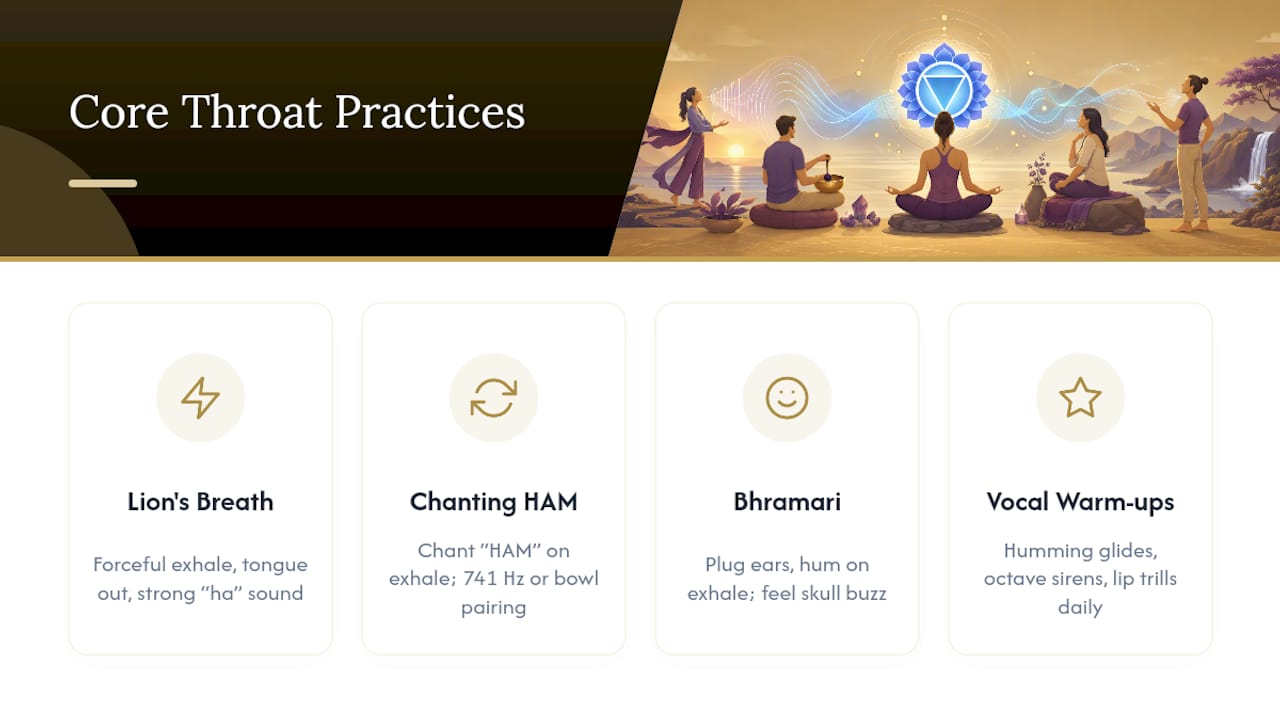
Lion’s breath (Simhasana). Sit tall, inhale deeply through the nose, then exhale hard through the mouth while sticking your tongue out toward your chin, opening your eyes wide, and making a strong “ha” sound. Repeat several times. Art of Living recommends this pose alongside Cat-Cow and Fish as part of restoring upward energetic flow through Vishuddha. Skip or soften this one if you’re prone to dizziness or manage high blood pressure, since the forceful exhale and eye-widening can spike sensations for some people.
Chanting HAM. This is the bija, or seed mantra, associated with the throat chakra. Sit with a straight spine, inhale, and chant “HAM” (rhymes with “mom”) on the exhale, letting the sound vibrate at the base of your throat rather than forcing volume. Start with a short time and build gradually as it feels natural. Some practitioners pair the chant with a tuned external tone, like a 741 Hz frequency or a G-note singing bowl, which gives beginners who can’t sustain a long chant something to vibrate against instead.
Bhramari, or bee breath. Close your eyes, plug your ears gently with your thumbs, and hum steadily on the exhale, feeling the buzz move through your skull and throat. A few rounds work well as a reset between meetings or before sleep.

Vocal warm-ups. Humming glides (sliding your hum from a low note to a high one), gentle octave sirens, and lip trills rebuild comfort with your own voice outside of any spiritual framing. A few minutes daily can help notice a difference in how your voice feels within days.
Pro Tip: If chanting HAM feels awkward at first, do it in the shower. The water sound gives you cover, and the acoustics make the vibration easier to feel.
Yoga and Neck Work: Releasing Physical Tension at the Throat
The throat chakra doesn’t just live in the mind. It lives in the cervical spine, the jaw, and the muscles that clench when you swallow words instead of saying them.
Cat-Cow. On hands and knees, alternate arching and rounding your spine, letting your head follow the movement naturally rather than forcing it up or down.
Fish pose (Matsyasana). Lying on your back, arch gently through the upper back and let the crown of your head touch the floor, opening the front of the throat. Keep the movement small if your neck feels tight.
Camel pose (Ustrasana). Kneeling, hands on your lower back, lift the chest and let the head drop back only as far as feels supported. This one asks for care.
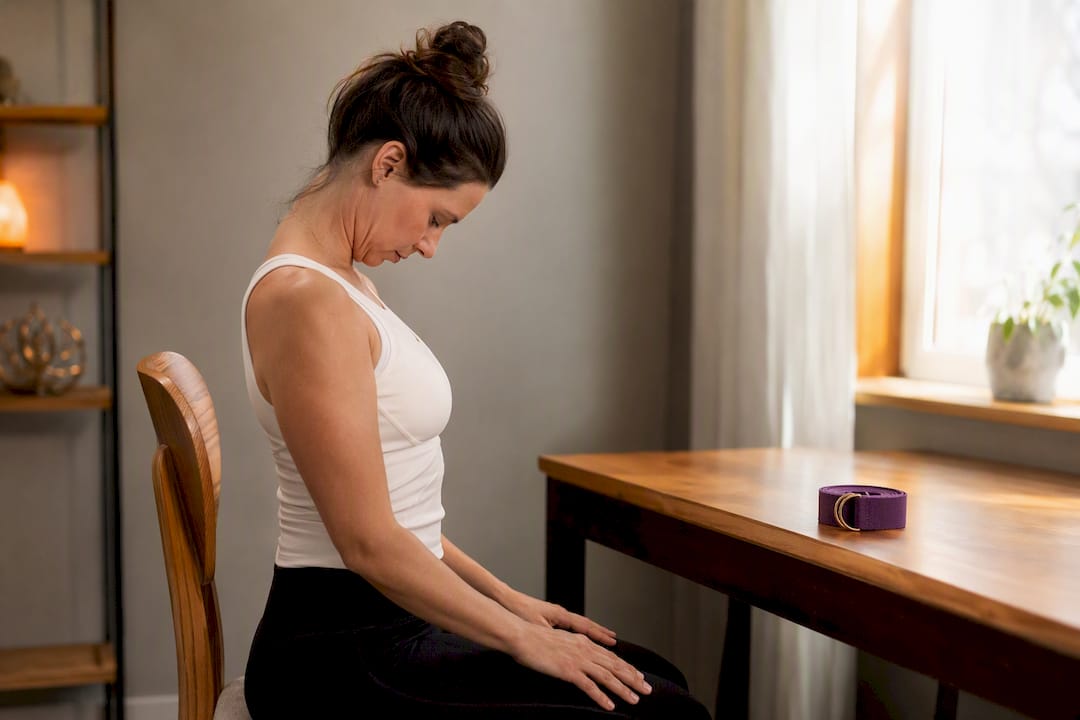
Chin tucks and gentle neck tilts. Slowly drop your ear toward one shoulder, hold for a few breaths, then switch sides. Follow with a chin tuck, drawing your head straight back like you’re avoiding a low doorway.
Posture matters more than depth here. Keep the cervical spine neutral rather than hyperextending backward, and stop the moment you feel pinching rather than stretching. Anyone managing thyroid conditions or cervical spine issues should skip deep neck extensions and inversions altogether, or ask a qualified instructor for a modification, since aggressive neck extension can aggravate existing cervical problems rather than release them.
Pro Tip: Do the chin tucks and neck tilts at your desk. You don’t need a mat to release the muscles that tighten every time you bite back an honest sentence.
Crystals, Oils, and Everyday Tools for Throat Chakra Balance
Supportive tools won’t do the deeper work alone, but they make the daily practice easier to remember and stick with.
Lapis lazuli, aquamarine, and blue lace agate are the crystal allies most often recommended for Vishuddha. Wear one as a pendant near the throat, hold it during meditation, or simply set it on your desk where you’ll see it before a hard conversation.
Peppermint, chamomile, and frankincense essential oils are commonly used for throat comfort. Diffuse them rather than applying peppermint directly to skin near the throat, since it can irritate mucous membranes at full strength.
Hydration and warm teas, particularly chamomile or licorice root, soothe the physical throat and make daily chanting more comfortable.
Blue and purple foods, like blueberries and purple cabbage, are a simple, low-effort way to build a visual and dietary connection to the chakra’s color association.
None of these substitute for the breath and voice work above. Think of them as scaffolding around the real practice, not the practice itself.
Turning Energy Work Into Real Self-Expression
Balancing the throat chakra only matters if it changes how you actually speak, which is why expressive practice belongs alongside breath and sound work rather than after it.
Journal three prompts weekly. Write about a truth you’ve been withholding, one thing you’re grateful you finally said out loud, and one small courageous sentence you’ll speak tomorrow.
Practice micro-exposure speaking. Script a one to three minute statement, something as small as disagreeing with a coworker’s plan, and say it out loud alone before you say it to the person.
Balance voice with active listening. After you speak up once, ask a genuine follow-up question and let someone else finish their point without interrupting. This matters especially if your self-check pointed toward overactive patterns.
Combining vibration work like chanting with these behavioral exposures tends to build confidence faster than ritual practiced in isolation, because the nervous system gets evidence that speaking up doesn’t backfire.
A Simple 7-Day Plan to Start Opening Your Throat Chakra
Short, structured weeks work better than vague intentions. This one asks for roughly 10 to 15 minutes a day, mixing breath, sound, movement, and expression.
Day 1: Five rounds of lion’s breath plus a two minute journaling prompt on a withheld truth.
Day 2: Chin tucks and neck tilts, then chant HAM for three minutes.
Day 3: Bhramari humming for five rounds plus one micro-exposure speaking script.
Day 4: Cat-Cow and Fish pose, followed by vocal warm-ups (humming glides, lip trills).
Day 5: Chant HAM for five minutes with a blue lace agate or lapis lazuli held at the throat.
Day 6: Camel pose (modified if needed) plus an active-listening conversation with no interrupting.
Day 7: Repeat lion’s breath and journal on what shifted over the course of the practice.
Expect noticeable relief in tension and voice ease within days, but treat the deeper emotional shift as a matter of weeks, not one week. Once the seven days are done, repeating a lighter version two or three times weekly keeps the gains rather than letting them fade.
When Throat Chakra Symptoms Need a Doctor, Not Just a Practice
Energy work is a companion to medical care, never a replacement for it. Certain symptoms are red flags that call for a clinician before a chant.
Hoarseness lasting more than two to three weeks
Difficulty swallowing, or pain that worsens with eating
Rapid or unexplained changes tied to thyroid function
A lump or swelling in the neck that doesn’t resolve
When you do bring this up with a doctor, plain language works best: “I’ve noticed throat tightness that seems tied to stress and difficulty speaking up. I’m also doing some breathing and relaxation practices alongside it.” That framing keeps the conversation honest without asking a physician to weigh in on energy work they may not practice.
If you choose to work with an energy practitioner, expect a session that includes some form of guided breath, sound, or channeled dialogue aimed at where you feel blocked, and look for someone who is transparent about their training and comfortable working alongside your existing medical care rather than instead of it.
How Shantana Approaches Throat Chakra Healing
Breath and mantra work address the mechanics of the throat chakra. What often gets missed is the layer underneath: the identity you built around staying quiet, or around being the loudest voice in the room because silence once felt dangerous. That’s the layer multidimensional channeling is built to reach.
Shantana’s sessions use channeled guidance to locate where a client’s voice got shut down long before any yoga pose could address it.
The work pairs energetic recalibration with practical embodiment, so a session doesn’t end at insight. It ends at a client feeling the shift in her actual voice.
A typical arc moves from identifying the original block, through releasing it energetically, toward a grounded next step the client can practice in daily life.
A guided session tends to accelerate what solo practice builds slowly, particularly for women who feel stuck in a pattern they can name but haven’t been able to shift alone.
— Shantana
Ready for Guided Support With Your Throat Chakra Work
Daily practice gets you far. A guided session gets you further, faster, especially when the block you’re facing isn’t really about breathing technique but about a story you’ve been carrying about your own voice. Shantanatelisehealing offers a channeled healing and guidance session built specifically for this kind of work: identifying where self-expression got shut down and clearing it at the energetic root rather than just managing the symptoms.

If your throat chakra imbalance feels tangled up with bigger questions about purpose or a pattern you can’t quite name, the Divine Energy Alignment Package offers a deeper, multi-session path rather than a single reset. Sessions typically involve channeled dialogue and energetic recalibration focused on where you’re holding back, with practical steps you carry into daily life afterward. Book a session directly through the channeled healing page to find a time that works for you.
Where to Learn More About Throat Chakra Healing
For readers who want to go deeper on any single practice, a few outside guides are worth bookmarking. Healthline’s throat chakra guide offers a medically grounded rundown of nine practical techniques. Art of Living connects breath and yoga to emotional patterns like gratitude versus grief. Chakra Serenity digs into sound healing specifics, including frequency work. Esoteric Universe covers crystal pairings and breath techniques in more detail.
Sources
Throat Chakra Healing: How to Unblock for Better Health — Healthline
The Throat Chakra: Discover and Balance the Fifth Chakra — Art of Living
Unlock Your Voice: 9 Powerful Ways to Open Your Throat Chakra — Chakra Serenity
Opening Throat Chakra: Healing Vishuddha for Clear Communication — Esoteric Universe
Recommended
Comments