

5 Clinically Grounded Steps to Heal the Mother Wound for Women
Mother wound healing means retiring old operating assumptions about worth and intimacy and replacing them with reliable inner caregiving. It is possible, and attachment research along with modalities like Internal Family Systems and somatic therapy back that up. The practical sequence, naming the pattern, grieving what was missing, reparenting yourself, and setting boundaries, is covered step by step below.
TL;DR:
The mother wound often manifests as deep-seated assumptions about worth and intimacy, rooted in childhood emotional neglect, criticism, or enmeshment.
Healing requires a step-by-step process that includes naming the pattern, grieving unmet needs, reparenting oneself, setting boundaries, and practicing relational new patterns.
Signs in adulthood include chronic self-criticism, boundary issues, difficulty receiving care, and relationship triggers like panic or sabotage.
Matching therapy modalities such as attachment-focused therapy, somatic work, or Internal Family Systems can effectively target different layers of the wound depending on individual needs.
Contact with a wounded mother should be evaluated based on safety, her willingness to change, reciprocity, and capacity, with boundaries or grief as appropriate responses.
Table of Contents
What Is the Mother Wound, Exactly?
The mother wound isn’t in the DSM. You won’t find it as a diagnosis code, and no therapist will bill your insurance for it. But the pattern it describes maps cleanly onto three things clinicians study closely: insecure attachment, childhood emotional neglect, and parentification, where a child takes on a caretaking or emotional-management role that belongs to an adult. Simply Psychology’s clinical overview frames it as the lasting imprint left when maternal care was absent, conditional, critical, engulfing, or unprotective.
Here’s the distinction that matters most: the wound rarely lives in your memory as a single event. It lives as an operating assumption. “Intimacy is a threat.” “My needs are too much.” “If I stop performing, I’ll be abandoned.” These aren’t conclusions you reasoned your way into as an adult. They’re defaults installed before you had language to argue with them, which is exactly why Simply Psychology notes that the wound shows up as pattern, not as episodic recall.
One more thing worth naming gently: mothers who wounded their daughters were very often shaped by mothers who did the same to them. That context doesn’t excuse harm, and it doesn’t require you to forgive anyone. It just helps explain why the pattern repeats without anyone consciously choosing it.
How Does the Mother Wound Actually Form?
A handful of family dynamics show up again and again in the clinical literature: emotional absence (a mother physically present but unreachable), conditional warmth (love that had to be earned through achievement or compliance), chronic criticism, enmeshment or parentification (where the child manages the mother’s emotions instead of the reverse), and unprotected experiences, meaning the mother failed to shield the child from harm, including harm from others.
The neurodevelopmental piece is simpler than it sounds. A young child’s nervous system calibrates itself against the caregiving it receives, not against some ideal. If comfort is unpredictable, the child’s system learns that closeness is unreliable and starts anticipating rejection before it happens. That anticipation becomes automatic. By adulthood it doesn’t feel like a learned response. It feels like the truth.
Picture a woman who grew up praised only for good grades and quiet obedience. She learned early that visibility had a price tag. Or picture a girl who became her mother’s confidante for marital problems at age nine. She learned that her role was to manage other people’s feelings, never her own. Neither woman remembers a single traumatic day. They remember a climate.
How Does the Mother Wound Show Up in Adulthood?
The mother wound rarely announces itself directly. It shows up sideways, in reactions that feel disproportionate to whatever triggered them, and in relationship patterns that repeat no matter who the other person is.
Common signs include:
Chronic self-criticism that activates even after clear success
People-pleasing that overrides your own preferences almost automatically
Difficulty receiving care, comfort, or compliments without deflecting them
Boundary issues, either rigid walls or none at all
Intimacy triggers: panic, numbness, or the urge to sabotage closeness right when it deepens
Verywell Mind’s clinical reporting confirms these as the signs therapists see most often, alongside low self-esteem and a persistent sense of not being enough.
The ripple effects touch nearly every relationship you have. In parenting, it might show up as overcorrecting, being so afraid of repeating the pattern that you swing into permissiveness that leaves your own child ungrounded. In friendships, it can look like being the fixer who never asks for help back. In romance, it often means either merging so completely with a partner that you lose your own outline, or keeping one foot out the door so you’re never caught off guard by abandonment again. At work, it frequently reads as overachievement chasing a sense of worth that never quite lands.
Try this quick self-check. Ask yourself three things: When someone offers me help, is my first instinct to refuse it? When I set a boundary, do I feel guilty before I even finish the sentence? When a relationship gets close, do I look for the exit before anything has gone wrong? If two or more of those land uncomfortably close to home, the mother wound may be part of your story, not just a personality quirk.
What Is the Practical Sequence for Healing the Mother Wound?
The clinically grounded sequence runs Name, then Grieve, then Reparent, then Boundary, then Practice. Each stage builds on the one before it, and skipping ahead (going straight to boundaries without grief, for instance) often causes healing attempts to stall.
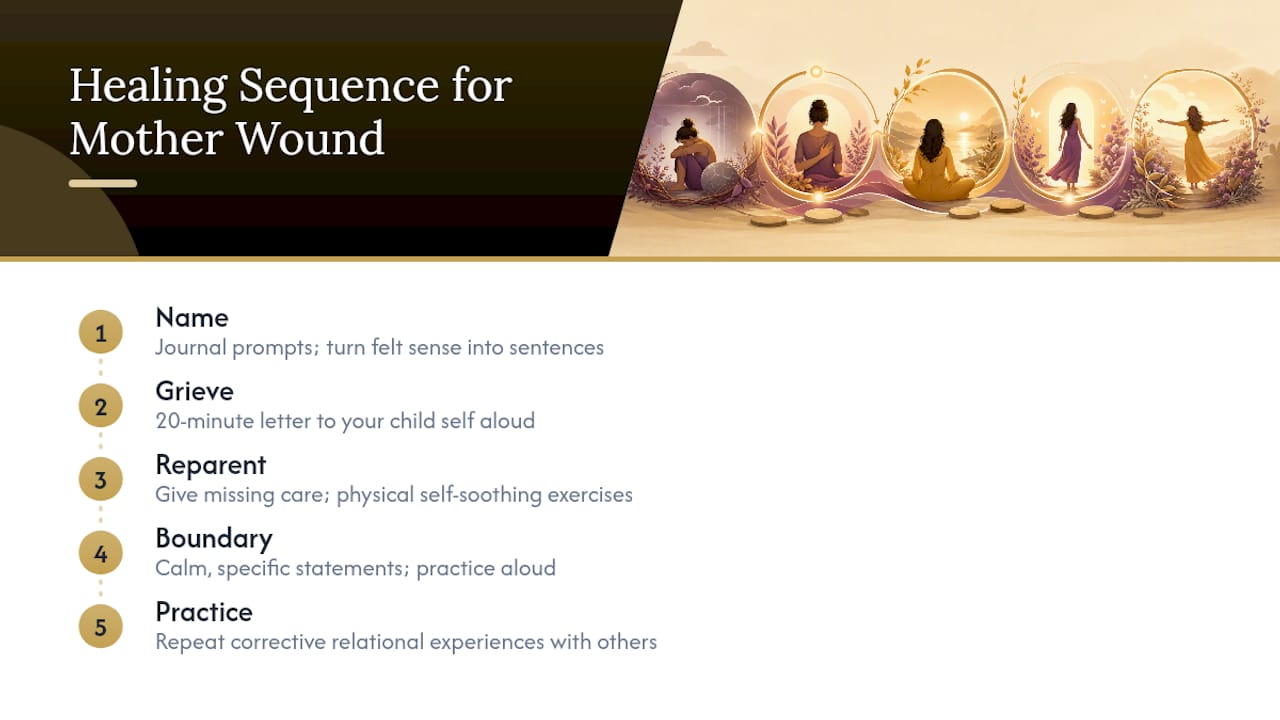
1. Name the pattern. You can’t dismantle an assumption you haven’t identified. Journal on specific prompts rather than vague ones: “What did I learn I had to do to be loved?” “What emotion was never allowed in my house?” “What do I assume will happen if I disappoint someone I love?” Write the answers as sentences, not fragments. Naming turns a felt sense into language you can actually work with.
2. Grieve what didn’t happen. This is the stage most people try to skip, and it’s the one therapist-written guidance points to as essential: grieving the mother you needed and didn’t get, separate from the mother you actually had. A simple ritual helps here. Set aside twenty uninterrupted minutes. Write a letter to the child version of yourself, describing what she needed and didn’t receive. Read it aloud. Let whatever comes up, anger, sadness, relief, move through you without editing it. This isn’t about blame. It’s about acknowledging a real loss so it stops operating underground.
3. Reparent yourself. Reparenting means deliberately giving yourself what was missing. If you never heard “you don’t have to earn rest,” start saying it to yourself, out loud, in your own voice, especially in moments when the old guilt spikes. Self-soothing exercises work best when they’re physical, not just cognitive: a hand on your chest, a warm cup of tea taken slowly, a five-minute pause before responding to a stressful text. The goal is to become a source of steady, unconditional regard for yourself, since earned security is a documented outcome of exactly this kind of consistent internal repair.
4. Set boundaries. Boundaries fail when they’re delivered as ultimatums built on unprocessed anger. They tend to work better as calm, specific statements. Try: “I’m not able to talk about my weight. I’ll change the subject if it comes up.” Or, with a friend who over-relies on you: “I care about you, and I can’t be your only support right now.” Practice saying these sentences alone, out loud, before you ever need them in real time.
5. Practice corrective relational experiences. Healing isn’t complete in isolation. Clinical guidance emphasizes practicing new relational patterns, letting someone show up consistently and letting yourself believe it, staying present during conflict instead of fleeing, receiving help without immediately reciprocating. Each repetition slowly overwrites the old default.
For somatic grounding between these stages, a slow body scan, feet pressed into the floor, breath counted to a slow four count, helps regulate the nervous system before you attempt anything emotionally demanding.

Pro Tip: Track your distress on a simple 1 to 10 scale before and after any grief or reparenting exercise. If it climbs above a 7 and doesn’t come back down within twenty minutes, stop the exercise and reach for grounding, or contact a therapist rather than pushing through alone.
Safety matters here more than momentum. If a memory surfaces that feels overwhelming, or if you notice dissociation, numbness that lasts hours, or intrusive thoughts, pause the self-guided work and bring it to a licensed professional. This sequence is a strong starting framework, not a replacement for clinical support when the material runs deep.
Which Therapy or Body-Based Approach Fits You Best?
Different modalities target different layers of the wound, and matching the right one to your situation saves months of frustration.
Attachment-focused therapy works directly on the relational patterns formed in early caregiving, useful if your struggles center on trust and closeness in current relationships.
Internal Family Systems (IFS) treats the psyche as made up of distinct “parts,” helpful when you notice conflicting internal voices, like one part that people-pleases and another that resents it.
Trauma-informed CBT targets the automatic thoughts and behavioral loops the wound generates, a good fit if you want structured, skills-based work.
EMDR processes specific traumatic memories that feel stuck, often useful alongside talk therapy rather than instead of it.
Somatic therapies work through the body directly, which matters because research on relational trauma shows early attachment wounds are stored partly outside conscious, verbal memory. A clear guide to somatic therapy breaks down how these body-based methods access what talk alone often can’t reach.
Thriveworks’ clinical overview lists these as the modalities most commonly recommended for mother-wound work specifically. When you’re evaluating a therapist, ask directly about their experience with attachment injuries and parentification, not just general family issues. A therapist who can name the difference between reactive parenting and relational trauma is usually further along the learning curve you need.
Some signs call for immediate professional attention rather than self-guided work: severe dissociation, self-harm, or suicidal ideation. If you’re in crisis or fear for your safety, the 988 Lifeline is available around the clock.
Should You Repair, Renegotiate, or Limit Contact With Your Mother?
There’s no universal answer here, and no confrontation is required for healing to happen. Verywell Mind’s reporting is clear that repair, when it’s attempted, works best in bounded, low-stakes conversations rather than dramatic reckonings.
Weigh four factors before deciding your approach:
Capacity: Is she cognitively and emotionally able to hear feedback without collapsing or retaliating?
Reciprocity: Has she ever taken responsibility for anything, even something small?
Safety: Does contact put you at emotional or physical risk?
Willingness to change: Has she shown any actual behavior shift, not just an apology?
If the answers lean positive, a bounded script might sound like: “I need you to not comment on my parenting when you visit. If it happens, I’ll end the visit early.” If repair genuinely isn’t possible, the healing work shifts toward grief and self-protection: mourning the relationship you wished for, and building your support system elsewhere rather than waiting for change that may never come.
Where Can You Find More Support?
Discovering the Inner Mother by Bethany Webster is a widely recommended starting point, built specifically around reparenting and grief work rather than general self-help advice; you can find it through Bookshop.
When choosing a therapist, ask about specific training in attachment work or somatic methods, not just years in practice. A short checklist: Do they name attachment or parentification unprompted? Do they describe a clear approach to grief work? Do you feel steadier, not smaller, after a first consultation? Understanding how emotional connection actually develops in relationships can also help you evaluate whether a prospective partner or friend is capable of the reciprocity you’re building toward.
If you are in crisis, call or text the 988 Lifeline immediately.
Where Energetic Work Fits Into the Healing Picture
Talk therapy and body-based clinical work are where I always tell women to start, especially if there’s real trauma, dissociation, or safety risk involved. That’s not a caveat. It’s the foundation everything else sits on.
What I’ve come to understand through years of guiding women through embodiment work is that some of the wound lives below where language can reach it, a held breath, a flinch, a body that braces before closeness even begins. One client described it as feeling her shoulders drop for the first time in a session, as though she’d been bracing since childhood without realizing it. That’s the layer energetic and embodiment practices are built to address, alongside clinical care, never instead of it.
— Shantana
Ready to Go Deeper Than Journaling Alone?
If you’ve worked through naming, grief, and reparenting on your own and you’re still feeling stuck in your body, that’s usually a sign the next layer of healing needs guided support, not more willpower. This work supports women who are past the insight stage, ready for the felt-sense shift that makes the new pattern actually stick.

The Quantum Energy Alignment Package is built for one-on-one energetic recalibration, useful if you want focused support around a specific pattern, like the intimacy triggers or self-worth loops covered above. Women stepping into deeper embodiment work often start with the Warrior Goddess Embodiment Program, a group setting for reclaiming personal power alongside others doing the same work. Either path starts with a short consultation to map what your nervous system is actually asking for. If you’re ready to move past insight and into integration, book a session and take that first step.
This article is general information, not a substitute for advice from a qualified doctor. Consult a qualified healthcare professional about your own circumstances before acting on anything here.
Sources
Recommended
Comments