

Practice Ready Energetic Boundaries for Empaths With a Practitioner Tip
The fastest way to protect your energy is to picture a clear container around your body, silently say “this is mine to feel, that is not,” and take three slow breaths that push your awareness back into your own skin. Do it right now, before you read another line, if someone’s mood is still sitting in your chest. That thirty-second reset, followed by a ten-minute walk away from screens and other people, is often enough to interrupt the absorption cycle before it turns into a headache or a day-long fog.
TL;DR:
Limiting exposure to emotionally draining environments and digital inputs reduces the risk of empathy overwhelm and chronic fatigue.
Daily practices like grounding rituals, quick visualizations, and setting clear boundaries are essential to maintain energetic separation.
Guilt often hinders boundary setting, but reframing boundaries as informational rather than rejection helps empaths hold their limits effectively.
Supportive, self-regulation-capable partners are vital, especially those who do not test boundaries or rely on emotional dumping.
When habitual boundary tools fail, deeper energetic recalibration or guided healing sessions may be necessary to address root-level patterns.
Table of Contents
What Are Energetic Boundaries for Empaths?
An energetic boundary is the felt line between what belongs to you and what belongs to someone else, emotionally and physically. It is not a wall you build once. It is closer to a container with a door you control, the kind that lets warmth in and lets you decide what leaves.
Personal boundaries and emotional boundaries usually get talked about in terms of behavior: you say no to a request, you leave a bad conversation, you set a curfew for a difficult relative. Energetic boundaries live one layer underneath that. They govern what you absorb before you have even decided how to respond. An empath can say “no” perfectly and still walk away carrying a coworker’s anxiety in their stomach for the rest of the afternoon. That is a failure of the energetic layer, not the verbal one.
You know your boundaries are thin when you notice:
Sudden fatigue or heaviness after a conversation that had nothing to do with your own life
Mood swings that mirror whoever you were just around, especially anger or despair that arrives without a clear personal trigger
Physical symptoms, like a tight chest or stomach ache, that show up specifically in crowded rooms or emotionally charged calls
Intrusive thoughts or replaying someone else’s problem long after you have left the situation
A pull to fix, soothe, or manage other people’s feelings before you have checked in with your own
If several of those sound familiar, you are likely functioning as an open channel rather than a filtered one. That is common among empaths, and it is fixable.
Why Empaths Need Strong Energetic Boundaries
Empathic absorption without a container is exhausting in a specific, measurable way. You are running two nervous systems at once, your own and whoever is nearby, and the body cannot sustain that indefinitely. Clinician Judith Orloff has written extensively about this pattern, noting that empaths who do not limit how much emotional input they take in tend to slide from healthy empathy into what she calls empathy overwhelm, a state that mimics chronic stress and burnout.
Empathy without a container becomes exhaustion, not compassion. The line between your feelings and someone else’s blurs, and you lose track of which emotion is actually yours to solve.
Certain settings drain faster than others:
Open offices and team meetings, where multiple emotional states collide at once
Caregiving roles, whether for a parent, a child, or a client, where the imbalance of giving versus receiving runs constant
Public spaces like grocery stores or transit, where you have no control over who is near you
News and social media feeds, which deliver concentrated emotional content with no pause between hits
Asana’s research on energy management points to a practical fix that applies well beyond office work: limiting exposure to draining inputs and protecting unstructured time reduces overwork and stress measurably. For an empath, that means the same principle, just aimed at people and rooms instead of tasks and meetings. Skipping this work does not just cost you a bad day. Left unaddressed, it compounds into chronic fatigue, anxiety that has no obvious cause, and a slow erosion of your own sense of what you actually want.
How to Set Energetic Boundaries: Step-by-Step Exercises
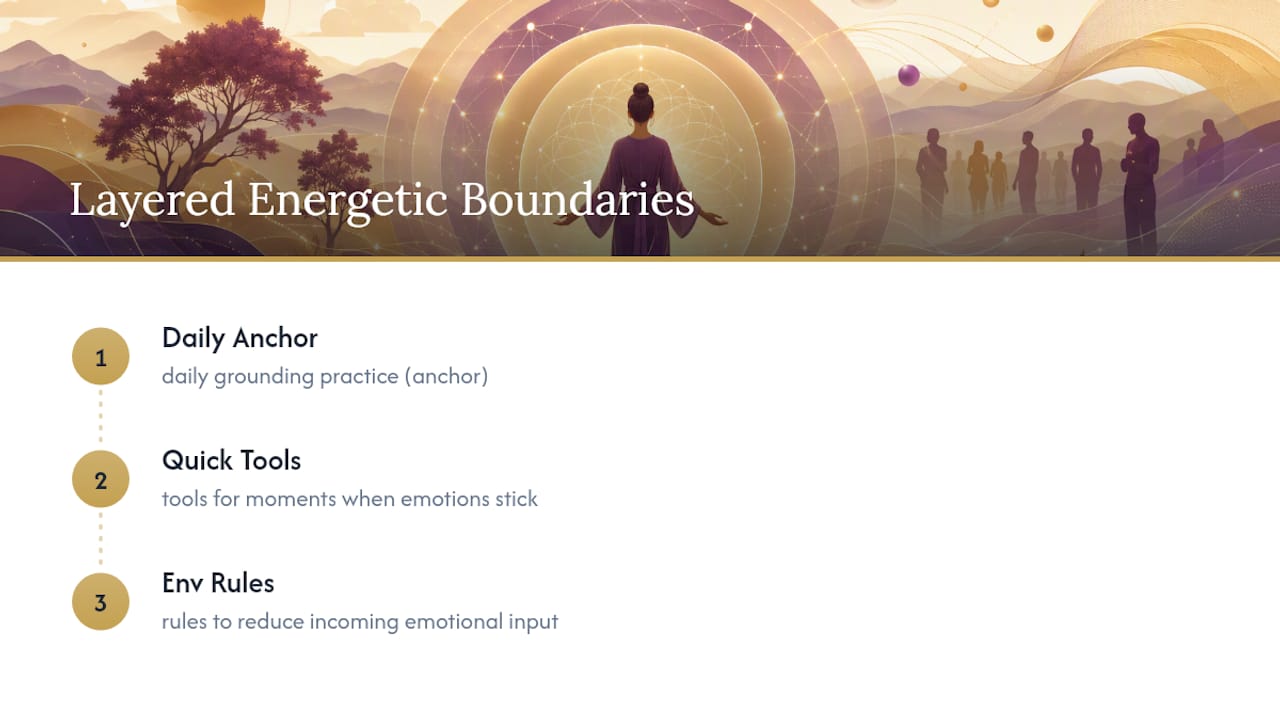
Setting energetic boundaries for empaths works best as a layered system: a daily anchor, a set of quick tools for the moment something starts to stick, and a few environmental rules that reduce how much you have to defend in the first place.
Start with a morning grounding ritual
Before your day fills up with other people’s emotions, spend five minutes grounding. Feel your feet on the floor, name three things you can physically sense in the room, and set an intention like “I feel with people today, I do not absorb for them.” Grounding practices work because they give your nervous system a stable reference point to return to once the day gets noisy. Skipping this step is like leaving your front door unlocked and hoping nobody walks in.

Use quick shields in the moment
When you feel someone’s energy start to attach, you do not need a ritual. You need something fast.
Visualize a bubble. Picture a thin, clear boundary a few feet around your body. Nothing crosses it without your permission.
Anchor with breath. Inhale for four counts, hold for four, exhale for six. The longer exhale signals your body to stand down from absorbing mode.
Try the internal eye roll. Some experienced practitioners use a quiet, private mental “eye roll” the instant they feel someone else’s emotion trying to land. It sounds almost too simple, but the small internal gesture of dismissal can stop the energy before it sticks, without you saying a word out loud.
Use a short script. A calm line like “I hear you, and I need to sit with that separately” buys you space without escalating the conversation.
Pro Tip: Keep one boundary phrase memorized and ready, the way you would keep a fire exit route in mind. Rehearsing it out loud once a week, even alone in your car, makes it far easier to say when you actually need it.
Clean up your environmental and digital inputs
Realized Empath’s guidance on energy protection recommends curating your surroundings the same way you would curate a diet: fewer draining inputs, more deliberate recovery. In practice, that means muting group chats that spike your anxiety, turning off notifications outside a window you choose, and scheduling short recovery breaks between emotionally heavy meetings or visits, rather than treating recovery as something you only get to if there is time left over.
A seven-day starter routine
Day 1: Practice the morning grounding ritual and set one intention for the day.
Day 2: Add the bubble visualization before your most draining daily interaction.
Day 3: Write one boundary script and say it out loud three times, alone.
Day 4: Mute one digital input that consistently spikes your stress.
Day 5: Schedule a fifteen-minute recovery break after your most demanding commitment.
Day 6: Use the internal eye roll technique at least once and notice how it feels.
Day 7: Review the week. Note which tool worked best, and keep only that one going forward.
Holding Boundaries Day to Day: Work, Family, and Friends
A boundary you set once and never repeat is not a boundary. It is a moment. Holding it long term means turning a single good decision into a repeatable habit, with language ready before you need it.
At work: State your availability window directly, something like “I answer messages between 9 and 5, and I’ll get to anything after that the next morning.” Asana’s guidance on protecting energy backs this up directly: avoiding after-hours messages and holding a defined schedule reduces burnout risk in measurable ways.
With family: Time-box visits in advance. “I can stay until three” spoken before you arrive prevents the awkward exit negotiation later.
With friends: Steer conversations away from repeat emotional dumping by redirecting once, gently: “I want to be here for this, and I also need us to talk about something lighter for a bit.” If that does not land, have an exit line ready and use it without apologizing.
Aftercare matters as much as the boundary itself. A short cleansing ritual, whether that is a shower, a few minutes outside, or a specific piece of music, tells your nervous system the interaction is over. Optimist Outlook’s framing of energy management puts it plainly: recovery has to be a built-in part of your day, not a reward you get to if everything else goes well.
Common Obstacles When Setting Boundaries as an Empath
Guilt is the most common obstacle, and it usually traces back to people-pleasing patterns formed long before adulthood. Terri Cole’s work on empath burnout connects this directly to childhood conditioning, where being agreeable was rewarded and asserting a limit was not. The reframe that helps most: a boundary is information, not rejection. Saying “I can’t take this on right now” tells someone what is true, it does not punish them.
Boundary-testing shows up in specific, recognizable phrases: “You’re the only one who understands me,” or “I thought you cared.” Neither statement requires you to change your answer. A steady response like “I do care, and my answer is still no” holds the line without a fight.
Watch for these signs that self-practice is not enough on its own:
You feel guilty for hours or days after a small, reasonable boundary
The same person repeatedly ignores a limit you have stated clearly more than once
You notice anxiety or dread building before interactions you cannot avoid
Recovery time keeps getting longer instead of shorter
If that list sounds like your current pattern, it may be time for support beyond what a solo routine can offer, whether that is therapy, coaching, or more concentrated energetic work.
Shantana Telise’s Approach to Boundary and Energy Work
Some practices offer support for those who have tried self-help tools and grounding rituals but still find their boundaries collapsing under pressure. That gap is usually not a discipline problem. It is a deeper energetic pattern that a container built through visualization alone cannot always hold.
Certain healing practices center on multidimensional channeling and energetic recalibration, approaches designed to address boundary breakdown at a root level rather than managing it symptom by symptom. Where the exercises above give you daily maintenance, this kind of work aims at the underlying pattern that keeps letting other people’s energy back in.
Relevant support can include sessions focused on energetic recalibration to help restore clearer energetic boundaries, guided containment work for empaths struggling with boundary collapse in caregiving or high-conflict relationships, and ongoing support structures for those rebuilding boundaries that have been repeatedly ignored or overridden.
This is not a replacement for the daily practices in this guide. It is what tends to help when those practices keep getting undone by the same relationship or pattern, over and over.
A Boundary I Almost Didn’t Hold
A few months ago, someone close to me needed to vent, and I felt the old pull to absorb every word of it as my own emergency. I said the short version, “I can listen for ten minutes, then I need to step away,” and meant it. I stepped away, took a walk, and the heaviness lifted faster than I expected. It was not a perfect boundary. My voice shook a little. It held anyway, and that is really the whole point: you are not aiming for flawless, you are aiming for held.
— Shantana
When Self-Practice Isn’t Enough
The exercises in this guide work for a lot of empaths a lot of the time. But some boundary breaks are not maintenance problems, they are root-level patterns that keep reasserting themselves no matter how consistent your morning ritual is.
If you notice the same relationship, the same room, or the same recovery time coming back around after months of trying the daily tools, that repetition is worth paying attention to. Shantana Telise Healing’s Quantum Energy Alignment Package is built specifically for this kind of recalibration, guided energetic work aimed at restoring containment and helping you hold sovereignty over your own energy without constantly rebuilding the wall by hand. For readers who want a conversation first, a Quantum Alignment Consultation is a lower-commitment way to figure out whether guided work fits your situation. If you are ready to look at the whole picture rather than one boundary at a time, you can also explore working directly with Shantana to map out a path forward.
Sources
FAQ
How do I set boundaries as an empath without feeling guilty?
Frame the boundary as information rather than rejection, and pair it with a short, calm script like “I can’t take this on right now.” Optimist Outlook’s approach treats energy as a daily budget, which tends to reduce the moral weight people attach to saying no.
What are energetic boundaries?
An energetic boundary is the felt line that separates your emotions and physical state from someone else’s, distinct from a verbal or behavioral boundary. It is often described using a container or bubble metaphor, something you can open or close on purpose.
What do manipulative or boundary-testing people think of empaths?
People who test boundaries often target empaths specifically because they read as more likely to absorb guilt and back down. Recognizing phrases like “you’re the only one who understands me” as a pressure tactic, rather than a genuine plea, makes it easier to hold your answer steady.
Who tends to be a good partner for an empath?
Definitions of an ideal partner vary widely and depend on individual needs, but empaths generally do best with partners who respect stated limits without repeated testing and who can self-regulate their own emotions instead of routinely offloading them. That pattern matters more than any specific personality type.
Recommended
Comments