

Ancestral Healing in 5–8 Minutes for Women Seekers, Trauma Aware
Ancestral healing is the intentional practice of identifying and transforming emotional or behavioral patterns passed down through family and culture, often through ritual, reflection, and guided energy work. The core outcome is relief: a lightening of burdens you didn’t create but have been carrying, and a stronger sense of belonging to something older than your own story. You can start with a simple practice on your own, but the deepest shifts usually happen with guided support.
TL;DR:
Ancestral healing works best when approached gradually, with one well-guided session often moving further than multiple solo attempts.
It is most effective when practitioners handle strong emotional reactions with trauma-informed care, especially if overwhelming feelings persist.
Starting with simple practices like invitation meditations or family mapping can help surface patterns, but deeper issues may require professional guidance.
Using culturally adapted rituals with respectful boundaries prevents cultural misappropriation and ensures respectful, trauma-aware practice.
Combining ancestral work with psychotherapy enhances emotional regulation and relationship repairs but is not a substitute for clinical support in trauma cases.
Table of Contents
What Is Ancestral Healing, Exactly?
Ancestral healing sits at the intersection of ritual arts and psychotherapy. It borrows from ceremony, storytelling, and trance work, while sharing a goal with talk therapy: helping you stop repeating patterns that were never fully yours to begin with. Practitioner-led programs in this space, like those described by Ancestral Medicine, frame the work as complementary to family-systems therapy rather than a substitute for it.
“Ancestor” is broader than most people expect. It can mean:
Bloodline ancestors — biological relatives, going back generations
Cultural ancestors — figures from your ethnic or spiritual tradition, even without a direct genetic link
Chosen ancestors — mentors, elders, or spiritual guides you’ve adopted into your lineage
Ethics matter here more than technique. Responsible ancestral work asks for consent (yours and, symbolically, theirs), respects the cultural origin of any practice you borrow, and stays trauma-aware rather than pushing you toward forced closure. A facilitator who skips these safeguards is doing something other than healing work.
Common Ancestral Healing Practices You Can Try
Most accessible entry points fall into a handful of categories. None require special training, though some deserve more caution than others.
Guided meditation and acknowledgment. A quiet, structured visualization where you mentally invite a “wise and well” ancestor into awareness, rather than summoning whoever shows up.
Ritual and altar work. Small, intentional offerings, photos, or objects placed on a dedicated surface, often tied to seasonal transitions like solstices or death anniversaries.
Storytelling and family mapping. Interviewing living relatives, journaling family history, or building a simple genogram to spot repeating patterns across generations.
Nature immersion. Walking land your family once lived on, or simply grounding outdoors, which several nature-based wellness practices treat as a legitimate somatic entry point.
Culturally specific rituals, adapted with care. Practices like Yoruba Gbere traditionally involve physical, embodied ritual elements; modern adaptations often translate the underlying intention into non-invasive versions rather than copying the original ceremony wholesale.
Clinicians who study this work, including the team at Clinicians of Color, point to meditative exercises, personalized ceremony, and intentional storytelling as the most commonly used tools. The line to watch: borrowing the spirit of a tradition is different from performing its exact ceremony without training or lineage claim to it.
How Ancestral Healing Actually Helps
Ancestral healing work tends to report three consistent benefits: better emotional regulation, a felt sense of belonging, and repaired family relationships, even when the relative in question has passed away or remains estranged. The theory behind the relational benefit is straightforward and comes from practitioner literature rather than a lab: wounds formed in relationship are usually healed in relationship, and engaging directly with ancestors widens that relational field beyond who is currently alive to help you.
What the evidence actually shows: No large clinical trials measure ancestral healing outcomes directly. What exists is practitioner-reported experience and a consistent clinical caution: this work supports trauma recovery, but it does not replace it.
Clinician-informed guidance treats ancestral practices as a complement to psychotherapy, not a stand-in for it, particularly for anyone managing a diagnosed condition or complex trauma history.
How to Begin Ancestral Healing Without Overwhelming Yourself
Start small. A first session should feel more like a gentle check-in than a dramatic ceremony.
Ground yourself first. Sit somewhere quiet, take five slow breaths, and name one intention (comfort, curiosity, or simply presence).
Extend an invitation. Mentally invite an ancestor who was “wise and well,” someone whose presence historically brought calm rather than conflict.
Acknowledge, don’t demand. Silently or aloud, say what you notice or feel. This is observation, not negotiation.
Offer gratitude. Thank whatever showed up, or thank the practice itself if nothing did.
Ground again and close. Return attention to your breath and your body before standing up.
The whole practice takes five to eight minutes.
Pro Tip: If a strong wave of grief or anger surfaces during a session, that’s a signal to pause, not push through. Ancestral work should never require forcing forgiveness on command.
Stop immediately if you feel dissociated, panicked, or flooded. Those responses call for trauma-informed clinical support, not a longer meditation.
When Guided Support Makes More Sense Than Going Solo
Working with a practitioner becomes worthwhile once you notice a few specific signals:
Sessions consistently bring up overwhelm rather than relief
You suspect trauma patterns that span multiple generations, not just your own history
The tradition you want to engage with isn’t yours culturally, and you need guidance to do it respectfully
Guided sessions typically involve lineage mapping, somatic integration, and sometimes group intensives with ritual arts and shared processing. Before committing to any practitioner, ask how they handle intense emotional responses and whether they’ve trained in trauma-informed methods. Walk away from anyone promising a guaranteed “cure” or asking you to embody a troubled or unnamed spirit. That’s a boundary violation dressed up as ceremony.
A Practitioner’s Approach to Ancestral Lineage Work
A practitioner may work with clients through multidimensional channeling and energetic recalibration, an approach that treats ancestral patterns as energetic imprints as much as psychological ones. Rather than following a fixed script, sessions align a client’s energy with the destiny already encoded in their lineage. This maps closely onto ancestral work: both ask you to relate to something larger than your current, isolated self. Clients typically arrive feeling stuck in inherited patterns and leave with a felt sense of alignment they can act on, whether through one-on-one guided sessions or ongoing work together.
The Part of This Work Most Articles Get Wrong
Most explainers on ancestral healing treat it as either pure folklore or pure therapy, and both framings miss the point. This work lives in the gap between them, which is exactly why clinician caution matters as much as ritual knowledge. The conventional advice, do a ritual, feel lighter, tends to skip the fact that some family wounds are too large for a solo candle ceremony to move.
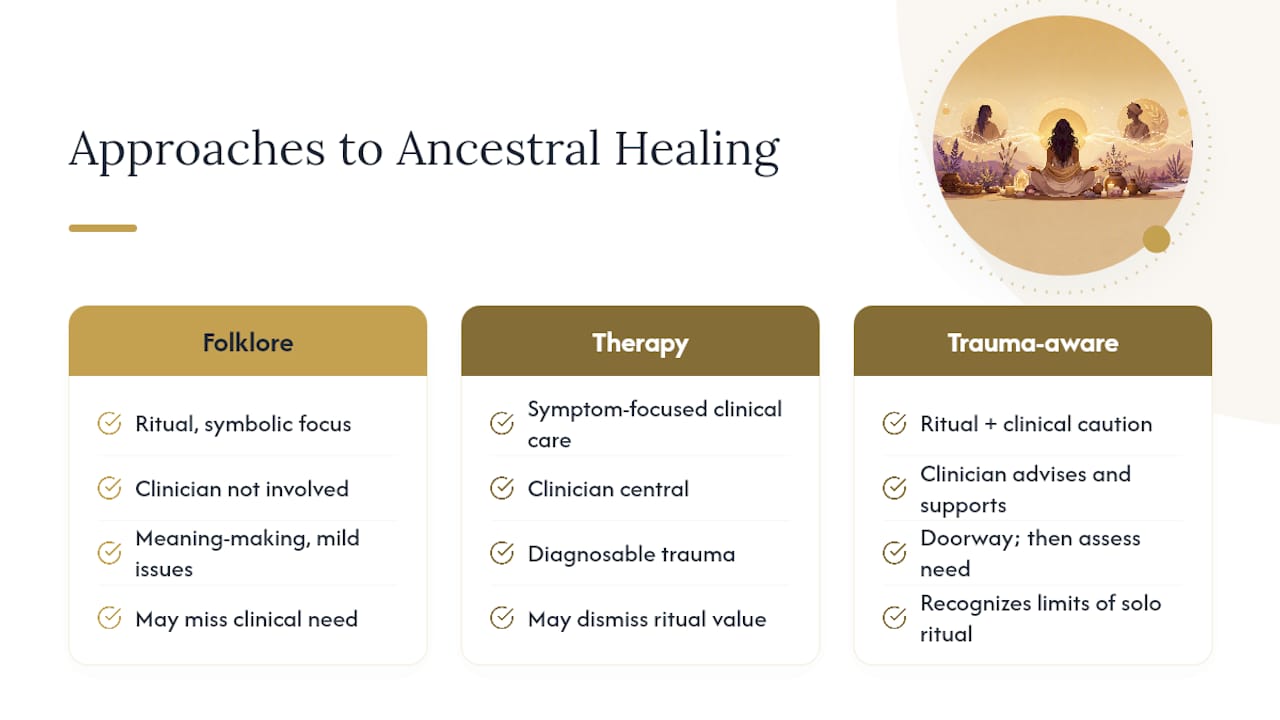
What gets underweighted is timing. Most people try ancestral practices when they’re already at capacity, exhausted from carrying a pattern for years, then wonder why a five-minute meditation didn’t undo it. The practices in this article work best as a doorway, not a destination. Try the starter ritual first. Notice what surfaces. Then decide, honestly, whether you’re working with a manageable ripple or a wave that needs a trained guide standing beside you.
If there’s one thing to prioritize, it’s this: pick depth over frequency. One well-held session with someone trained in both energy work and trauma awareness will move you further than a dozen unguided attempts at forcing a breakthrough.
— Shantana
Ready for Guided Ancestral Healing?
If the starter practice above surfaced more than you expected, or if you sense your family patterns need dedicated attention, the Quantum Energy Alignment Package is built for exactly that. It combines the multidimensional channeling and energetic recalibration Shantana is known for with the kind of structured, session-by-session pacing that solo ritual work can’t offer on its own.
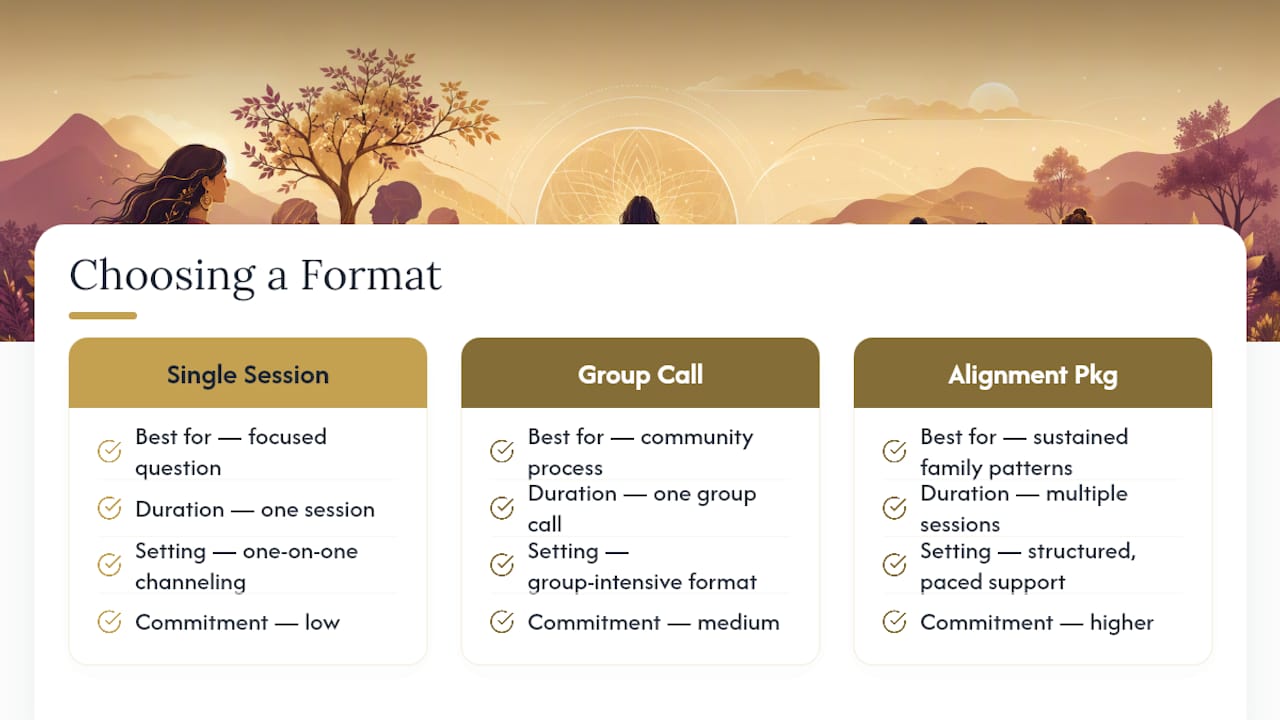
If you’re unsure which format fits, think about scope and time. A single channeled healing and guidance session suits a focused question or a specific pattern you want to address now. A healing group call works well if you want community alongside the process, echoing the group-intensive format many ancestral programs use. For a fuller commitment, the alignment package gives you sustained support across multiple sessions rather than a single touchpoint.
Whichever format fits your situation, the next step is simple: visit Work With Me to see current session options and book a time that matches where you are right now.
Where to Learn More
For deeper reading, Ancestral Medicine covers lineage-healing frameworks in detail, and The Ancestral Healing Podcast offers beginner-friendly episodes for ongoing practice.
Sources
FAQ
What are the signs your ancestors are trying to reach you?
Many people describe recurring dreams, sudden intuitive nudges, or an unexplained pull toward a specific tradition or object as signs of ancestral contact, though these experiences vary widely and aren’t clinically verified.
How do you clear ancestral trauma?
Clearing usually means working through a repeating pattern with a combination of acknowledgment, ritual, and often guided support, rather than a single fix; clinician-informed guidance recommends pairing this work with trauma-informed care when the pattern feels overwhelming.
How can I heal from past trauma using ancestral practices?
Start with grounding and a short acknowledgment practice like the one outlined above, and treat ancestral work as a complement to therapy rather than a replacement for it.
How do you know if your ancestors are protecting you?
There’s no verified test for this. Practitioners who work with “wise and well” ancestors describe a felt sense of calm, guidance, or support during connection practices, but this remains subjective and rooted in personal or cultural belief rather than measurable evidence.
Is ancestral healing the same as ancestral medicine?
The terms are often used interchangeably, though “ancestral medicine” more specifically refers to structured lineage-healing programs that combine ritual arts with therapeutic frameworks.
Recommended
Comments